


The Central Epidemic Command Center (CECC) yesterday urged people to increase vigilance and thoroughly practice preventive measures against COVID-19 as it reported 16 locally transmitted cases of the disease.
Minister of Health and Welfare Chen Shih-chung (陳時中), who heads the center, said that 21 cases were confirmed in Taiwan yesterday: 16 local cases, four imported cases and one case undetermined.
The locally transmitted cases are three linked to a cluster of infections at a gambling house in Yilan County, 10 associated with a previous case in New Taipei City and three with unclear sources of infection.
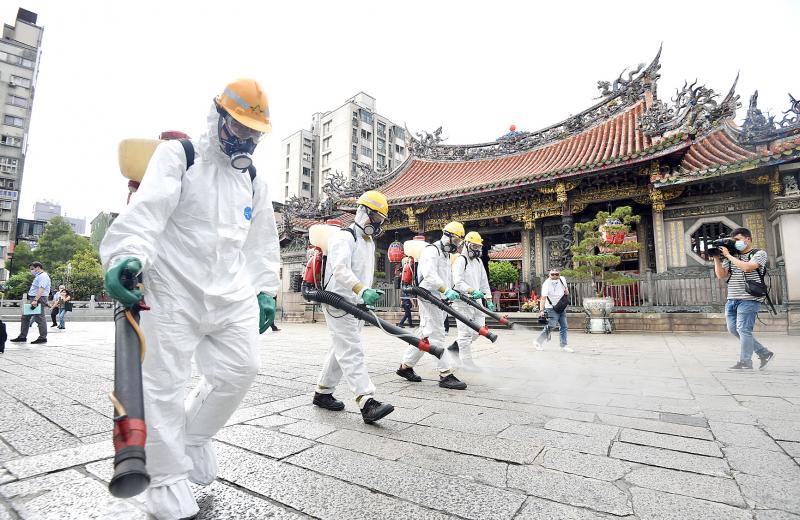
Photo: Peter Lo, Taipei Times
The CECC on Tuesday reported a cluster of five cases — four employees and a frequent customer — linked to the Galaxy Baccarat (銀河百家樂) gambling house on Zhongzheng N Road in Yilan County’s Luodong Township (羅東).
One more employee and two family members of two previously infected employees have not shown any symptoms, but tested positive for COVID-19 yesterday, bringing the cluster of infections to eight people, Chen said.
One of them is an elementary-school student, so his classes have been suspended and his classmates ordered to isolate at home, he said.
On Tuesday, the CECC reported that case No. 1,203, a former Lions Club president in New Taipei City, attended banquets while he was contagious.
Ten new confirmed cases — five women and five men aged 50 to 80 — are linked to the man, including his wife and nine close contacts of the club, so the cluster has expanded to 11 people, Chen said.
Among the cases with unknown infection sources, case No. 1,217 is a woman in her 50s who on May 2 reported a fever, coughing and shortness of breath, and sought treatment at a clinic five times from Tuesday last week to Monday, Chen said.
The woman went to a hospital on Tuesday with difficulty breathing, abdominal pain and muscle soreness, he said.
She was diagnosed with pneumonia and tested for COVID-19, he said, adding that the result came back positive.
Fourteen close contacts have been ordered to isolate at home, he said.
Case No. 1,220 — a woman in her 60s who works at Hongda Tea House (鴻達茶藝館) on Sanshui Street in Taipei’s Wanhua District (萬華) — on Thursday last week reported symptoms of fatigue, fever and a sore throat, and sought treatment at a clinic on Friday and Saturday last week, Chen said.
The woman sought treatment at a hospital on Tuesday as the symptoms were not relieved, and she was diagnosed with pneumonia and tested positive for COVID-19, with 30 close contacts placed in home isolation, he said.
Case No. 1,221 — a woman in her 50s who works at Fengxiang Tea House (楓香清茶館) on Siyuan Road Sec 2 in Wanhua on Monday reported an itchy throat, coughing and chills, and was tested at a hospital on Tuesday, he said.
The test came back positive and 12 close contacts have been placed in home isolation, he said.
Local health departments are conducting contact tracing on the confirmed cases to identify other close contacts and the locations they visited, Chen said.
Locations that the confirmed cases in the Galaxy Baccarat cluster visited include the Three Mom Stinky Hot Pot’s Luodong Jhongshan Branch (三媽臭臭鍋羅東中山店) on Thursday evening last week; Veteran Cafeteria (老將自助餐) in Yilan County’s Jiaosi Township (礁溪) at noon on Thursday last week; and the Ba Fang Yue Hot Pot’s Luodong Branch (八方悅鍋物羅東店) in Yilan’s Tungshan Township (冬山) on Friday evening last week, Chen said.
They also visited Jiu Qian Dai Seafood Buffet Restaurant (久千代海鮮百匯餐廳) in Yilan City and a Pxmart branch in Yilan County on Monday evening, he said.
A China Airlines (華航) flight attendant who worked with case No. 1,187 — a pilot — on a flight to Vietnam on Wednesday last week also tested positive, Chen said.
The CECC also reported four imported cases — three migrant workers from the Philippines and a Taiwanese who returned from India.

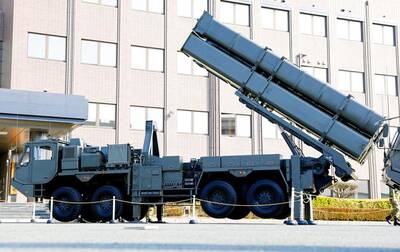
Japan has deployed long-range missiles in a southwestern region near China, the Japanese defense minister said yesterday, at a time when ties with Beijing are at their lowest in recent years. The missiles were installed in Kumamoto in the southern region of Kyushu, as Japan is attempting to shore up its military capacity as China steps up naval activity in the East China Sea. “Standoff defense capabilities enable us to counter the threat of enemy forces attempting to invade our country ... while ensuring the safety of our personnel,” Japanese Minister of Defense Shinjiro Koizumi said. “This is an extremely important initiative for
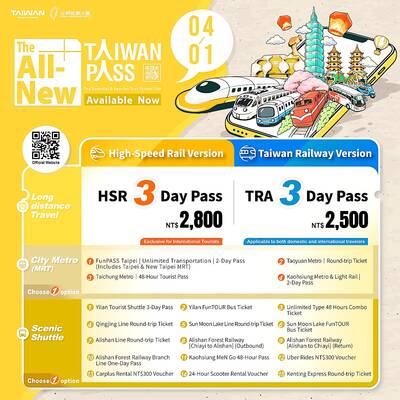
MORE POPULAR: Taiwan Pass sales increased by 59 percent during the first quarter compared with the same period last year, the Tourism Administration said The Tourism Administration yesterday said that it has streamlined the Taiwan Pass, with two versions available for purchase beginning today. The tourism agency has made the pass available to international tourists since 2024, allowing them to access the high-speed rail, Taiwan Railway Corp services, four MRT systems and four Taiwan Tourist Shuttles. Previously, five types of Taiwan Pass were available, but some tourists have said that the offerings were too complicated. The agency said only two types of Taiwan Pass would be available, starting from a three-day pass with the high-speed rail and a three-day pass with Taiwan Railway Corp. The former costs NT$2,800

NEW LOW: The council in 2024 based predictions on a pessimistic estimate for the nation’s total fertility rate of 0.84, but last year that rate was 0.69, 17 percent lower An expected National Development Council (NDC) report expects the nation’s population to drop below 12 million by 2065, with the old-age dependency ratio to top 100 percent sooner than 2070, sources said yesterday. The council is slated to release its latest population projections in August, using an ultra-low fertility model, the sources said. The previous report projected that Taiwan’s population would fall to 14.37 million by 2070, but based on a new estimate of the total fertility rate (TFR) — the average number of children born to a woman over her lifetime — the population is expected to reach 12 million by

COUNTERING HOSTILITY: The draft bill would require the US to increase diplomatic pressure on China and would impose sanctions on those who sabotage undersea cable networks US lawmakers on Thursday introduced a bipartisan bill to bolster the resilience of Taiwan’s submarine cables to counter China’s hostile activities. The proposal, titled the critical undersea infrastructure resilience initiative act, was cosponsored by Republican representatives Mike Lawler and Greg Stanton, and Democratic Representative Dave Min. US Senators John Curtis and Jacky Rosen also introduced a companion bill in the US Senate, which has passed markup at the chamber’s Committee on Foreign Relations. The House’s version of the bill would prioritize the deployment of sensors to detect disruptions or potential sabotage in real-time and enhance early warning capabilities through global intelligence sharing frameworks,


 RSS
RSS