

The Burmese military must restore democracy and stop committing violence against citizens, Indonesian President Joko Widodo said after crisis talks with Burmese junta leader Senior General Min Aung Hlaing and Southeast Asian leaders yesterday.
The strongly worded statement followed a meeting of ASEAN in Jakarta, which marked the Burmese general’s first foreign trip since security forces on Feb. 1 staged a coup that ousted Burmese State Counselor Aung San Suu Kyi.
Min Aung Hlaing has become the focus of international outrage over the coup and a subsequent crackdown on dissent that has left more than 700 dead.
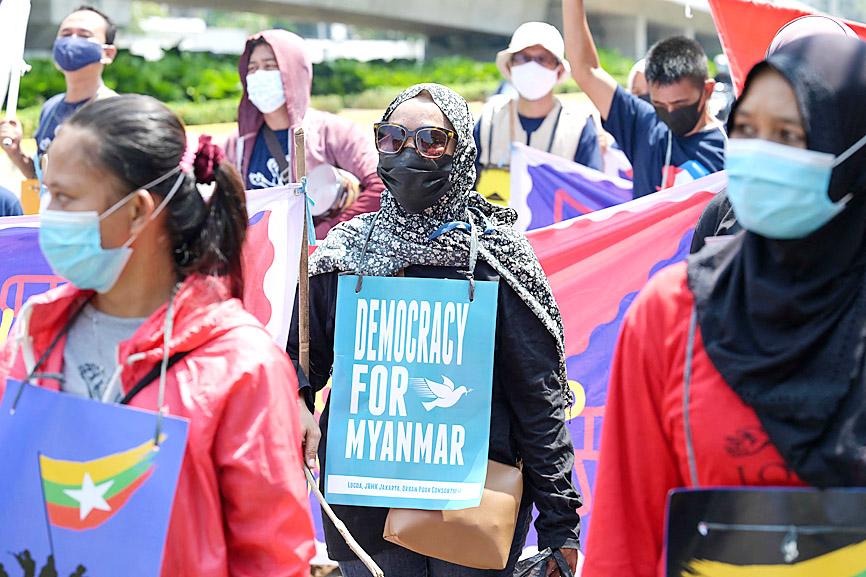
Photo: AFP
“The first requested commitment is for the Myanmar military to stop the use of violence and that all parties there at the same time must refrain so that tensions can be reduced,” Widodo said yesterday. “The violence must be stopped and democracy, stability and peace in Myanmar must be restored.”
He also called for the release of political prisoners and for a special envoy to be allowed into the country to “push for dialogue.”
Singaporean Prime Minister Lee Hsien Loong (李顯龍) called on the military to release Myanmar’s ousted president, as well as democracy icon Aung San Suu Kyi, who is under house arrest.
The meeting followed mass protests, which have been met by a brutal crackdown that has left blood on the streets.
An estimated 250,000 people have been displaced, a UN envoy has said, with Myanmar’s top democratically elected leaders in hiding or under house arrest.
Also at the meeting was the Sultan of Brunei, the chair of ASEAN, and leaders and foreign ministers from most of the 10-country group, including Malaysia, Cambodia, Thailand, Vietnam, the Philippines and Laos.
Small protests outside the bloc’s Jakarta headquarters were dispersed by security personnel.
In Myanmar, protesters continued to take to the streets, including in northern Kachin State, where demonstrators wore blue shirts to symbolize detainees.
In commercial hub Yangon, some residents staged a mock funeral for the senior general by smashing saffron-colored clay pots on the ground, symbolic of cutting ties with the dead.
The general’s involvement in the Jakarta talks has angered advocates, human rights groups and a shadow government of ousted Burmese lawmakers, which was not invited to the gathering.
“Meetings that contribute to a solution to the deepening crisis in Myanmar are welcome,” the latter said in a statement. However, “meetings that exclude the people of Myanmar, but include murderer-in-chief Min Aung Hlaing ... are unlikely to be helpful.”
Separately, the Burmese military fired warning shots above a civilian boat carrying Thai border patrol officers amid heightened tensions in border areas since the junta seized power, but Thailand yesterday said the incident was a misunderstanding.
Thai Ministry of Foreign Affairs spokesman Tanee Sangrat said the warning shots on Thursday were used to signal boats for inspection due to the lack of official coordination method on the section of the Salween River, where Thailand and Myanmar share a border.
Additional reporting by Reuters
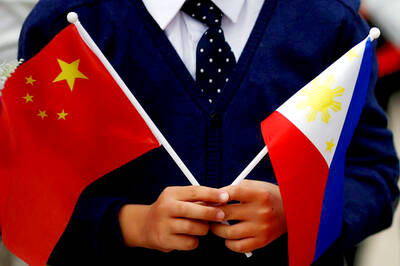
The Philippine Coast Guard yesterday said it has deployed its largest vessel and an aircraft to challenge a Chinese research ship operating off northern Batanes near Taiwan, adding that a Chinese coast guard vessel had also moved in. The Philippine operation “disrupted the vessel’s unauthorized marine scientific research and compelled it to leave its loitering position,” said Jay Tarriela, Philippine Coast Guard spokesperson on South China Sea issues. The Philippine Coast Guard said the BRP Teresa Magbanua and an aircraft were deployed to counter the Chinese vessel, which it said had remained about 37 nautical miles northwest of Itbayat Island since Monday. The
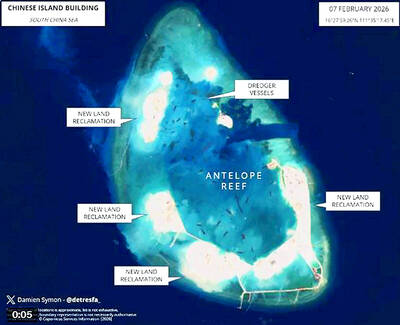
RUNWAY: Analysts said the first aircraft landing is expected by the middle of next year, while Chinese state media said it would serve civilian needs Chinese construction of a runway on Antelope Reef (Lingyang Reef, 羚羊礁) in the Paracel Islands (Xisha Islands, 西沙群島), is well under way with analysts estimating it could be completed by the middle of next year, strengthening Beijing’s military control over the disputed South China Sea. Satellite images reviewed by Reuters show grading work, piles of gravel and concrete, and compaction cranes in operation to build a full-scale runway that military attaches and security analysts say could be one of China’s most important offshore bases in the region. The images, taken on Friday last week by commercial satellite imagery provider Vantor, also show

SHIFTING COOPERATION: With the new arrangement, US representatives would be able to participate directly in defense discussions, including weapons procurement Taiwan-US military cooperation is deepening, with the Pentagon expected to station personnel at the Ministry of National Defense (MND), sources said. The NT$470 million (US$14.77 million) joint program is scheduled to run from this year through 2028, under which the Pentagon would dispatch representatives from the Office of the Under Secretary of Defense for Policy and the Institute for Defense Analyses, a senior military official said on condition of anonymity, adding that one representative from each organization would be stationed at the ministry’s headquarters. The Office of the Under Secretary of Defense for Policy is one of the US’ bodies responsible for

The Presidential Office today condemned China's transnational repression after an alleged Chinese foreign agent was arrested in California yesterday on suspicion of surveilling President William Lai's (賴清德) son, Lai Ting-yu (賴廷與), the FBI said. The 34-year-old woman, named Wanying Heather Zhang (張婉瑩), was arrested on suspicion of acting as an unregistered foreign agent, US news agency CBS reported. She was apprehended at Los Angeles International Airport yesterday attempting to fly to Shanghai, it said. This represents a “typical case” of China’s transnational repression, Presidential Office spokeswoman Karen Kuo (郭雅慧) said today. "Our country expresses the strongest condemnation of such barbaric conduct that


 RSS
RSS