


A company providing access to an online database of academic theses and dissertations has been accused of cooperating with Chinese political censorship and content revisions.
Media reports said that master’s theses and doctoral dissertations by students at local universities, including National Taiwan University (NTU), had all instances of “my country” changed to “Taiwan.”
Not a single word should be changed in papers authorized by students and professors, NTU president Kuan Chung-ming (管中閔) said yesterday on the sidelines of an NTU event.
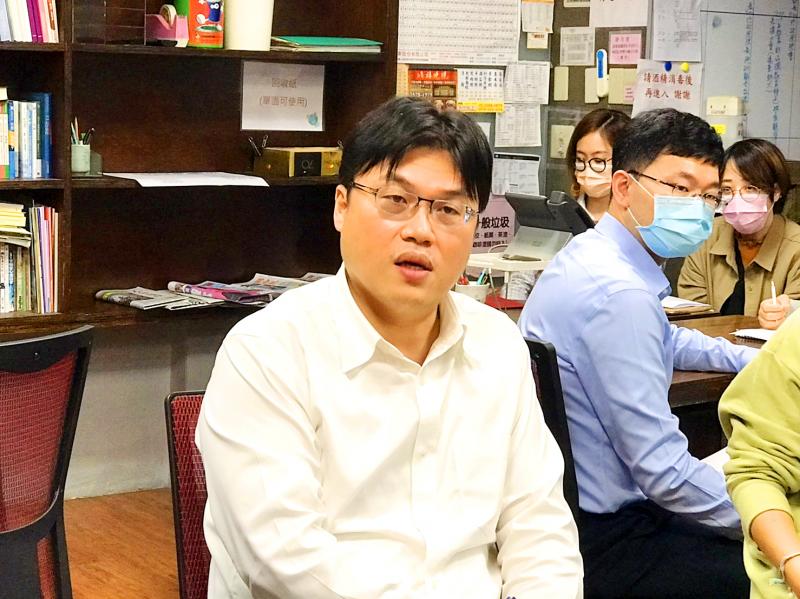
Photo: Wu Po-hsuan, Taipei Times
No one is allowed to revise papers that have been authorized, he said, adding that it was a fundamental rule in academia.
For example, it would be unreasonable if automated translation software changed every mention of “New Taiwan dollar” in a paper to “New Chinese Taipei dollar,” he said.
The university would ask businesses not to make changes, he said.
The Ministry of Education said that the nation’s sovereignty should not be belittled.
The ministry would instruct universities and colleges to evaluate their database vendors, it said.
If improper actions are found, universities should immediately demand that the vendors make improvements, it said, adding that the universities should terminate their contracts if no improvements are made.
Airiti (華藝) — the vendor in question — said in a statement on Wednesday that when it exports Taiwanese academic content, the content is in its original form.
The Chinese market has certain particularities, so the metadata can be tweaked to increase the possibility of the content being discovered in an online search, but the body of a work would not be touched, Airiti said.
NTU sociology professor Ho Ming-sho (何明修) wrote on Facebook on Wednesday that a keyword search of his full name resulted in 23 hits on Airitilibrary.cn and 57 results on Airitilibrary.com, despite the databases belonging to the same company.
Not all of the 57 search results on the second platform were his articles, but articles of his that were missing could be considered “sensitive,” including a 2017 article titled “The Third Force and Umbrella Soldiers: Comparing the Elections of Taiwan after the Sunflower Movement and Hong Kong after the Umbrella Movement,” Ho said.
An Airiti representative said that it is inevitable that different countries and regions have different regulations.
The company can only respect that a database subscriber chooses the content they need, the representative said.

The Tourism Administration yesterday announced that it would reward repeat international visitors with incentives of up to NT$8,000 to boost inbound tourism. The incentives are available to all international tourists, it said, adding that repeat visitors would be rewarded with NT$5,000 and would receive an additional NT$3,000 if they bring travel companions. The nation received 2,990,657 inbound visitors during the first quarter, marking a 3.8 percent increase from the same period last year, agency data showed. Japanese nationals are among groups visiting Taiwan the most. About 1.48 million Japanese tourists arrived last year, a year-on-year increase of more than 12
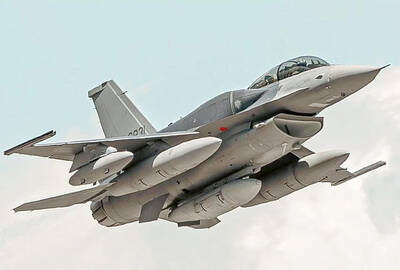
66 FIGHTER JETS: The aircraft is likely undergoing preparations for its transfer to Taiwan — a significant step forward in the nation’s modernization program, a lawmaker said The first of Taiwan’s order of F-16V Block 70 aircraft has been sighted in Texas ahead of delivery, Democratic Progressive Party (DPP) Legislator Wang Ting-yu (王定宇) said. Taiwan’s first F-16V Block 70 two-seat aircraft, tail number 6831, was seen flying from Lockheed Martin’s production facility in Greenville, South Carolina, to Naval Air Station Joint Reserve Base Fort Worth in Texas, Wang wrote on Facebook yesterday. The plane is likely undergoing preparations for its transfer to Taiwan, marking a significant step forward in the Republic of China Air Force’s modernization program, Wang said, citing military analysts. The F-16V Block 70 is a new-build version
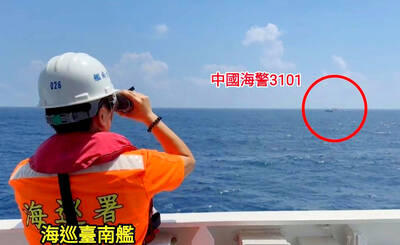
‘BRAZEN’: The holiday did not stop China from activities that infringe on Taiwan’s maritime jurisdiction, but the CGA is ready to defend the nation, Kuan Bi-ling said Beijing is intensifying maritime pressure on Taiwan, but the nation will never yield, Ocean Affairs Council Deputy Minister Sung Chen-en (宋承恩) said. The Coast Guard Administration (CGA) has adopted a “shadowing and monitoring” approach to avoid falling into a Chinese trap to escalate tensions and deepen the conflict, Sung said in an interview published yesterday in the Chinese-language Liberty Times (the Taipei Times’ sister newspaper). China Coast Guard formations patrolling waters east of Taiwan, as well as official Chinese vessels entering areas around Itu Aba Island (Taiping Island, 太平島) and Pratas Islands (Dongsha Islands, 東沙群島) show Beijing’s attempts to significantly step up
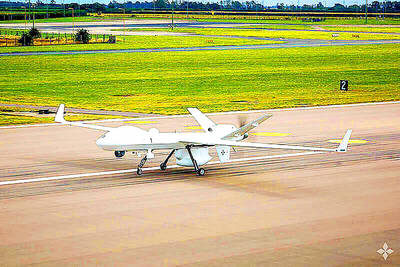
BOOST: By operating the same advanced systems as the US military, Taiwan would be better positioned to share and integrate intelligence with partners, an expert said The first batch of MQ-9B SkyGuardian drones has arrived in Taiwan, and is being assembled and tested by drone manufacturer General Atomics and the military ahead of flight trials as part of the air force’s acquisition to bolster its aerial surveillance capabilities, a source said yesterday. The air force allocated a budget of NT$21.7 billion (US$687 million) from 2022 to 2029 to procure four MQ-9B uncrewed aerial vehicles (UAVs) manufactured by General Atomics along with associated equipment such as ground control stations. The US has agreed to deliver the four MQ-9Bs to Taiwan in two batches this year and next


 RSS
RSS