


Hong Kong media tycoon and Beijing critic Jimmy Lai (黎智英) yesterday was charged under Hong Kong’s National Security Law, accused of colluding with foreign forces, making him the latest democracy advocate targeted under the legislation.
Lai, 73, is the most high-profile figure charged under the sweeping law, which has targeted the territory’s pro-democracy movement, but brought a semblance of calm to the territory after months of often-violent protests.
The new national security unit charged him “with one count of ‘collusion with a foreign country or with external elements to endanger national security,’” police said in a statement.
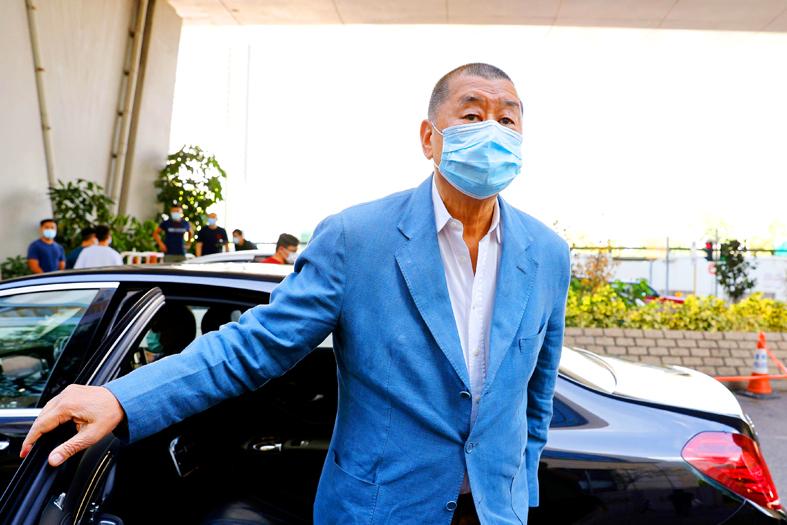
Photo: Reuters
National security offenses carry a maximum sentence of life in prison.
The publisher is today to appear in court in relation to the national security charge, police said.
Lai is the owner of Hong Kong’s best-selling Apple Daily, a popular tabloid that is unashamedly pro-democracy and fiercely critical of the authorities.
Police in August raided the newspaper’s headquarters and arrested a string of senior company figures, including Lai, on suspicion of “collusion with foreign forces” under the vaguely worded new law that Beijing imposed on Hong Kong.
Last week, he was denied bail and remanded into custody until April after being charged with fraud, the latest in a string of prosecutions brought against high-profile democracy campaigners.
He is to apply for bail on that charge at the High Court on Tuesday.
China’s clampdown on Hong Kong has dramatically accelerated since it imposed the security law in June, with opposition politicians disqualified from the legislature and dozens of democracy advocates charged or investigated.
Lai is only the fourth person charged under the controversial national security legislation.
During the police operation on the Apple Daily, journalists streamed dramatic footage on Facebook as officers raided its offices and led Lai away in handcuffs.
In Chinese state media he is routinely cast as a traitor, “black hand” and anti-China “rabble-rouser.”
Lai has long said he fears authorities want to shutter his newspaper and had vowed to use the outlet to continue speaking out against Beijing.
“I’m prepared for prison,” Lai said in an interview two weeks before the security law was imposed.
“I’m a troublemaker. I came here with nothing, the freedom of this place has given me everything. Maybe it’s time I paid back for that freedom by fighting for it,” he added.
In related news, Chinese authorities have detained a Chinese national working for the Bloomberg news bureau in Beijing on suspicion of endangering national security, Bloomberg reported yesterday.
Haze Fan (范若伊) was seen being escorted from her apartment building by plain clothes security officials on Monday, the report said.
“Chinese citizen Ms Fan has been detained by the Beijing National Security Bureau according to relevant Chinese law on suspicion of engaging in criminal activities that jeopardize national security. The case is currently under investigation. Ms Fan’s legitimate rights have been fully ensured and her family has been notified,” Bloomberg quoted Chinese authorities as saying.
The Chinese Ministry of Foreign Affairs did not immediately respond to a request for comment, while the Beijing National Security Bureau could not immediately be reached for comment.
“We are very concerned for her, and have been actively speaking to Chinese authorities to better understand the situation. We are continuing to do everything we can to support her while we seek more information,” a Bloomberg spokeswoman said in an e-mailed statement.
Fan has worked for Bloomberg since 2017 and previously worked for CNBC, CBS News, al-Jazeera and Reuters, Bloomberg reported.
Additional reporting by Reuters
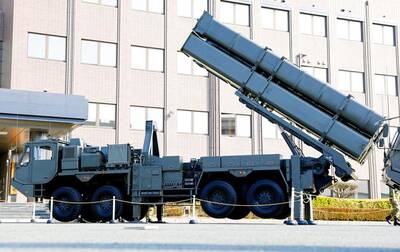
Japan has deployed long-range missiles in a southwestern region near China, the Japanese defense minister said yesterday, at a time when ties with Beijing are at their lowest in recent years. The missiles were installed in Kumamoto in the southern region of Kyushu, as Japan is attempting to shore up its military capacity as China steps up naval activity in the East China Sea. “Standoff defense capabilities enable us to counter the threat of enemy forces attempting to invade our country ... while ensuring the safety of our personnel,” Japanese Minister of Defense Shinjiro Koizumi said. “This is an extremely important initiative for
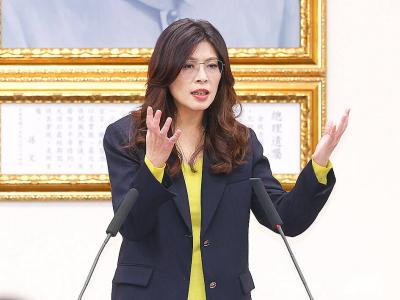
Chinese Nationalist Party (KMT) Chairwoman Cheng Li-wun (鄭麗文) today accepted an invitation from Chinese President Xi Jinping (習近平) to lead a delegation to China next month, saying she hopes to promote the peaceful development of cross-strait relations and bring stability to the Taiwan Strait. “I am grateful and happy to accept this invitation,” Cheng said in a statement from the KMT chairperson’s office. Cheng said she hopes both sides can work together to promote the peaceful development of cross-strait relations, enhance exchange and cooperation, bring stability to the Taiwan Strait and improve people’s livelihoods. At today's news conference, Cheng said any efforts to
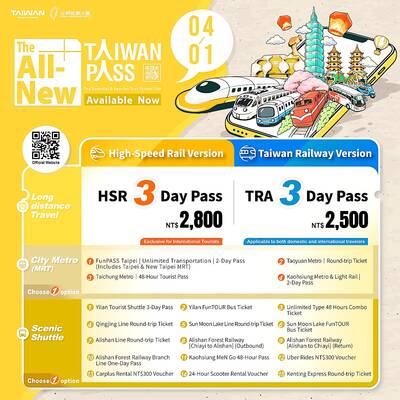
MORE POPULAR: Taiwan Pass sales increased by 59 percent during the first quarter compared with the same period last year, the Tourism Administration said The Tourism Administration yesterday said that it has streamlined the Taiwan Pass, with two versions available for purchase beginning today. The tourism agency has made the pass available to international tourists since 2024, allowing them to access the high-speed rail, Taiwan Railway Corp services, four MRT systems and four Taiwan Tourist Shuttles. Previously, five types of Taiwan Pass were available, but some tourists have said that the offerings were too complicated. The agency said only two types of Taiwan Pass would be available, starting from a three-day pass with the high-speed rail and a three-day pass with Taiwan Railway Corp. The former costs NT$2,800

The nation’s fastest supercomputer, Nano 4 (晶創26), is scheduled to be launched in the third quarter, and would be used to train large language models in finance and national defense sectors, the National Center for High-Performance Computing (NCHC) said. The supercomputer, which would operate at about 86.05 petaflops, is being tested at a new cloud computing center in the Southern Taiwan Science Park in Tainan. The exterior of the server cabinet features chip circuitry patterns overlaid with a map of Taiwan, highlighting the nation’s central position in the semiconductor industry. The center also houses Taiwania 2, Taiwania 3, Forerunner 1 and


 RSS
RSS