


Hong Kong media tycoon Jimmy Lai (黎智英) yesterday was remanded into custody after being charged with fraud, the latest in a string of prosecutions brought against high-profile Beijing critics and democracy advocates.
Lai, 73, is the owner of Hong Kong’s best-selling tabloid, the Apple Daily, which is unashamedly pro-democracy and fiercely critical of the authorities.
Lai and two of the firm’s executives — Royston Chow (周達權) and Wong Wai-keung (黃偉強) — face fraud charges that court documents say are related to the paper’s offices allegedly being used for purposes not permitted by the building’s lease.
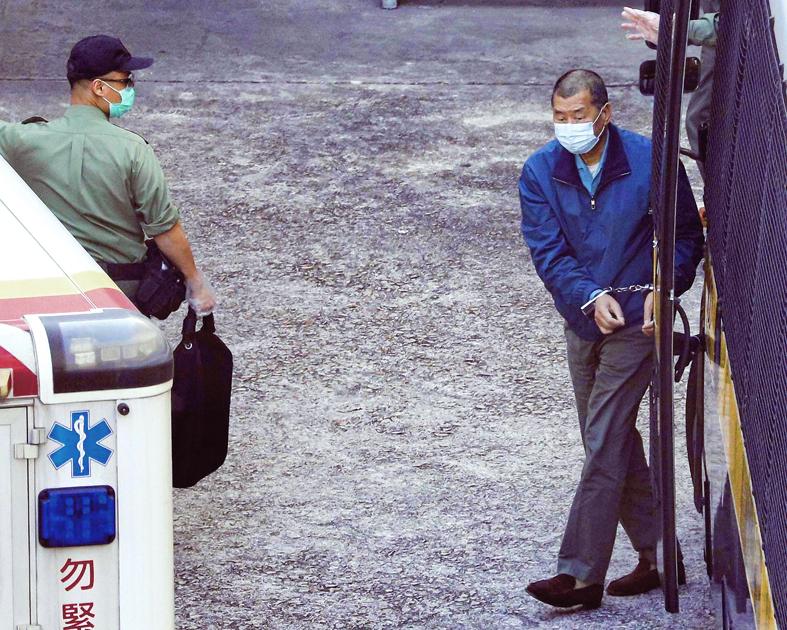
Photo: EPA/EFE
Police raided the headquarters of the Apple Daily in August and arrested a string of senior company figures, including Lai, on suspicion of “collusion with foreign forces,” under a vaguely worded National Security Law that Beijing imposed on the territory.
None has so far been charged with any national security breaches, but Chief Magistrate Victor So (蘇惠德), who oversaw yesterday’s hearing, is from a group of judges selected by Hong Kong Chief Executive Carrie Lam (林鄭月娥) to try such cases.
So denied Lai bail, but granted it to Wong and Chow, setting the next court date for April.
The decision means Lai, who was later photographed arriving at prison with his hands cuffed, faces months behind bars as police continue their investigation.
China’s clampdown on Hong Kong has dramatically accelerated since it imposed its sweeping security law in June, with opposition politicians disqualified, and dozens of democracy advocates charged or investigated.
Three prominent young democracy advocates — Joshua Wong (黃之鋒), 24, Agnes Chow (周庭), 23, and Ivan Lam (林朗彥), 26 — were jailed on Wednesday for taking part in last year’s protests.
Lai is also being prosecuted for his alleged part in those rallies in a separate case.
Judges have also denied bail to others prosecuted for their political views.
Former radio presenter Tam Tak-chi (譚得志) has been in custody since mid-September after he became the first person since the 1997 handover from the UK to be charged with “uttering seditious words” under a colonial era law.
At a hearing yesterday he was denied bail ahead of his trial in May.
The crackdown has provoked outrage in the West and fear for millions who last year took to the streets to protest Beijing’s tightening grip on the territory.
Lai has long said that he fears the authorities want to shutter his newspaper, one of the few local media outlets still willing to vocally take on Beijing.
In Chinese state media, he is routinely cast as a traitor and “black hand.”
“I’m prepared for prison,” Lai said in an interview two weeks before the security law was imposed. “I’m a troublemaker. I came here with nothing, the freedom of this place has given me everything. Maybe it’s time I paid back for that freedom by fighting for it.”
Prosecutors have tried bringing cases against him in the past.
Lai in September was acquitted of intimidating a reporter from a pro-government newspaper.
The corruption watchdog also dropped a case against him over political donations to democracy advocates after four years of investigations.

‘NO SECURITY RISK’: The Railway Bureau reassured the public that the technicians’ activities were limited to technical guidance and did not involve sensitive systems The Railway Bureau yesterday said it had invited eight Chinese technicians to assist with an airport MRT construction project. The bureau issued the confirmation after an Internet user said Chinese nationals had entered the construction zone of Taiwan Taoyuan International Airport’s Terminal 3 project. They asked why “individuals from an enemy state” were allowed access to such a major national infrastructure project, which raised serious concerns over Taiwan’s industrial safety, sensitive systems and information security. The bureau’s Northern Region Engineering Branch Office said subcontractor Taiwan Handle Industrial Co (台灣手把工業) of the Taoyuan airport MRT’s “Contract No. CU05 Project A14 Station Civil, MEP &

A US uncrewed surface vessel (USV) encountered multiple Chinese warships during an autonomous transit of the Taiwan Strait, US defense company Seasats said in a statement on Wednesday. Seasats announced that a Lightfish USV had completed the first autonomous transit of the Taiwan Strait. Over five days, the USV traversed the entire length of the Strait while constantly monitoring surface vessel traffic, the company said. The Lightfish encountered multiple Chinese warships, one of which was a Chinese People’s Liberation Army Navy (PLAN) Type 056 corvette, it said. The Chinese vessels were operating “well within Taiwan’s exclusive economic zone without transmitting their identity via the
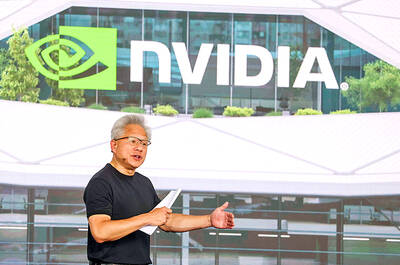
‘BOOMING’: ’ The number of partners we have here is incredible. You can see from their stock prices. They’re doing so well, they’re so happy,’ Jensen Huang said Nvidia Corp’s spending in Taiwan has ballooned to about US$150 billion a year, 10 times the US$10 billion to US$15 billion the company spent five years ago, Nvidia chief executive officer Jensen Huang (黃仁勳) said yesterday, suggesting Taiwan’s strategic importance in the global artificial intelligence (AI) supply chain. “Taiwan is the epicenter of the AI revolution. This is where the chips come, packaging comes. This is where the systems are made. This is where AI supercomputers were created,” Huang said at a meeting for the company’s employees in Beitou-Shilin Technology Park (北投士林科技園區) in Taipei, the planned site of Nvidia’s Taipei headquarters. “Taiwan
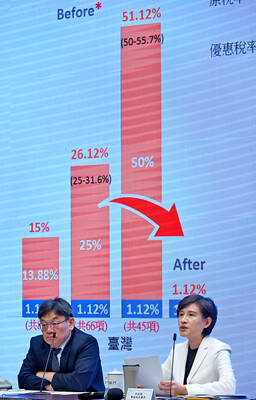
GREATER REACH? Auto parts and wood products would face tariffs of up to 15%, matching those targeting the EU, Japan and South Korea, Vice Premier said The US has announced that preferential tariff treatment for Taiwan’s non-semiconductor Section 232 goods would take effect retroactively from May 1, the Executive Yuan said yesterday. The US government yesterday posted a notice on the Federal Register’s public inspection Web site previewing tariff concessions for Taiwan under a memorandum of understanding (MOU) on Taiwan-US investment after two months of negotiations. The MOU signed on Jan. 15 stipulated three major preferential tariff arrangements: a 15 percent “reciprocal” tariff rate for Taiwan without stacking most-favored nation (MFN) rates; preferential Section 232 treatment for semiconductors and related products; and preferential Section 232 treatment for non-semiconductor


 RSS
RSS