


An air force F-16 jet went missing off the east coast of Taiwan last night, and search and recovery operations were ongoing as of press time, the Ministry of National Defense said.
The F-16 disappeared from radar screens at 6:07pm 9 nautical miles (17km) northeast of Hualien Air Base, two minutes after taking off from the base as part of a nighttime training exercise, the ministry said.
The F-16, serial number 6672, was piloted by Colonel Chiang Cheng-chih (蔣正志), it said.
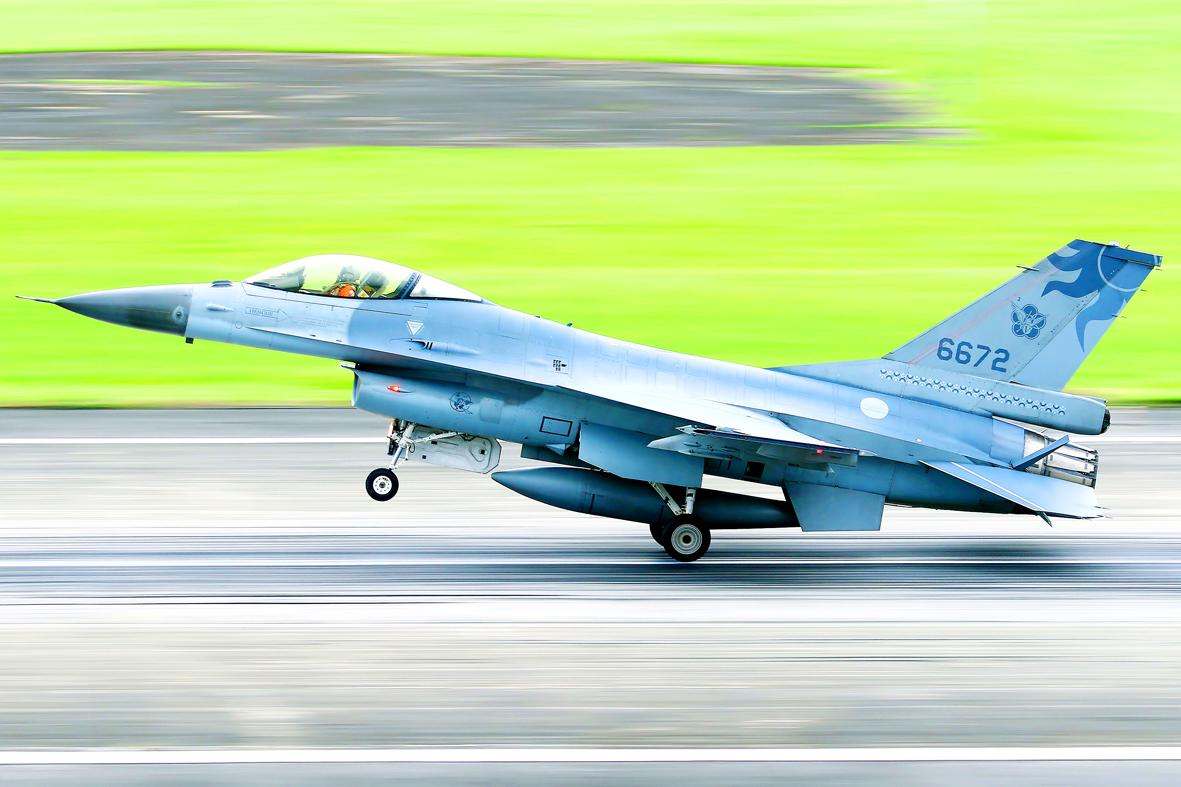
Photo: CNA
A National Rescue Command Center statement said that a Black Hawk helicopter and Coast Guard Administration vessels had been dispatched to the area to locate the aircraft and its pilot.
President Tsai Ing-wen (蔡英文) said that night searches are difficult, so she hoped that the public would keep Chiang in their prayers so that the search teams could bring back good news, Presidential Office spokesman Xavier Chang (張惇涵) quoted Tsai as saying.
Tsai earlier in the day attended a memorial ceremony to honor air force captain Chu Kuan-meng (朱冠甍), who died on Oct. 29 when his F-5E jet crashed into the sea after taking off from Chihhang Air Base in Taitung County.
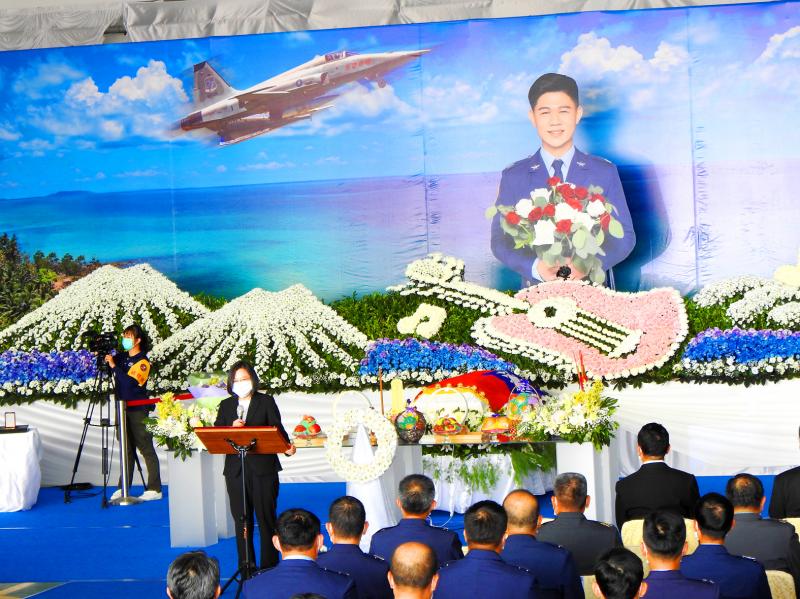
Photo: Huang Ming-tang, Taipei Times
At the Chihhang base service, Tsai presented a citation to Chu’s widow and thanked the 29-year-old pilot for his dedication and the sacrifices he made to protect the nation.
Chu was posthumously promoted to lieutenant colonel and air force Commander Hsiung Hou-chi (熊厚基) also presented him with the Order of Loyalty and Valor, which was received by his father.
During the service, four F-5 jets flew the missing comrade formation over the base to pay their respects to their fallen comrade.
Chu is to be interred at the air force Martyrs’ Shrine in New Taipei City.
His F-5E crashed into the sea less than two minutes after taking off from the base at 7:29am on Oct. 29. Although he managed to eject from the plane, he died of his injuries at 9:27am.
The military’s investigation into the crash is still ongoing.
Taiwan in 1992 procured a total of 150 F-16s from the US; the first batch was delivered in 1997.
Prior to last night’s incident, there had been seven F-16 crashes during training missions.
Additional reporting by Yang Chun-hui
The Ministry of Transportation and Communications yesterday inaugurated the Danjiang Bridge across the Tamsui River in New Taipei City, saying that the structure would be an architectural icon and traffic artery for Taiwan. Feted as a major engineering achievement, the Danjiang Bridge is 920m long, 211m tall at the top of its pylon, and is the longest single-pylon asymmetric cable-stayed bridge in the world, the government’s Web site for the structure said. It was designed by late Iraqi-British architect Zaha Hadid. The structure, with a maximum deck of 70m, accommodates road and light rail traffic, and affords a 200m navigation channel for boats,
Taiwan Semiconductor Manufacturing Co (TSMC, 台積電), the world’s largest foundry service provider, yesterday said that global semiconductor revenue is projected to hit US$1.5 trillion in 2030, after the figure exceeds US$1 trillion this year, as artificial intelligence (AI) demand boosts consumption of token and compute power. “We are still at the beginning of the AI revolution, but we already see a significant impact across the whole semiconductor ecosystem,” TSMC deputy cochief operating officer Kevin Zhang (張曉強) said at the company’s annual technology symposium in Hsinchu City. “It is fair to say that in the past decade, smartphones and other mobile devices were
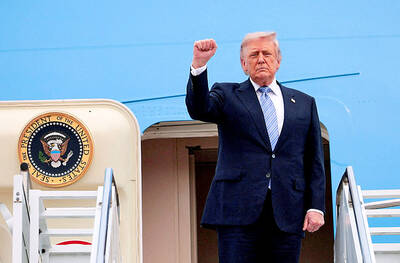
US-CHINA SUMMIT: MOFA welcomed US reassurance of no change in its Taiwan policy; Trump said he did not comment when Xi talked of opposing independence US President Donald Trump yesterday said he has not made a decision on whether to move forward with a major arms package for Taiwan after hearing concerns about it from Chinese President Xi Jinping (習近平). Trump’s comments on Taiwan came as he flew back to Washington after wrapping up critical talks in which both leaders said important progress was made in stabilizing US-China relations even as deep differences persist between the world’s two biggest powers on Iran and Taiwan. “I will make a determination,” Trump said, adding: “I’ll be making decisions. But, you know, I think the last thing we need right

TAIWAN ISSUE: US treasury secretary Scott Bessent said on the first day of meetings that ‘it wouldn’t be a US-China summit without the Taiwan issue coming up’ There were no surprises on the first day of the summit between US President Donald Trump and Chinese President Xi Jinping (習近平), the Mainland Affairs Council (MAC) said yesterday, as the government reiterated that cross-strait stability is crucial to the Asia-Pacific region, as well as the world. As the two presidents met for a highly anticipated summit yesterday, Chinese state media reported that Xi warned Trump that missteps regarding Taiwan could push their two countries into “conflict.” Trump arrived in China with accolades for his host, calling Xi a “great leader” and “friend,” and extending an invitation to visit the White House


 RSS
RSS