


Lawmakers and other top officials from the Democratic Progressive Party (DPP) yesterday castigated the Chinese Nationalist Party (KMT) over a Twitter post that compared President Tsai Ing-wen (蔡英文) to Mao Zedong (毛澤東).
DPP caucus whip Cheng Yun-peng (鄭運鵬) said that the post has turned into an “international joke.”
“As a citizen of this country, I feel quite ashamed of it,” Cheng said.
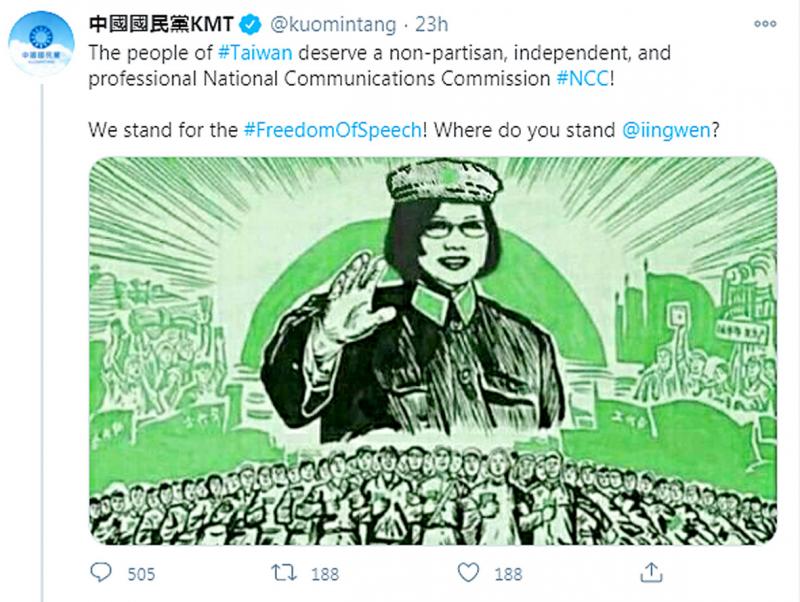
Photo: screen grab from Twitter
The KMT on Tuesday shared the image with the text: “The people of #Taiwan deserve a non-partisan, independent, and professional National Communications Commission #NCC! We stand for the #FreedomOfSpeech! Where do you stand @iingwen?” using the president’s Twitter account name.
The KMT has objected to an NCC review of CTi News’ (中天新聞台) operating license, calling it suppression of free speech.
The image was compiled of a drawing of Mao — made during the Cultural Revolution in which he is depicted wearing a cap of the Red Army and waving over a crowd of Red Guards — with his face replaced with Tsai’s.
“The whole world knows they have no media freedom in China and no freedom of expression,” he said. “People know that the KMT has a pro-China political stance.”
“The KMT has contradicted itself through this post, given its stance on cross-strait relations while touting freedom of expression,” Cheng added.
DPP Legislator Chen Ting-fei (陳亭妃) said that the KMT had gone too far.
“It is ridiculous for the KMT to portray Tsai as Mao Zedong, as the [CTi News] issue has nothing to do with freedom of expression,” Chen told reporters at the legislature in Taipei. “When the Twitter post came out, we thought it was made by a KMT auxiliary group. Then we learned it was the KMT itself and on the party’s official site.”
“Has the KMT regressed so far that it would make a joke in such poor taste to be ridiculed by the international community?” she asked. “People are wondering what level the KMT would not stoop to.”
“Tsai Ing-wen was elected through a popular vote in a democratic system, while Mao was a dictator,” top officials of the DPP wrote in a statement. “How could the KMT make such a comparison?”
“It is hard to believe that the KMT would post this on an international social media platform... Many people have left messages of criticism and ridicule,” DPP spokeswoman Hsieh Pei-fen (謝佩芬) said.
“It is only the KMT that is using social media for smear campaigns while eschewing statements of its position on policy issues,” Hsieh said. “It posted an extremely absurd picture to vilify our nation’s leader. Despite being on the opposite side of the aisle from the KMT, the DPP is embarrassed by its post.”
Hsieh cited Taipei-based journalist Chris Horton, who wrote: “Comparing Tsai Ing-wen, who overthrew the KMT in Taiwan through democratic elections, to Mao Zedong, who overthrew the KMT in China via bloody revolution, feels a tad unfair.”
She also quoted French researcher Antoine Bondaz, who wrote: “How pathetic for the KMT, supposedly a serious political party that aspires to govern Taiwan, to compare Tsai to Mao... Know your own history, and be a little bit more responsible.”
KMT officials have previously compared Tsai and former president Chen Shui-bian (陳水扁) to Adolf Hitler.
In October 2016 during a confirmation process for grand justices and the Judicial Yuan president, then-KMT caucus convenor Sufin Siluko (廖國棟) compared Tsai to Hitler and Tang Dynasty empress Wu Zetian (武則天).
“Led by President Tsai, Taiwan’s political environment is now close to entering a rule by ‘Taiwan’s Hitler’ and Empress Wu Zetian,” Sufin said at the time.
During the presidential campaign in 2004, the KMT ran full-page advertisements in Taiwan’s five major newspapers comparing then-president Chen Shui-bian to Hitler, with the ads showing Hitler in his full military regalia and a message to Taiwanese saying: “Let’s end [Chen Shui-bian’s] dictatorship.”
New Power Party international department director Daniel Liu (劉仕傑) said that there is no connection between Tsai and Mao, so the post only exposed the contrast between them.
“The KMT was responsible for atrocities during the White Terror era,” Liu said. “Many Taiwanese were persecuted and suffered terribly while fighting for freedom of expression. The KMT has no legitimacy when it comes to discussions of freedom of expression.”
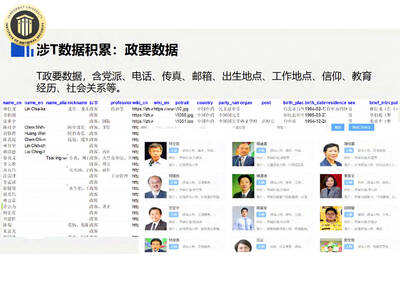
NETWORK-MAPPING PROJECT: The database contains 170 detailed files of Taiwanese politicians and about 23 million records of household registration data in Taiwan China has developed a network-mapping project targeting political figures and parties in Taiwan to monitor public opinion during elections and to craft tailored influence campaigns aimed at dividing Taiwanese society, according to documents leaked by Chinese technology firm GoLaxy (中科天璣). The documents, collected by Taipei-based Doublethink Lab, showed a database was specifically created to gather detailed information on Taiwanese political figures, including their political affiliations, job histories, birthplaces, residences, education, religion and a brief biography about them. Several notable Taiwanese politicians are in the database, including President William Lai (賴清德), former president Tsai Ing-wen (蔡英文), Minister of Foreign Affairs Lin Chia-lung (林佳龍),
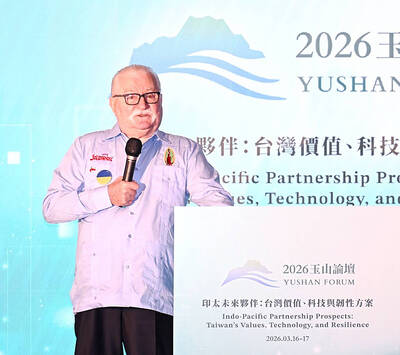
RECOGNITION: Former Fijian prime minister Mahendra Chaudhry said that Taiwan’s New Southbound Policy serves as a stabilizing force in the Indo-Pacific region Taiwan can lead the unification of the Chinese people, Nobel Peace Prize laureate and former Polish president Lech Walesa said in Taipei yesterday, adding that as the world order is changing, peaceful discussion would find good solutions, and that the use of force and coercion would always fail. Walesa made the remarks during his keynote address at a luncheon of the Yushan Forum in Taipei, titled “Indo-Pacific Partnership Prospects: Taiwan’s Values, Technology and Resilience,” organized by the Taiwan-Asia Exchange Foundation with the Ministry of Foreign Affairs. Walesa said that he had been at the forefront of a big peaceful revolution and “if
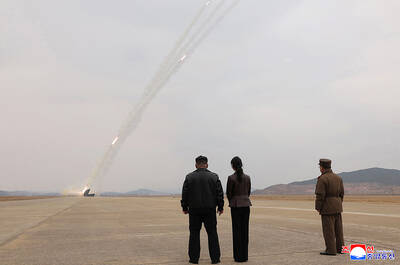
North Korea tested nuclear-capable rocket launchers, state media reported yesterday, a day after Seoul detected the launch of about 10 ballistic missiles. The test comes after South Korean and US forces launched their springtime military drills, due to run until Thursday. North Korean leader Kim Jong-un on Saturday oversaw the testing of the multiple rocket launcher system (MRLS), the Korean Central News Agency (KCNA) said. The test involved 12 600mm-caliber ultra-precision multiple rocket launchers and two artillery companies, it said. Kim said the drill gave Pyongyang’s enemies, within the 420km striking range, a sense of “uneasiness” and “a deep understanding

North Korea yesterday fired about 10 ballistic missiles to the sea toward Japan, the South Korean Joint Chiefs of Staff (JCS) said, days after Pyongyang warned of “terrible consequences” over ongoing South Korea-US military drills. Pyongyang recently dashed hopes of a diplomatic thaw with Seoul, Washington’s security ally, describing its latest peace efforts as a “clumsy, deceptive farce.” Seoul’s military detected “around 10 ballistic missiles launched from the Sunan area in North Korea toward the East Sea [Sea of Japan] at around 1:20pm,” JCS said in a statement, referring to South Korea’s name for the body of water. The missiles


 RSS
RSS