


The US Coast Guard (USCG) is basing Enhanced Response Cutters in the western Pacific for maritime security missions, the US national security adviser said on Friday, citing illegal fishing and harassment of vessels by China.
US National Security Adviser Robert O’Brien in a statement said that the coast guard also planned to evaluate next fiscal year the feasibility of basing Fast Response Cutters in American Samoa in the South Pacific.
The statement described the US as a Pacific power and added that China’s “illegal, unreported and unregulated fishing, and harassment of vessels operating in the exclusive economic zones of other countries in the Indo-Pacific threatens our sovereignty, as well as the sovereignty of our Pacific neighbors and endangers regional stability.”
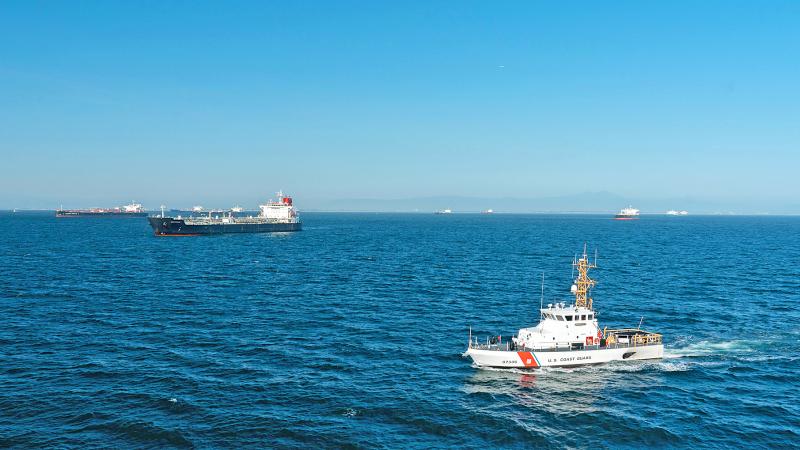
Photo: AFP/US Coast Guard/Aidan Cooney/Handout
It said US efforts, including by the coast guard, were “critical to countering these destabilizing and malign actions.”
“To that end, the USCG is strategically homeporting significantly enhanced Fast Response Cutters ... in the western Pacific,” the statement said, without detailing where the vessels would be based or how many were involved.
O’Brien said the new-generation coast guard vessels would conduct maritime security missions, such as fisheries patrols, and enhance maritime-domain awareness and enforcement efforts in collaboration with “regional partners who have limited offshore surveillance and enforcement capacity.”
“Enhancing the presence of the USCG in the Indo-Pacific ensures the United States will remain the maritime partner of choice in the region,” the statement said.
The coast guard did not immediately respond to a request for comment on the statement, which came just ahead of a planned visit to Asia by US Secretary of State Mike Pompeo.
Pompeo led a meeting of foreign ministers from India, Japan and Australia this month in Tokyo, a grouping Washington hopes to develop as a bulwark against China’s growing assertiveness and extensive maritime claims in the region, including to most of the strategic South China Sea.
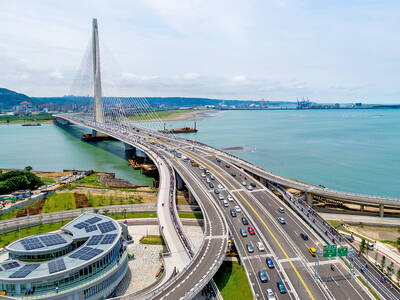
The Ministry of Transportation and Communications yesterday inaugurated the Danjiang Bridge across the Tamsui River in New Taipei City, saying that the structure would be an architectural icon and traffic artery for Taiwan. Feted as a major engineering achievement, the Danjiang Bridge is 920m long, 211m tall at the top of its pylon, and is the longest single-pylon asymmetric cable-stayed bridge in the world, the government’s Web site for the structure said. It was designed by late Iraqi-British architect Zaha Hadid. The structure, with a maximum deck of 70m, accommodates road and light rail traffic, and affords a 200m navigation channel for boats,
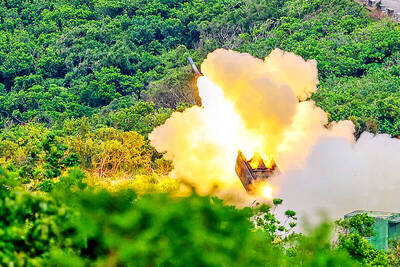
PRECISION STRIKES: The most significant reason to deploy HIMARS to outlying islands is to establish a ‘dead zone’ that the PLA would not dare enter, a source said A High Mobility Artillery Rocket System (HIMARS) would be deployed to Penghu County and Dongyin Island (東引) in Lienchiang County (Matsu) to force the Chinese military to retreat at least 100km from the coastline, a military source said yesterday. Taiwan has been procuring HIMARS and Army Tactical Missile Systems (ATACMS) from the US in batches. Once all batches have been delivered, Taiwan would possess 111 HIMARS units and 504 ATACMS, which have a range of 300km. Considering that “offense is the best defense,” the military plans to forward-deploy the systems to outlying islands such as Penghu and Dongyin so that

‘CLEAR MESSAGE’: The bill would set up an interagency ‘tiger team’ to review sanctions tools and other economic options to help deter any Chinese aggression toward Taiwan US Representative Young Kim has introduced a bill to deter Chinese aggression against Taiwan, calling for an interagency “tiger team” to preplan coordinated sanctions and economic measures in response to possible Chinese military or political action against Taiwan. “[Chinese President] Xi Jinping [習近平] has directed the People’s Liberation Army to be ready to invade Taiwan by 2027. China has a plan. America should have one too,” Kim said in a news release on Thursday last week. She introduced the “Deter PRC [People’s Republic of China] aggression against Taiwan act” to “ensure the US has a coordinated sanctions strategy ready should

TAIWAN ISSUE: US treasury secretary Scott Bessent said on the first day of meetings that ‘it wouldn’t be a US-China summit without the Taiwan issue coming up’ There were no surprises on the first day of the summit between US President Donald Trump and Chinese President Xi Jinping (習近平), the Mainland Affairs Council (MAC) said yesterday, as the government reiterated that cross-strait stability is crucial to the Asia-Pacific region, as well as the world. As the two presidents met for a highly anticipated summit yesterday, Chinese state media reported that Xi warned Trump that missteps regarding Taiwan could push their two countries into “conflict.” Trump arrived in China with accolades for his host, calling Xi a “great leader” and “friend,” and extending an invitation to visit the White House


 RSS
RSS