


US Ambassador to the UN Kelly Craft on Wednesday had lunch with Taipei Economic and Cultural Office in New York Director James Lee (李光章), a meeting she called “historic” and a further step in the US’ campaign to strengthen relations with Taiwan.
Craft said her lunch with Lee at an outdoor restaurant on Manhattan’s East Side was the first meeting between a top Taiwanese official and a US ambassador to the UN.
“I’m looking to do the right thing by my president, and I feel that he has sought to strengthen and deepen this bilateral relationship with Taiwan, and I want to continue that on behalf of the administration” of US President Donald Trump, Craft said.
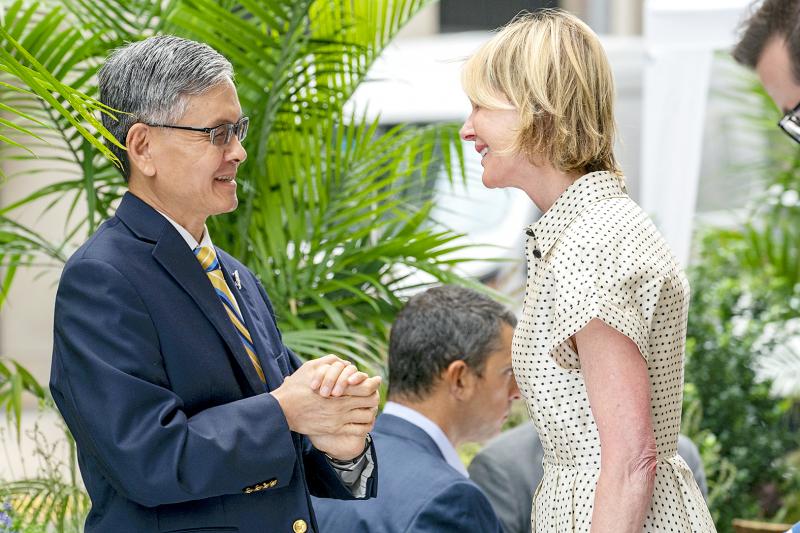
Photo: AP
The meeting came weeks ahead of the US presidential election on Nov. 3 and barely a day before US Undersecretary of State for Economic Growth, Energy and the Environment Keith Krach arrived in Taiwan.
Warmer US relations with Taiwan are largely a result of strong bipartisan support in the US Congress, but also appear to show how the Trump administration is willing to defy Beijing’s threats and promote an alternative to Chinese Communist Party authoritarianism.
Craft said that Lee, who was secretary-general in the Ministry of Foreign Affairs until July and had recently arrived in New York, invited her to lunch and she accepted.

Photo courtesy of the Taipei Economic and Cultural Office in New York via CNA
“It was a nice way for the host country to welcome him to New York, and to hear about his family and his experience, and obviously his respect and admiration for the Chinese people,” as well as the “many, many innovations in technology ... that Taiwan has to offer the world,” Craft said.
Craft said that Taiwanese “need to be heard and they’re being marginalized by Beijing.”
“It really is a shame because they should be able to participate in UN affairs just like everyone else,” she said. “If the US doesn’t stand up to China then who’s going to when it comes to Taiwan, and not only Taiwan, but Hong Kong and others?”
Craft said that she and Lee “discussed different ways that we can best help Taiwan become more engaged within the UN.”
She echoed Trump in pointing to an e-mail sent by Taiwan to the WHO in December last year that the organization ignored, warning about person-to-person transmission of COVID-19 in China, which indicated that the infection was highly contagious.
“Obviously, we really are pushing for them to be back into the UN, or have a role in the UN health assembly,” Craft said.
Lee called Craft “a terrific diplomat” and said that he was at the meeting to engage, and being new in town, he appreciates meeting people and making friends.
“Taiwan and the US share the values of democracy, human rights and the rule of law,” Lee said. “We could make great partners.”
Craft said that the next step is “just being supportive ... and just making sure that he knows that the US appreciates all of their contributions.”
“They have so much to offer the world and are most unselfish about sharing best practices,” she said. “They care about the relationship [of] the Chinese people with the Taiwanese. They care — which to me spoke volumes.”
Craft said that the US and Taiwan share the goal of promoting democracy, and that she was looking forward to meeting President Tsai Ing-wen (蔡英文) one day.
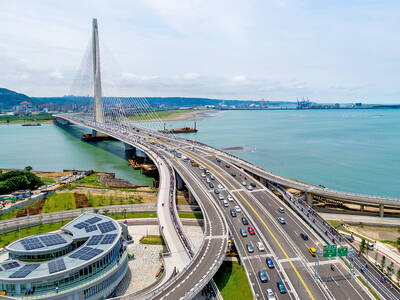
The Ministry of Transportation and Communications yesterday inaugurated the Danjiang Bridge across the Tamsui River in New Taipei City, saying that the structure would be an architectural icon and traffic artery for Taiwan. Feted as a major engineering achievement, the Danjiang Bridge is 920m long, 211m tall at the top of its pylon, and is the longest single-pylon asymmetric cable-stayed bridge in the world, the government’s Web site for the structure said. It was designed by late Iraqi-British architect Zaha Hadid. The structure, with a maximum deck of 70m, accommodates road and light rail traffic, and affords a 200m navigation channel for boats,

Taiwan Semiconductor Manufacturing Co (TSMC, 台積電), the world’s largest foundry service provider, yesterday said that global semiconductor revenue is projected to hit US$1.5 trillion in 2030, after the figure exceeds US$1 trillion this year, as artificial intelligence (AI) demand boosts consumption of token and compute power. “We are still at the beginning of the AI revolution, but we already see a significant impact across the whole semiconductor ecosystem,” TSMC deputy cochief operating officer Kevin Zhang (張曉強) said at the company’s annual technology symposium in Hsinchu City. “It is fair to say that in the past decade, smartphones and other mobile devices were
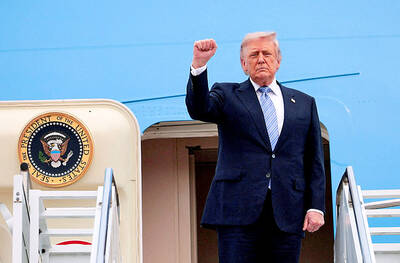
US-CHINA SUMMIT: MOFA welcomed US reassurance of no change in its Taiwan policy; Trump said he did not comment when Xi talked of opposing independence US President Donald Trump yesterday said he has not made a decision on whether to move forward with a major arms package for Taiwan after hearing concerns about it from Chinese President Xi Jinping (習近平). Trump’s comments on Taiwan came as he flew back to Washington after wrapping up critical talks in which both leaders said important progress was made in stabilizing US-China relations even as deep differences persist between the world’s two biggest powers on Iran and Taiwan. “I will make a determination,” Trump said, adding: “I’ll be making decisions. But, you know, I think the last thing we need right

TAIWAN ISSUE: US treasury secretary Scott Bessent said on the first day of meetings that ‘it wouldn’t be a US-China summit without the Taiwan issue coming up’ There were no surprises on the first day of the summit between US President Donald Trump and Chinese President Xi Jinping (習近平), the Mainland Affairs Council (MAC) said yesterday, as the government reiterated that cross-strait stability is crucial to the Asia-Pacific region, as well as the world. As the two presidents met for a highly anticipated summit yesterday, Chinese state media reported that Xi warned Trump that missteps regarding Taiwan could push their two countries into “conflict.” Trump arrived in China with accolades for his host, calling Xi a “great leader” and “friend,” and extending an invitation to visit the White House


 RSS
RSS