


Twitter Inc on Wednesday was investigating a massive hack in which high-profile users from Elon Musk to former US vice president Joe Biden had their accounts hijacked by scammers, who the social network believes targeted its employees to gain access to internal systems.
Posts trying to dupe people into sending hackers the cryptocurrency bitcoin were added to the accounts of Apple Inc, Uber Technologies Inc, Kanye West, Bill Gates, former US president Barack Obama and many others.
“We detected what we believe to be a coordinated social engineering attack by people who successfully targeted some of our employees with access to internal systems and tools,” Twitter said.

Photos: AFP
“They used this access to take control of many highly-visible ... accounts,” the company said, adding that it was investigating “what other malicious activity they may have conducted or information they may have accessed.”
The fraudulent posts, which were largely deleted, said people had 30 minutes to send US$1,000 in bitcoin, promising they would receive twice as much in return.
A total of 12.58 bitcoin — almost US$116,000 — were sent to e-mail addresses mentioned in the posts, according to Blockchain.com, which monitors cryptocurrency transactions.
“Tough day for us at Twitter,” chief executive Jack Dorsey wrote. “We all feel terrible this happened. We’re diagnosing and will share everything we can when we have a more complete understanding of exactly what happened.”
Twitter said that it had locked down the affected accounts and removed the hackers’ posts.
“Most accounts should be able to Tweet again,” the Twitter support team said in an evening update, but the firm also told users that it “may take further actions and will update you if we do.”
US President Donald Trump’s Twitter account, which has more than 83 million followers, was not among those targeted, but many specialist bitcoin firms were.
“All major crypto Twitter accounts have been compromised,” Cameron Winklevoss, cofounder of the Gemini cryptocurrency exchange, wrote on Twitter. “This is a SCAM, DO NOT participate!”
Vice News reported that a Twitter insider was responsible, citing leaked screen shots and two anonymous sources apparently behind the hack, one of whom told the media outlet they had paid the employee.
US Senator Josh Hawley posted on Twitter a letter to Dorsey expressing concern over privacy for the San Francisco-based company’s millions of users worldwide.
“I am concerned that this event may represent not merely a coordinated set of separate hacking incidents but rather a successful attack on the security of Twitter itself,” Hawley said.
BitTorrent Inc chief executive Justin Sun was offering a US$1 million reward for bringing the hackers to justice, reports said.
The post that appeared on Tesla Inc founder Musk’s feed said: “Happy Wednesday! I am giving back Bitcoin to all of my followers. I am doubling all payments sent to the Bitcoin address below. You send 0.1 BTC, I send 0.2 BTC back!”
It added that the offer was “only going on for 30 minutes.”
The fake messages that appeared on other famous accounts made similar promises of instant riches.
The BBC reported that a Web site address in some of the duplicitous tweets had been registered under the name “Anthony Elias,” which appeared to be a play on the words “an alias.”
Twitter has been targeted by hackers in the past.
In March 2017, the accounts of Amnesty International, the French Ministry of the Economy and Finance and the BBC’s North America service were broken into by hackers believed to have been loyal to Turkish President Recep Tayyip Erdogan.
In August last year, a series of insulting or racist messages were posted on Dorsey’s personal Twitter account without his knowledge.
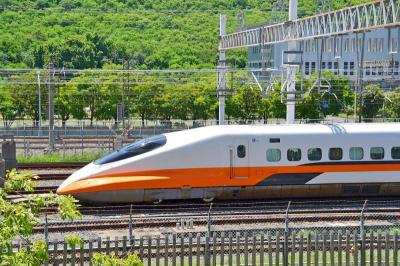
A signaling system malfunction disrupted high-speed rail (HSR) services beginning at 8am today, with trains temporarily reduced to three northbound and three southbound trains per hour as authorities conduct inspections. The malfunction occurred on a section of track in Miaoli County during pre-operation checks early this morning, forcing northbound and southbound trains to use a single track, the HSR operator said. The regular schedule has been replaced with three hourly trains offering only nonreserved seating in each direction, stopping at every station, it said, adding that business class cars would still have reserved seating. Departures from terminal stations are scheduled at the top

DRONE CENTRAL: Taiwan aims to become Asia’s democratic hub for drones, with most exports focused on high-quality military-grade models, an official said Taiwan’s drone industry is expected to expand significantly by 2030, producing 100,000 units per month and exporting half of them, the Ministry of Economic Affairs said yesterday. Current drone production capacity is about 15,000 units per month, but the industry can quickly scale up as demand increases, Industrial Development Administration Director-General Chiou Chyou-huey (邱求慧) told a news conference in Taipei. Taiwan’s drone output grew 2.5-fold last year to NT$12.9 billion (US$408.3 million) under a government program to develop the uncrewed vehicle sector, he said. The Executive Yuan in October last year approved plans to invest NT$44.2 billion into domestic production of uncrewed aerial
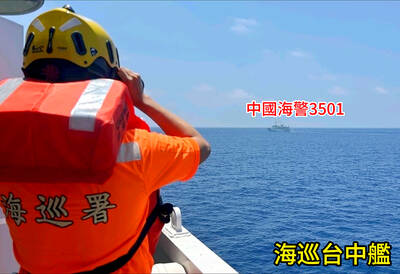
VERBOSE VESSELS: A CGA cutter and a China Coast Guard exchanged verbal barbs for more than a day in Taiwanese-controlled waters before the Chinese vessel left The Taiwanese and Chinese coast guards had a standoff near the strategically located Pratas Islands (Dongsha Islands, 東沙群島) in the north of the South China Sea, the Coast Guard Administration (CGA) said yesterday. The two sides engaged in intense radio exchanges over sovereignty claims during the 33-hour standoff. China Coast Guard vessel 3501 eventually left the restricted waters, 26.6 nautical miles (49.2km) west of the Pratas Islands, at 5pm yesterday, the CGA said. Lying approximately between southern Taiwan and Hong Kong, the Taiwan-controlled Pratas are seen by some security experts as vulnerable to Chinese attack due to their distance — more than
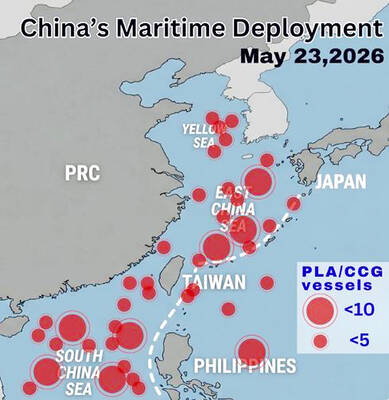
WARNING: China should stop engaging in actions that undermine regional peace and stability, as it would only build resentment among people across the Strait, the CGA said China has deployed more than 100 navy, coast guard and other vessels in waters from the Yellow Sea to the South China Sea and the western Pacific since US President Donald Trump and Chinese President Xi Jinping (習近平) met in Beijing, National Security Council Secretary-General Joseph Wu (吳釗燮) said yesterday. “In this part of the world, #China is the one & only PROBLEM wrecking the #StatusQuo & threatening regional peace & stability,” Wu wrote on X. In a separate post, he said Beijing was coercing Taiwan’s maritime domain, calling it illegal and provocative, after the Coast Guard Administration (CGA) expelled a


 RSS
RSS