


Scuffles broke out at the Legislative Yuan yesterday as Chinese Nationalist Party (KMT) lawmakers again occupied the legislative chamber, stymieing a report by Control Yuan presidential nominee Chen Chu (陳菊) and a question-and-answer session.
The KMT lawmakers showed up at the back door of the chamber at about 5am and tried to enter, but were stopped by several Democratic Progressive Party (DPP) lawmakers who were guarding the door.
Scuffles broke out as the KMT lawmakers tried to force their way through the door, injuring legislators on both sides.
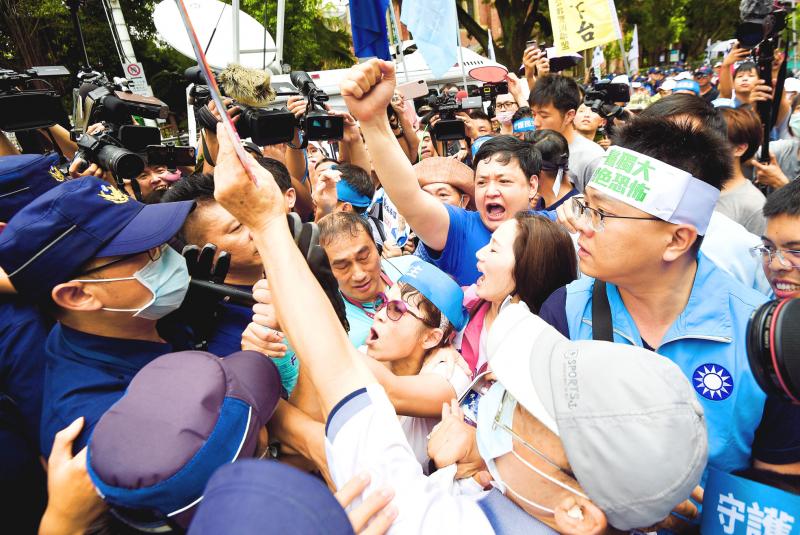
Photo: Peter Lo, Taipei Times
KMT Legislator Hung Mong-kai (洪孟楷) tackled DPP Legislator Wang Ting-yu (王定宇), while DPP Legislator Wu Ping-jui (吳秉叡) became entangled with KMT Legislator Lin Wei-chou (林為洲).
Wang, showing a bruise on his face and scrapes on his body, accused two of Lin’s assistants of attacking him during the scuffle.
KMT Legislator Alex Fai (費鴻泰) cut his wrist during the standoff. His injury was purportedly caused by a sheet of glass in one of the chamber’s doors that had been broken during the confrontation.
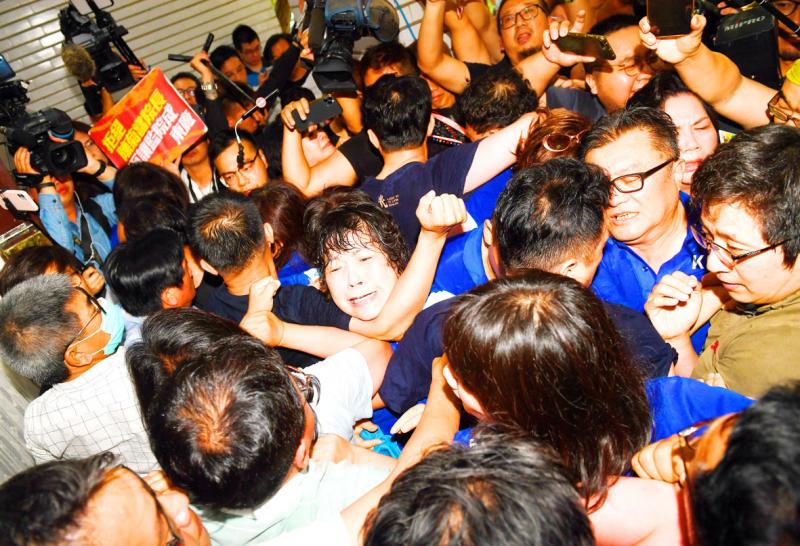
Photo: CNA
DPP and KMT lawmakers ran for the speaker’s rostrum once the chamber’s doors opened for yesterday’s meeting, but KMT lawmakers were quicker, allowing them to freeze the proceedings for the rest of the day.
KMT lawmakers then overturned three podiums, damaging monitors fitted in them.
Five lawmakers from the Taiwan People’s Party later entered the chamber to join their KMT counterparts in chanting: “Abolish the Control Yuan and the Examination Yuan,” and “Retract the nominations.”
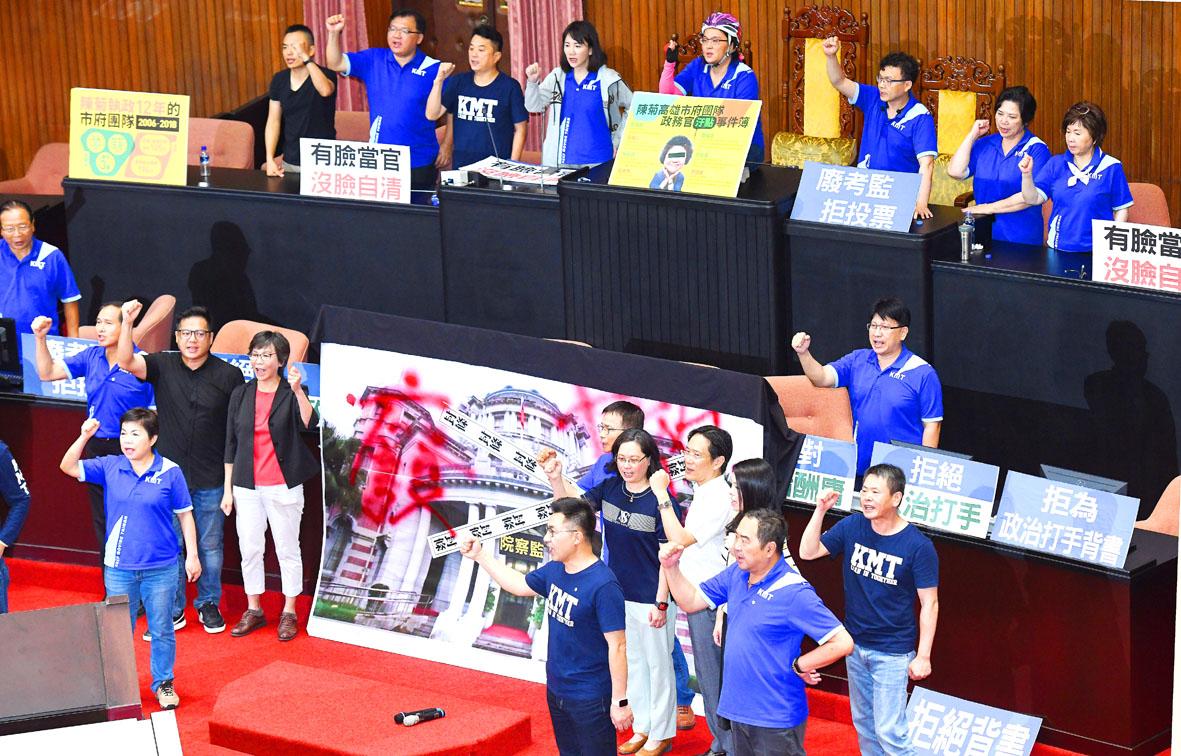
Photo: Liao Chen-huei, Taipei Times
Several KMT lawmakers lay on a driveway at the Legislative Yuan’s back door on Qingdao E Road in an attempt to stop Chen from entering the chamber, but Chen entered by the side door on Zhenjiang Street and was escorted into the chamber by police.
Seeing that the meeting had been stymied, Chen left the legislature at about 11:30am.
About 200 protesters also gathered outside the Legislative Yuan to protest Chen’s nomination. They later marched to the Control Yuan in an attempt to continue their protest there, but were evicted by police, as they had not obtained permission for a demonstration.
As of press time last night, the legislative chamber was still controlled by the KMT caucus.
Legislative Speaker You Si-kun (游錫堃) in a statement said that the lawmakers’ assistants who were involved in the scuffle had seriously affected lawmakers’ right to exercise their authority.
To ensure lawmakers’ safety and that they can duly exercise their authority as mandated by the Constitution, the assistants who took part in the scuffle would be reported to the police, he said.
Lin said that physical contact was inevitable during the chaos.
The physical contact was unintentional and should not be scrutinized, he added, calling on people to focus on the larger issue.
Chen later said she regretted not being able to deliver her report and posted its transcript on Facebook.
Stating that she understands that abolishing the Control Yuan has become a public consensus, she wrote that she would shoulder the responsibility of pushing forward a transition in the political system, as long as lawmakers arrive at that conclusion through constitutional reform.
Until then, she would ensure that the branch operates in a non-partisan manner and is insulated from any undue influence when discharging its duties of impeachment and censure, she added.
Regarding the Control Yuan president’s role as the chair of the National Human Rights Commission, Chen wrote that she would offer the Executive Yuan and lawmakers advice on legislation relating to the protection of human rights, and ensure that the concept of human rights is instilled in government agencies at all levels.
As for accusations of corruption leveled against her by the KMT, Chen wrote that other than being imprisoned as a political prisoner after the 1979 Kaohsiung Incident, she had been clean-handed throughout her political career and had never once faced impeachment.
Additional reporting by Lin Liang-sheng
A magnitude 7.8 earthquake struck off the southern coast of Mindanao in the Philippines at 7:38am today, prompting the US Tsunami Warning System to issue an alert for neighboring countries, including Taiwan. The system issued a purple alert indicating a "tsunami threat." The potential threat zone includes Taiwan, the Philippines, Papua New Guinea, Yap and Palau. Philippine authorities were assessing the damage from the quake, with the office of civil defense seeking to verifying initial reports that 15 people had been killed and 129 injured in the region, mostly from falling debris. Arlene Hollero, disaster chief of Maasim town in the Philippines' Sarangani Province,

‘GRAY ZONE’ PRESSURE: Beijing’s activities are intended to create the deceitful impression that China has jurisdiction over the area around Taiwan, the CGA said Taiwan’s rights over its territorial waters and exclusive economic zone must not be violated by any country, the Mainland Affairs Council said yesterday, adding that it will not accept any unprovoked actions. The council issued the remarks in response to the China Coast Guard conducting maritime enforcement drills near eastern Taiwan and claiming to fully exercise China’s maritime administrative law enforcement authority. The Coast Guard Administration (CGA) has been closely monitoring the situation and is taking concrete steps to defend the nation’s sovereignty and secure its waters, the council said. China has no sovereign rights over the waters off eastern

RESILIENCE: Taiwan plays a key role in semiconductors, energy, information infrastructure and advanced manufacturing, AIT Director Raymond Greene said Taiwan’s continued investment in deterrence and resilience remains vital, especially in uncrewed systems and other emerging technologies, American Institute in Taiwan (AIT) Director Raymond Greene said yesterday. Greene made the remarks at the annual National Strategic Summit on Supply Chain Resilience held by the Research Institute for Democracy, Society and Emerging Technology (DSET), a government-backed think tank. As Taiwan last year became the US’ fourth-largest trading partner and supply chain security is becoming more important, cooperation in emerging technologies continues to deepen between the two countries, he said. The US is committed to accelerating innovation, building key infrastructure, strengthening cooperation

The National Chungshan Institute of Science and Technology yesterday showcased its locally developed variants of the Vision 60 robotic patrol dog, which it plans to deploy on the nation’s outlying territories in the South China Sea. The variants were produced under the Joint Lab project — created by the institute and domestic companies — and assembled with domestically produced motors, lenses and artificial intelligence (AI) systems alongside licensed tech from the US, Missile and Rocket Systems Research Division deputy director Jen Kuo-kang (任國光) told the media event at a military base in Taipei’s Dazhi (大直) area. Taiwan has built up its strengths


 RSS
RSS