


The Ministry of Foreign Affairs yesterday announced that it is to reopen a representative office in Guam, citing the growing strategic importance of the Pacific region and a strong Taiwan-US partnership.
Preparations for reopening the Taipei Economic and Cultural Office in Guam were already under way, the ministry said yesterday in a statement.
The de facto embassy in the US’ unincorporated, organized territory was closed in August 2017 during the tenure of former minister of foreign affairs David Lee (李大維), along with offices in Norway and Jeddah, Saudi Arabia.

Photo: Lu Yi-hsuan, Taipei Times
Due to budget and personnel considerations, the government in 2017 deemed it necessary to temporarily halt operation of the office in Guam, the ministry said.
With the ministry’s budget rising steadily from 2018, Taiwan and the US have forged an increasingly strong global partnership and the strategic importance of the Pacific region has continued to grow, leading to the ministry’s decision to reinstate the office, it said.
The US has paid increased attention to the Pacific region, as it launched the US Indo-Pacific Strategy in 2018, and the Indo-Pacific Strategy Report and a report titled A Free and Open Indo-Pacific: Advancing a Shared Vision last year, the ministry said.
Re-establishing the representative office in Guam would facilitate economic and trade cooperation, and exchanges between Taiwan and the greater western Pacific region, deepen relations with its Pacific allies and increase multilateral exchanges, it said.
Taiwan in September last year lost two Pacific allies — the Solomon Islands and Kiribati — within a week amid Beijing’s pressure.
It now maintains formal relations with 15 nations, including four in the Pacific — Palau, Nauru, Tuvalu and the Marshall Islands.
In 2017 and 2018, then-Guam governor Eddie Calvo led delegations to Taiwan and expressed his support for re-establishing the office when he met with President Tsai Ing-wen (蔡英文), as well as boosting bilateral tourism and economic exchanges, the ministry said.
Taiwan maintains steady economic and trade relations with Guam, as Taiwanese enterprises — such as Lih Pao Construction (麗寶建設), Chung Kuo Insurance (兆豐保險), First Commercial Bank (第一商銀), Asia Cement Corp (亞泥) and China Airlines (華航) — have invested in the territory, it said.
Medical tourism from Guam to Taiwan has also gained momentum, it added.
After the reopening of the Guam office, the number of representative offices in the US would increase to 13: Washington, New York, Boston, San Francisco, Los Angeles, Atlanta, Seattle, Houston, Chicago, Honolulu, Denver, Miami and Guam, the ministry said.
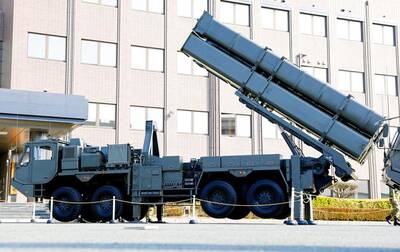
Japan has deployed long-range missiles in a southwestern region near China, the Japanese defense minister said yesterday, at a time when ties with Beijing are at their lowest in recent years. The missiles were installed in Kumamoto in the southern region of Kyushu, as Japan is attempting to shore up its military capacity as China steps up naval activity in the East China Sea. “Standoff defense capabilities enable us to counter the threat of enemy forces attempting to invade our country ... while ensuring the safety of our personnel,” Japanese Minister of Defense Shinjiro Koizumi said. “This is an extremely important initiative for
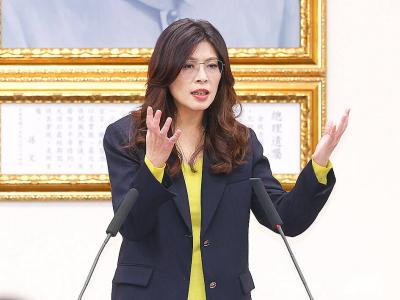
Chinese Nationalist Party (KMT) Chairwoman Cheng Li-wun (鄭麗文) today accepted an invitation from Chinese President Xi Jinping (習近平) to lead a delegation to China next month, saying she hopes to promote the peaceful development of cross-strait relations and bring stability to the Taiwan Strait. “I am grateful and happy to accept this invitation,” Cheng said in a statement from the KMT chairperson’s office. Cheng said she hopes both sides can work together to promote the peaceful development of cross-strait relations, enhance exchange and cooperation, bring stability to the Taiwan Strait and improve people’s livelihoods. At today's news conference, Cheng said any efforts to
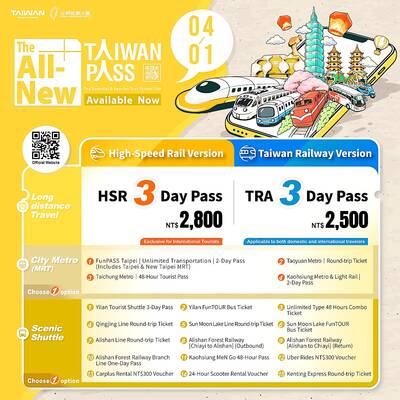
MORE POPULAR: Taiwan Pass sales increased by 59 percent during the first quarter compared with the same period last year, the Tourism Administration said The Tourism Administration yesterday said that it has streamlined the Taiwan Pass, with two versions available for purchase beginning today. The tourism agency has made the pass available to international tourists since 2024, allowing them to access the high-speed rail, Taiwan Railway Corp services, four MRT systems and four Taiwan Tourist Shuttles. Previously, five types of Taiwan Pass were available, but some tourists have said that the offerings were too complicated. The agency said only two types of Taiwan Pass would be available, starting from a three-day pass with the high-speed rail and a three-day pass with Taiwan Railway Corp. The former costs NT$2,800

The nation’s fastest supercomputer, Nano 4 (晶創26), is scheduled to be launched in the third quarter, and would be used to train large language models in finance and national defense sectors, the National Center for High-Performance Computing (NCHC) said. The supercomputer, which would operate at about 86.05 petaflops, is being tested at a new cloud computing center in the Southern Taiwan Science Park in Tainan. The exterior of the server cabinet features chip circuitry patterns overlaid with a map of Taiwan, highlighting the nation’s central position in the semiconductor industry. The center also houses Taiwania 2, Taiwania 3, Forerunner 1 and


 RSS
RSS