

The Ministry of Foreign Affairs yesterday thanked Japan for allowing 94 Taiwanese on a chartered plane evacuating others stranded in Russia, where COVID-19 cases are rising and many international flights have been canceled.
Ninety-four Taiwanese exchange students and expats, as well as two Russian spouses, arrived at Narita International Airport in Japan yesterday morning on a charter flight operated by Japan Airlines, before taking a transfer flight to Taiwan Taoyuan International Airport last night, ministry spokeswoman Joanne Ou (歐江安) said.
As of press time last night, Russia had reported more than 362,000 cases of COVID-19, including more than 3,800 deaths.
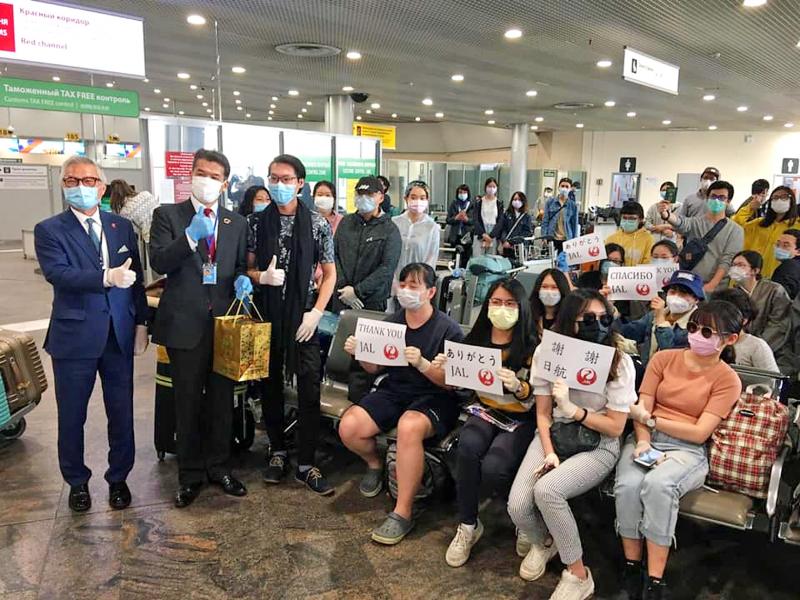
Photo courtesy of the Representative Office in Moscow
The government had since earlier this month been seeking ways to evacuate the trapped Taiwanese before Japan agreed to arrange seats for them on a charter flight evacuating 47 Japanese nationals from Russia.
The high cost had kept Taiwan from sending its own charter flight, Ou said.
The ministry expressed its sincere appreciation to Japan, as well as Russia, for all of the arrangements they made for the evacuation, she added.
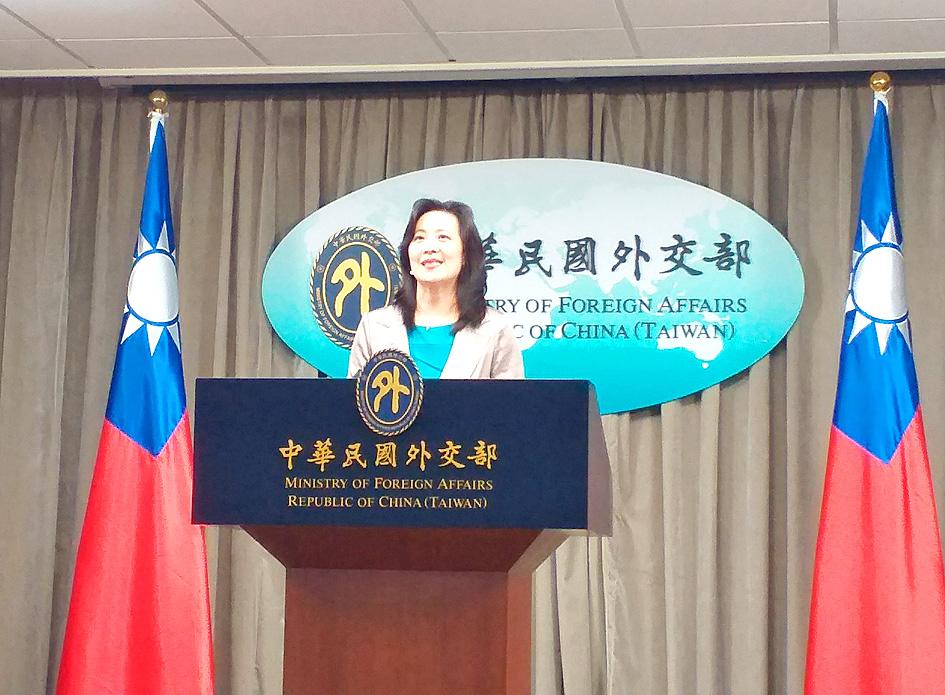
Photo: CNA
The 96 evacuees would be placed in centralized quarantine, in line with the Central Epidemic Command Center’s disease prevention regulations, Ou said.
The Taipei Economic and Cultural Representative Office in Japan also extended special thanks to Japan Airlines and the Japanese All-Party Parliamentary Group for Taiwan for their efforts in coordinating the flight, Representative to Japan Frank Hsieh (謝長廷) said.
Speaking at a regular news conference in Japan, Japanese Chief Cabinet Secretary Yoshihide Suga said that the successful evacuation is a great example of collaboration between Japan, Taiwan and Russia during the disease prevention period.
Japanese authorities assisted the evacuees, ensuring that they had a smoother experience getting a connecting flight back to Taiwan, Suga said.
Japan Airlines had reportedly planned to land the flight at Tokyo Haneda Airport, but changed the destination to Narita International Airport, which has direct flights to Taiwan.
Suga expressed appreciation for the 1 million masks that KGI Charity Foundation (凱基慈善基金會) chairman Angelo Koo (辜仲瑩) donated to Japan, as well as thanking Taiwanese for their various forms of support.
UNITY: Lai thanked the nations who spoke up for Taiwan, saying that democracies must stand together to face global authoritarian expansion Taiwan yesterday thanked eight European and Indo-Pacific countries for opposing unilateral changes to the “status quo” in the Taiwan Strait in a joint statement earlier this week, as well as three of Taiwan’s allies for speaking up for the nation’s participation in the UN at the body’s General Assembly in New York. Minister of Foreign Affairs Lin Chia-lung (林佳龍) welcomed the support and expressed his appreciation for the countries’ stance, the Ministry of Foreign Affairs said in a statement. Foreign ministers and senior representatives of Australia, France, Germany, Japan, New Zealand, Poland, South Korea and the UK issued a statement on Tuesday
PLEA: How the UN addresses Taiwan’s security issue would be a test of its strength and relevance, Marshall Islands President Hilda Heine told the UN General Assembly Only Taiwan’s elected government can represent the people of Taiwan, Marshall Islands President Hilda Heine said on Friday at the UN General Assembly, calling for the nation’s inclusion in the UN. Taiwan and its 23 million people are a reality, and only its democratically elected government can represent it, Heine said when addressing the 81st session of the UN General Assembly General Debate. Appropriate ways must be found for Taiwan’s substantive participation in UN meetings if the UN is to be truly inclusive and effective in years to come, she said. UN member states would experience pressure to accept a
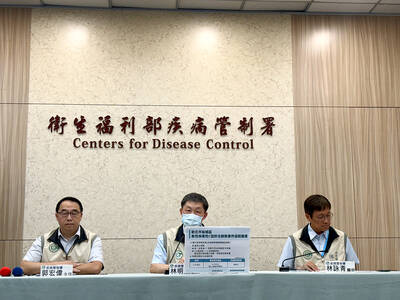
AT-RISK GROUPS: Of the accumulated 1,586 severe cases and 304 related deaths in this flu season, 65.8% were older people and 83.2% had chronic diseases, an official said The Centers for Disease Control (CDC) yesterday said that 165 severe flu cases and 30 flu-related deaths were reported last week, the highest weekly numbers in this flu season, and that cases might continue to increase, urging people to take precautions. Medical visits for flu-like illnesses increased by 1.4 percent to 141,374 last week, with 11.8 percent being emergency visits, showing that the seasonal flu is still in its epidemic period, CDC Epidemic Intelligence Center Director Guo Hung-wei (郭宏偉) said. From Tuesday last week to Monday, 165 severe flu cases and 30 flu-related deaths were confirmed, the highest weekly numbers
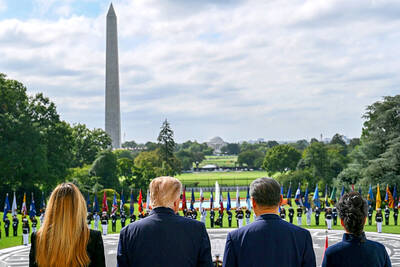
FACTS DISTORTION: The MAC rejected Xi’s remarks that the US and ‘China’ fought side-by-side during WWII, saying the ROC was Washington’s true ally during the war Taiwan yesterday denounced Chinese President Xi Jinping’s (習近平) comments to US President Donald Trump on the nation’s future, after Xi appeared to push Trump for a subtle change in stance that could erode US support for Taiwan. Xi told Trump in Washington on Thursday that he hoped the US would adhere to the “correct position” of opposing Taiwanese independence, according to a Chinese readout of the talks. That would be a tougher version of Washington’s long-standing formulation that it does not “support” independence. There was no immediate White House readout of the exchange. Xi’s remarks represent “the consistent Chinese approach of distorting facts


 RSS
RSS