

The number of spectators allowed at CPBL baseball games is to be raised to 2,000 from today, the Central Epidemic Command Center (CECC) said yesterday, as it reported no new cases of COVID-19 for the seventh consecutive day.
While fans would not be able to bring their own snacks into stadiums, the center is allowing league-prepared lunchboxes, which would also contain disinfectant products, Deputy Minister of the Interior Chen Tsung-yen (陳宗彥), who is deputy head of the center, said at the daily CECC media briefing in Taipei.
In a world first, the league on Friday last week opened stadiums to a maximum of 1,000 spectators per game under approval from the CECC.

Photo: Chen Chi-chu, Taipei Times
Fans are assigned staggered seats, required to wear masks and prohibited from eating, although water is allowed. Their temperatures are taken and their hands sprayed with disinfectant before they can enter the stadiums.
The CPBL was also the first professional baseball league in the world to start its new season, opening on April 12.
American Institute in Taiwan (AIT) Director Brent Christensen reportedly suggested that the league change its name by dropping the “Chinese” in Chinese Professional Baseball League and using “Taiwan,” so that foreigners would not mistake it as a China-based entity.

Photo: Chiu Chih-ju, Taipei Times
The AIT respects that the league’s name has been used for 31 years, but suggested that it increase the use of “Taiwan” in its English-language promotional materials, the league said in a statement on Saturday last week.
As of yesterday, Taiwan had recorded 440 confirmed cases of COVID-19 — 349 imported infections, 55 local and 36 from the navy’s “Friendship Flotilla” — while its death toll from COVID-19 stood at seven, center data showed.
Among people with confirmed cases, 383 have been released from isolation, up from 375 on Wednesday, the center said.
No new cases were reported by the center yesterday, for a seventh straight day. It has been 32 days since the last confirmed local case.
Regarding long-distance fishing vessels expected to return to Taiwan late this month, the center had initially planned to allow crew members to disembark and forgo the 14-day isolation period if they had not had contact with a foreign port over the past 30 days.
However, after a meeting with the Fisheries Agency and some local governments a week or two ago, experts felt that the health of crew members could not be ensured, so a 14-day isolation period would still be required, Chen said.
Later yesterday, the center and the Fisheries Agency were scheduled to meet to discuss financial concerns expressed by fishing companies, he said.
The center is preparing a report on Taiwan’s experiences in fighting COVID-19, to be shared with the world, said Minister of Health and Welfare Chen Shih-chung (陳時中), who heads the center.
The report is to include information on the center’s decisionmaking process, communications with the public, testing strategies and case investigations, he said.
Additional reporting by CNA
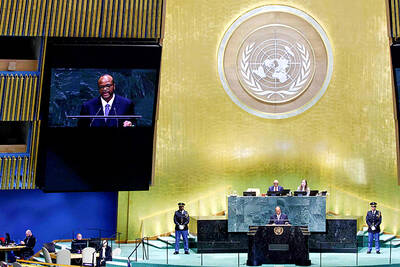
UNITY: Lai thanked the nations who spoke up for Taiwan, saying that democracies must stand together to face global authoritarian expansion Taiwan yesterday thanked eight European and Indo-Pacific countries for opposing unilateral changes to the “status quo” in the Taiwan Strait in a joint statement earlier this week, as well as three of Taiwan’s allies for speaking up for the nation’s participation in the UN at the body’s General Assembly in New York. Minister of Foreign Affairs Lin Chia-lung (林佳龍) welcomed the support and expressed his appreciation for the countries’ stance, the Ministry of Foreign Affairs said in a statement. Foreign ministers and senior representatives of Australia, France, Germany, Japan, New Zealand, Poland, South Korea and the UK issued a statement on Tuesday
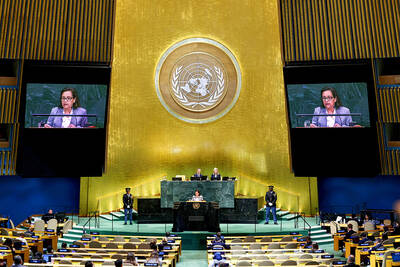
PLEA: How the UN addresses Taiwan’s security issue would be a test of its strength and relevance, Marshall Islands President Hilda Heine told the UN General Assembly Only Taiwan’s elected government can represent the people of Taiwan, Marshall Islands President Hilda Heine said on Friday at the UN General Assembly, calling for the nation’s inclusion in the UN. Taiwan and its 23 million people are a reality, and only its democratically elected government can represent it, Heine said when addressing the 81st session of the UN General Assembly General Debate. Appropriate ways must be found for Taiwan’s substantive participation in UN meetings if the UN is to be truly inclusive and effective in years to come, she said. UN member states would experience pressure to accept a
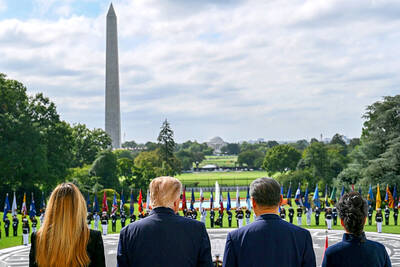
FACTS DISTORTION: The MAC rejected Xi’s remarks that the US and ‘China’ fought side-by-side during WWII, saying the ROC was Washington’s true ally during the war Taiwan yesterday denounced Chinese President Xi Jinping’s (習近平) comments to US President Donald Trump on the nation’s future, after Xi appeared to push Trump for a subtle change in stance that could erode US support for Taiwan. Xi told Trump in Washington on Thursday that he hoped the US would adhere to the “correct position” of opposing Taiwanese independence, according to a Chinese readout of the talks. That would be a tougher version of Washington’s long-standing formulation that it does not “support” independence. There was no immediate White House readout of the exchange. Xi’s remarks represent “the consistent Chinese approach of distorting facts
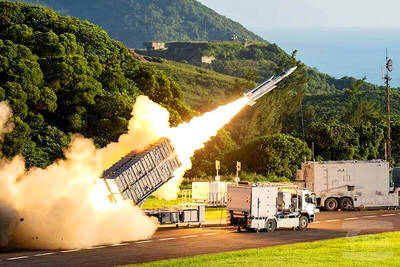
RESILIENCE: Keeping the defense industry’s assembly lines open would prove essential should the nation be involved in a prolonged conflict, a source said The Ministry of National Defense has prepared a NT$22 billion (US$692.3 million) program to acquire about 200 improved Hsiung Feng anti-ship missiles from next year to 2035, a source said. Commenting on condition of anonymity, a high-ranking defense official said the ministry’s plan for enhanced-capability Hsiung Feng II and Hsiung Feng III missiles would be funded as part of the regular defense budget. The 200 missiles would be added on top of the 1,400 missiles being funded via the Sea-Air Combat Power Improvement Plan, they said. The program is not about padding missile numbers, but expanding the capability to defeat


 RSS
RSS