


British Prime Minister Boris Johnson yesterday battled COVID-19 in intensive care as death tolls in the US and Europe reached new heights from the pandemic sweeping the world.
Johnson, 55, was moved into intensive care when his condition worsened 10 days after his diagnosis.
A senior Cabinet minister said that he had been given oxygen, but had not been put on a ventilator.
His case has highlighted the global reach of the virus.
The disease’s relentless march across the planet has now claimed more than 75,000 lives out of more than 1.3 million confirmed cases, with warnings that much worse is yet to come.
The number of daily deaths in Spain rose to 743 yesterday, after France on Monday recorded a new surge of 833 fatalities, its highest daily toll since the epidemic began, and Italy saw its death toll shoot up to 636 from 525 the day before, after days of dropping.
The US — which has by far the most confirmed coronavirus cases in the world — recorded 1,150 deaths over 24 hours, Johns Hopkins University said.
In New York state, the US epicenter of the crisis, the rate of growth in the death toll appeared to be slowing.
“New York City is fighting back. We have an invisible enemy. We have a ferocious enemy, but this city is fighting back with everything we’ve got,” New York City Mayor Bill de Blasio said.
The virus is stretching medical facilities to the limit and the WHO warned that there is a global shortage of 6 million nurses.
People around the world have been forced to improvise as supplies run short, with bodies packed in cardboard coffins in Ecuador and a mosque converted into a makeshift mask factory in Iran.
Governments around the world are also scrambling to put together rescue packages.
With the ink barely dry on a US$2 trillion economic rescue package passed by the US Congress, US President Donald Trump said he favored another massive spending program, again roughly US$2 trillion, but this time targeting infrastructure projects.
“We built the greatest economy in the world. I’ll do it a second time,” he said.
EU finance ministers are expected to clinch a deal to use the eurozone’s 410 billion euro (US$447 billion) bailout fund to fight the virus, but the bloc remains divided on pooling debt to issue “coronabonds.”
Stock markets have chosen to see the glass as half-full so far this week, with the Dow Jones Industrial Average on Monday soaring 1,600 points as traders saw hope the pandemic was reaching its apex.
Markets were also up in Tokyo, Hong Kong and Shanghai.

National Taiwan University (NTU) yesterday said it disqualified a person from an entrance examination for using AI smart glasses to cheat, along with two others for making untruthful statements in their curriculum vitae. The three applicants were given null scores, Taiwan’s highest-ranked university said, calling on prospective students to be honest in the admissions process. NTU registrar Lee Hung-sen (李宏森) said that the cheating applicant wore a hat and thick-rimmed glasses to the second written exam for medical school, claiming that they felt cold. Suspicions were aroused when the applicant stared oddly at the test for long stretches while steadily bringing the paper
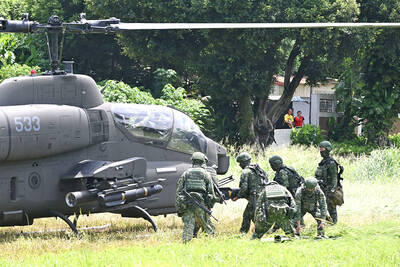
MILITARY ISSUES: A partisan divide between the Cabinet and the legislature ‘raised questions about Taiwan’s ability to adequately fund its defense,’ the report said Taiwan’s defense budget, military personnel numbers and resilience are challenges to its ability to meet national defense goals, the US Naval Institute said in a report published on Tuesday. In response to the perception of a growing military threat posed by China, Taiwan has embarked on an effort to enhance the capabilities needed to deter an attempt by Beijing to annex the nation by force, the institute said in the US Congressional Research Service report, titled Taiwan: Defense and Military Issues, which was filed on Thursday last week. Taiwan’s defense budget increased by about 7.5 percent from 2024 to last year, it
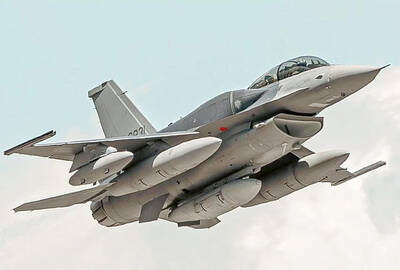
66 FIGHTER JETS: The aircraft is likely undergoing preparations for its transfer to Taiwan — a significant step forward in the nation’s modernization program, a lawmaker said The first of Taiwan’s order of F-16V Block 70 aircraft has been sighted in Texas ahead of delivery, Democratic Progressive Party (DPP) Legislator Wang Ting-yu (王定宇) said. Taiwan’s first F-16V Block 70 two-seat aircraft, tail number 6831, was seen flying from Lockheed Martin’s production facility in Greenville, South Carolina, to Naval Air Station Joint Reserve Base Fort Worth in Texas, Wang wrote on Facebook yesterday. The plane is likely undergoing preparations for its transfer to Taiwan, marking a significant step forward in the Republic of China Air Force’s modernization program, Wang said, citing military analysts. The F-16V Block 70 is a new-build version

NOT JUST NUMBERS: What matters to intelligence work is crucial, reliable information, so even a few credible leads can be highly valuable to national security, a legislator said The National Security Bureau (NSB) yesterday said it has finished the establishment of an information-reporting channel for Chinese nationals, the aim of which is to broaden intelligence gathering on China’s political, military, economic and social developments. Chinese nationals can submit information on the Web page, https://report.nsb.gov.tw, the NSB said in a statement. The move aims to expand the bureau’s diverse intelligence sources and is pursuant to the National Intelligence Services Act (國家情報工作法), it said, adding that it referenced practices adopted by intelligence agencies in the US, the UK and Israel. An increasing number of people are approaching Taiwanese agencies to provide information, as


 RSS
RSS