


The Presidential Office, the Executive Yuan and the Democratic Progressive Party (DPP) plan to pass an anti-infiltration bill on Tuesday as scheduled after gauging public opinion, which favors the move, a source said yesterday.
The DPP administration hopes to pass a version of the bill on which it and opposition parties have the largest common ground following cross-caucus talks tomorrow, the source said.
Despite the four legislative caucuses on Friday managing to discuss only two of the bill’s 12 articles, without reaching a consensus, an Executive Yuan official, who requested anonymity, applauded the lawmakers’ decision to commence a clause-by-clause review.
A DPP official, speaking on condition of anonymity, said that the DPP caucus’ version of the bill would certainly undergo minor adjustments, particularly to the definition of “infiltration sources” and Article 2, which currently includes groups, organizations and agencies “supervised by” the government, affiliated organizations or any intermediary of an external hostile force.
The Chinese Communist Party (CCP) assigns officials to larger Chinese companies, some of which hire Taiwanese, but that does not mean these Taiwanese will collude with the CCP to infiltrate Taiwan, the official said, adding that changes would allay the concerns of Taiwanese working in Chinese firms.
However, the Chinese Nationalist Party (KMT) caucus’ proposal that the Executive Yuan regularly publish a list of sources of infiltration — purportedly to enable better enforcement of the legislation — would create problems and the Cabinet would not accept it, the official said.
Separately yesterday, two pro-localization campaigners called for the bill to be pushed through to bolster national security.
Taiwan Friends Association chairman Huang Kun-hu (黃崑虎) said China has infiltrated Taiwan’s elections and society through various means, and that Taiwanese democracy must be protected if national security is to be safeguarded.
Now is an opportune time for the DPP to push the bill, as the issue of Chinese infiltration has been brought to the forefront by the pro-democracy movement in Hong Kong, he said.
Lawmakers must pass the bill, which would provide a legal basis to curb Chinese infiltration, he added.
Threats from the pan-blue camp to stage demonstrations against passing the bill cannot be justified, as opposing the legislation would be opposing efforts to uphold national security, Huang said, adding that he believed a majority of the public supports the legislation.
However, given the short time the DPP has to pass the bill, it should communicate extensively with the public about the urgency and importance of the legislation, he said.
Senior adviser to the president Yao Chia-wen (姚嘉文), a former lawyer, said that the pan-blue camp’s criticism of the bill has been hyperbolic and unfounded, as it only targets accepting political donations, campaigning, lobbying and disrupting peaceful rallies at the instruction or with the funding of an infiltration source.
The DPP caucus did not suddenly propose the bill, as it had already discussed legislation to crack down on Chinese infiltration and CCP proxies, Yao said.
“What is the KMT afraid of?” he asked.
Regarding criticism from former president Ma Ying-jeou (馬英九) that the bill is “most absurd and reminiscent of the Martial Law era,” Yao said that was a distortion of the facts and that Ma — who holds a doctorate in law from Harvard University — has wasted his legal expertise.
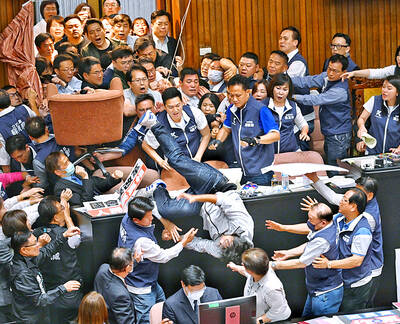
MUSICAL INTERLUDE: During the altercations, KMT Legislator Hsu Chiao-hsin at one point pulled out a flute and started to play the national anthem A massive brawl erupted between governing and opposition lawmakers in the main chamber of the legislature in Taipei yesterday over legislative reforms. President-elect William Lai (賴清德) is to be inaugurated on Monday, but his Democratic Progressive Party (DPP) lost its majority in the legislature and the Chinese Nationalist Party (KMT) has been working with the Taiwan People’s Party (TPP) to promote their mutual ideas. The opposition parties said the legislative reforms would enable better oversight of the Executive Yuan, including a proposal to criminalize officials who are deemed to make false statements in the legislature. “The DPP does not want this to be
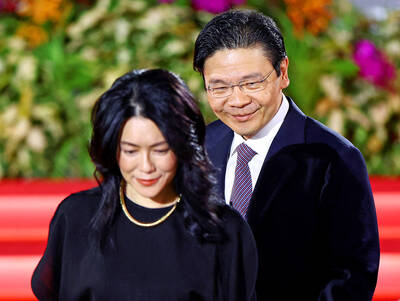
Singapore yesterday swore in Lawrence Wong (黃循財) as the city-state’s new prime minister in a ceremony broadcast live on television after Lee Hsien Loong (李顯龍) stepped down following two decades in office. Wong, formerly deputy prime minister, was inaugurated at the Istana government office shortly after 8pm to become the second person outside the Lee family to lead the nation. “I ... do solemnly swear that I will at all times faithfully discharge my duties as prime minister according to law, and to the best of my knowledge and ability, without fear or favor, affection or ill-will. So help me God,” the
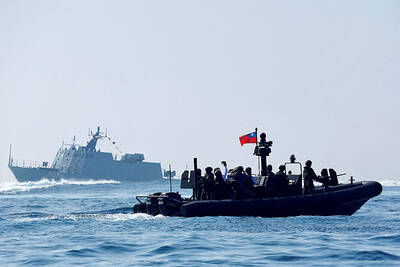
BASIC OPERATIONS: About half a dozen navy ships from both countries took part in the days-long exercise based on the Code for Unplanned Encounters at Sea An unpublicized joint military exercise between Taiwan and the US in the Pacific Ocean last month was carried out in accordance with an international code, the Ministry of National Defense (MND) said yesterday. According to a Reuters report citing four unnamed sources, the two nations’ navies last month conducted joint drills in the Western Pacific. The drills were not made public at the time, but “about half-a-dozen navy ships from both sides, including frigates and supply and support vessels, participated in the days-long exercises,” Reuters reported, citing the sources. The drills were designed to practice “basic” operations such as communications, refueling and resupplies,

‘TOO LATE’: Yu Pei-chen, a Taoyuan councilor and ex-army general, said the Chinese officials were 41 years late in imposing sanctions on him, as he enlisted in 1983 China’s Taiwan Affairs Office (TAO) yesterday announced sanctions against five Taiwanese politicians, pundits and public figures critical of Beijing, accusing them of spreading disinformation about China. The five are: Liu Bao-jie (劉寶傑), Lee Zheng-hao (李正皓), Wang Yi-chuan (王義川), Yu Pei-chen (于北辰), Huang Shih-tsung (黃世聰), TAO spokesman Chen Binhua (陳斌華) told a routine news briefing, adding that the sanctions included their families. They were responsible for making up and spreading false information about China that “deceived some Taiwanese, sowed division ... and harmed brotherly goodwill across the Strait,” Chen said. Speech is not free from the regulations of Chinese law, which punishes manufacturing incorrect


 RSS
RSS