


A veteran supporter of cross-strait exchanges has been arbitrarily detained in China for 420 days, sources told the Liberty Times (the sister newspaper of the Taipei Times) yesterday.
The case was revealed by Shih Chien University chair professor Chiang Min-chin (江岷欽) on Jaw Shaw-kong’s (趙少康) political talk show on Thursday evening, when he said that Southern Taiwan Union of Cross-strait Relations Associations chairman Tsai Chin-shu (蔡金樹) is being detained at a prison in China’s Fujian Province.
Tsai is allegedly being held on charges relating to state security, Chiang said, citing sources in China.
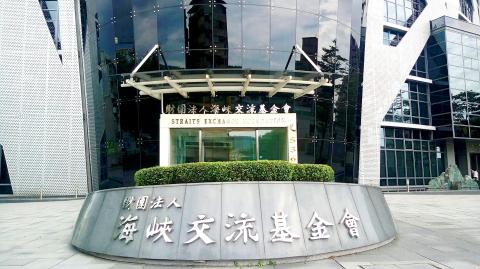
Photo: Chung Li-hua, Taipei Times
After investigating the claim, the Liberty Times reported that Tsai has been in detention for 420 days.
Sources with knowledge of the matter said that Tsai was allegedly detained by state security officers on July 22 last year while awaiting a connecting flight in Xiamen.
The sources added that they had not been able to obtain information about Tsai’s situation other than that he is “safe.”
The Straits Exchange Foundation yesterday said that Tsai’s family members had contacted the foundation for help in August last year and that it immediately sent a letter to its Chinese counterpart, the Association for Relations Across the Taiwan Straits, to inquire about Tsai’s whereabouts, but that it has not received any concrete response.
Chiang said that Tsai, who he has known since they were students together, is “as blue as can be,” referring to his support for the Chinese Nationalist Party (KMT).
“However, he has been jailed all the same. Whether you are in the pan-blue or pan-green camp, everyone is in danger amid the backsliding in cross-strait relations and lack of mutual judicial assistance,” Chiang said.
Tsai, 60, holds a master’s degree in political science from National Sun Yat-sen University and a doctorate from Xiamen University’s Graduate Institute for Taiwan Studies.
He is also chairman of the Kaohsiung Association for Research on Cross-Strait Relations and taught at the Fortune Institute of Technology, among other schools.
He has been promoting cross-strait exchanges for more than 20 years.
Members of Tsai’s family have said they hope that the government would help bring him back to Taiwan.
Meanwhile, the family of Morrison Lee (李孟居) yesterday published an open letter, in which they expressed the hope that Chinese authorities would soon complete their investigation against him so that he could return home.
Lee, 44, went missing in Shenzhen after attending an Aug. 18 anti-extradition bill rally in Hong Kong.
China’s Taiwan Affairs Office on Wednesday confirmed that Lee is under investigation on suspicion of engaging in criminal activity harmful to national security.
The letter said that the family would send a lawyer to visit Lee on their behalf to learn about the charges he is facing.
It also expressed the hope that family members could visit Lee and urged the Chinese authorities to grant the request.
The family said it had not asked any individual or political party to speak about the case on its behalf and that media reports about the case do not represent their stance on the matter.
The family said that it did not want “political factors” making Lee’s situation any more difficult.
Additional reporting by CNA

‘NO SECURITY RISK’: The Railway Bureau reassured the public that the technicians’ activities were limited to technical guidance and did not involve sensitive systems The Railway Bureau yesterday said it had invited eight Chinese technicians to assist with an airport MRT construction project. The bureau issued the confirmation after an Internet user said Chinese nationals had entered the construction zone of Taiwan Taoyuan International Airport’s Terminal 3 project. They asked why “individuals from an enemy state” were allowed access to such a major national infrastructure project, which raised serious concerns over Taiwan’s industrial safety, sensitive systems and information security. The bureau’s Northern Region Engineering Branch Office said subcontractor Taiwan Handle Industrial Co (台灣手把工業) of the Taoyuan airport MRT’s “Contract No. CU05 Project A14 Station Civil, MEP &
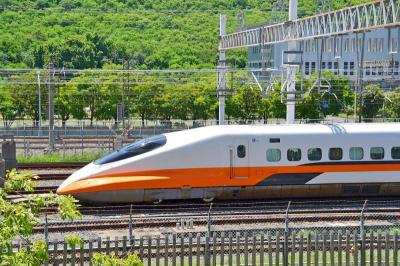
A signaling system malfunction disrupted high-speed rail (HSR) services beginning at 8am today, with trains temporarily reduced to three northbound and three southbound trains per hour as authorities conduct inspections. The malfunction occurred on a section of track in Miaoli County during pre-operation checks early this morning, forcing northbound and southbound trains to use a single track, the HSR operator said. The regular schedule has been replaced with three hourly trains offering only nonreserved seating in each direction, stopping at every station, it said, adding that business class cars would still have reserved seating. Departures from terminal stations are scheduled at the top
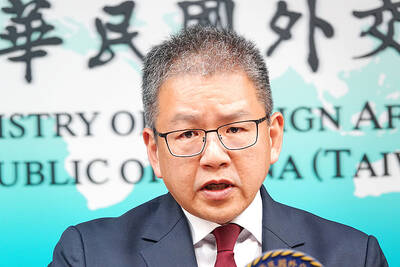
Taiwan is still in the process of assessing the possibility of recruiting workers from Eswatini, the Ministry of Foreign Affairs said yesterday, adding that its goal is to help Eswatini upgrade its vocational training centers. If there are plans to recruit workers from Eswatini, safeguarding national security, protecting public health and ensuring the employment rights of Taiwanese would be prerequisites, Department of West Asian and African Affairs Director-General Yen Chia-liang (顏嘉良) told a news conference. Key considerations would also include filling labor shortages in specific industries, and fostering bilateral professional and technical exchanges, he said. Yen was asked about the progress of labor

A US uncrewed surface vessel (USV) encountered multiple Chinese warships during an autonomous transit of the Taiwan Strait, US defense company Seasats said in a statement on Wednesday. Seasats announced that a Lightfish USV had completed the first autonomous transit of the Taiwan Strait. Over five days, the USV traversed the entire length of the Strait while constantly monitoring surface vessel traffic, the company said. The Lightfish encountered multiple Chinese warships, one of which was a Chinese People’s Liberation Army Navy (PLAN) Type 056 corvette, it said. The Chinese vessels were operating “well within Taiwan’s exclusive economic zone without transmitting their identity via the


 RSS
RSS