


A redesigned national identification card has been endorsed by Premier Su Tseng-chang (蘇貞昌) and is to be presented at a meeting of the Executive Yuan today for official approval, a source said yesterday.
The new version is to feature the Republic of China flag and was designed to better protect personal information, the source said, adding that it has an embedded chip to make it more difficult to forge.
Whether to include the flag was a subject of debate between Minister of the Interior Hsu Kuo-yung (徐國勇) and Chinese Nationalist Party (KMT) Legislator Huang Chao-shun (黃昭順) in March during a discussion of the redesign.
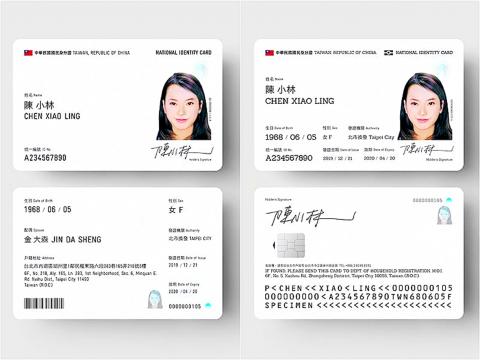
Screengrab from the Ministry of the Interior Web site
The cost of replacing existing national ID cards was estimated at NT$400 million (US$12.8 million), the source said, adding that the chip would enable the new card to provide more functionality.
Visually, the new card is to display significantly less personal information, showing only the cardholder’s name, birth date, marital status and card number, the source said.
“Republic of China (Taiwan) Identity Card” is to be prominently displayed at the top of the front face, along with the Chinese characters for “Republic of China national identification card,” they said.
The left side of the front face is to feature the cardholder’s name and birth date in Chinese and English, as well as their ID card number, with their picture on the right side above a reflective outline of Taiwan, the source said.
The back of the card would display marital status, as well as the issuance and expiration dates, they said.
The source said that the card is to provide eight new benefits: easy identification of real and forged cards through a key system that could also be interfaced over the Internet; the ability to link to other information over the Internet, such as health insurance and driver’s license records; the capacity to register for services electronically at a kiosk or online to reduce paper consumption and improve efficiency; better protection of personal information through encrypted electronic storage; quick access to personal records protected by a password; access to smart government services for better interaction; an anti-forgery system that includes hardware and software components; and reduced cost and risk for entrepreneurs.

LEVERAGE: China did not ‘need to fire a shot’ to deny Taiwan airspace over Africa when it owns ‘half the continent’s debt,’ a US official said, calling it economic warfare The EU has raised concerns about overflight rights following the delay of President William Lai’s (賴清德) planned state visit to the Kingdom of Eswatini after three African nations denied overflight clearance for his charter at the last minute. Taiwanese allies Paraguay and Saint Kitts and Nevis, as well as several US lawmakers and the Inter-Parliamentary Alliance on China (IPAC) condemned China for allegedly pressuring the countries. Lai was scheduled to fly directly to Taiwan’s only African ally from yesterday to Sunday to celebrate the 40th anniversary of King Mswati III’s accession and his 58th birthday, but Seychelles, Mauritius and Madagascar suddenly revoked

The number of pet cats in Taiwan surpassed that of pet dogs for the first time last year, reaching 1,742,033, a 32.8 percent increase from 2023, the Ministry of Agriculture said yesterday, citing a survey. By contrast, the number of pet dogs declined slightly by 1.2 percent over the same period to 1,462,528, the ministry said. Despite the shift, households with dogs still slightly outnumber those with cats by 1.2 percent. However, while the number of households with multiple dogs has remained relatively stable, households keeping more than two cats have increased, contributing to the overall rise in the feline population. The trend
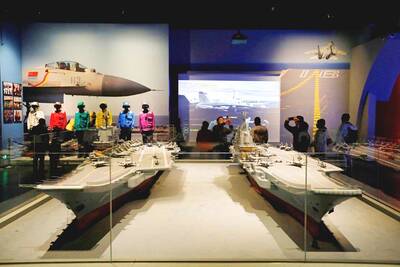
China on Wednesday teased in a video an aircraft carrier that could be its fourth, and the first using nuclear power, while making an allusion to Taiwan and vowing to further build up its islands, as it looks to boost maritime power, secure resources and bolster territorial claims. The video, issued on the eve of the 77th founding anniversary of the Chinese People’s Liberation Army Navy, featured fictional officers with names that are homophones of three commissioned aircraft carriers, the Liaoning (遼寧), Shandong (山東) and Fujian (福建). Titled Into the Deep, it showed a 19-year-old named “Hejian” (何劍) joining the group, sparking
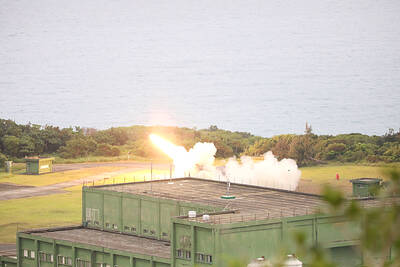
Taiwan has signed six arms procurement offers from the US totaling more than NT$208 billion (US$6.59 billion) covering long-range precision strike systems, missile stockpile replenishment and joint production of large-caliber ammunition, the Ministry of National Defense said yesterday. The government’s proposed NT$1.25 trillion special defense budget has been stalled in the Legislative Yuan as opposition lawmakers question the amount and procurement items, while the Presidential Office and defense ministry say that the full amount is necessary to safeguard Taiwan. Minister of National Defense Wellington Koo (顧立雄) on Monday briefed the legislature’s Foreign Affairs and National Defense Committee on the defense budget for


 RSS
RSS