


The Taoyuan Flight Attendants’ Union and EVA Airways (長榮航空) yesterday signed an agreement to end a strike at midnight on Tuesday.
Union president Chao Kang (趙剛) and EVA chairman Steve Lin (林寶水) signed the agreement at the Taoyuan City Government, after Minister of Labor Hsu Ming-chun (許銘春) and Taoyuan Mayor Cheng Wen-tsan (鄭文燦) mediated talks.
Airline officials and union representatives at 2pm resumed negotiations for the third time as the strike entered its 17th day after starting at 4pm on June 20.
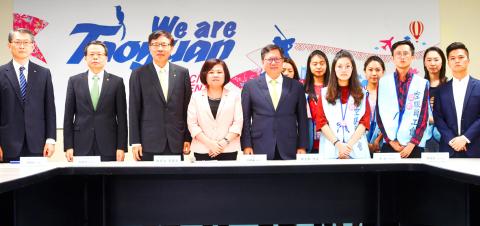
Photo: Fang Pin-chao, Taipei Times
A preliminary understanding of the agreement was that it was roughly based on the terms and conditions proposed by EVA on June 28, which a majority of the union’s members had voted in favor of, except for a few changes in language and an increase to the number of people the union would appoint as directors or supervisors on the firm’s board from 11 to 13.
Other terms in the June 28 version of the agreement include a pledge by the company not to take action against strikers and to cooperate with the union to end the strike; the provision of a bonus of NT$300 to NT$500 per trip; and to allow flight attendants to rest overnight on flights BR198 and BR108, which fly to Tokyo, from October to March, and on flight BR716 to Beijing from April to August, excluding May.
EVA would also host monthly employer-employee meetings; a quarterly board of directors’ or general manager’s meeting; and semi-annual reviews of duty rosters and work arrangements on regular, predetermined dates, it says.
A personnel evaluation committee would include five elected instructors, who would take turns; one coevaluator with the right to speak and vote; and one serving flight attendant to accompany the person being evaluated, it states.
The union’s board appointees would be entitled to 25 annual paid leave days for their participation and would have the company’s cooperation in arranging their schedules, the agreement says.
Meanwhile, the union described as a breakthrough EVA dropping Articles 1, 2 and 5 from its list of demands in the so-called “peace agreement.”
Article 1 said that union members should not “bully, discriminate or criticize” company employees, and refrain from making comments or taking actions that are “illegal or otherwise inappropriate.”
Article 2 would have banned the union from spreading “untrue comments” or “speaking against” the company, executives or shareholders or risk a NT$500,000 fine, with each union member’s remarks counted separately toward calculating the fine.
Article 5 would have required the union to give a 30-day notice prior to beginning a strike during the agreement’s stipulated effective period, or “shoulder all costs, including criminal consequences.”
The union also agreed not to call a strike in the next three years as long as EVA takes no action against its members for having taken part in the latest strike and to return within the next three days passports, Mainland Travel Permits for Taiwan Residents and EVA employee identification cards to striking members.
EVA later issued a statement apologizing to the public for the inconvenience and social disturbance the strike had caused.
As the union’s commitment not to go on strike for the next three years eliminated the need for advance notice of a strike and workplace bullying is already illegal, the company does not see the agreement as a concession, EVA attorney Chen Yi-hsuan (沈以軒) said.
As of yesterday, the strike had resulted in the cancelation of 1,439 flights and affected 278,420 travelers, the Ministry of Transportation and Communication said.
EVA’s transportation capacity dipped to a low of about 40 percent at the beginning of the strike before recovering to 60 to 70 percent, it said.
Travel agents and EVA have reached a settlement to cover the former’s financial losses, while individual travelers delayed for more than six hours are to receive compensation for additional lodging, dining and transportation costs of no more than US$250, it added.

Japan has deployed long-range missiles in a southwestern region near China, the Japanese defense minister said yesterday, at a time when ties with Beijing are at their lowest in recent years. The missiles were installed in Kumamoto in the southern region of Kyushu, as Japan is attempting to shore up its military capacity as China steps up naval activity in the East China Sea. “Standoff defense capabilities enable us to counter the threat of enemy forces attempting to invade our country ... while ensuring the safety of our personnel,” Japanese Minister of Defense Shinjiro Koizumi said. “This is an extremely important initiative for
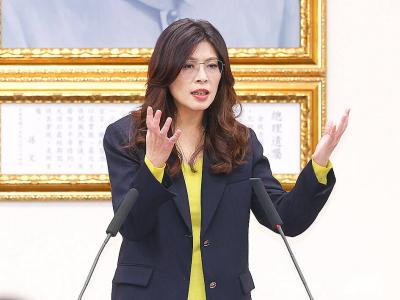
Chinese Nationalist Party (KMT) Chairwoman Cheng Li-wun (鄭麗文) today accepted an invitation from Chinese President Xi Jinping (習近平) to lead a delegation to China next month, saying she hopes to promote the peaceful development of cross-strait relations and bring stability to the Taiwan Strait. “I am grateful and happy to accept this invitation,” Cheng said in a statement from the KMT chairperson’s office. Cheng said she hopes both sides can work together to promote the peaceful development of cross-strait relations, enhance exchange and cooperation, bring stability to the Taiwan Strait and improve people’s livelihoods. At today's news conference, Cheng said any efforts to

MORE POPULAR: Taiwan Pass sales increased by 59 percent during the first quarter compared with the same period last year, the Tourism Administration said The Tourism Administration yesterday said that it has streamlined the Taiwan Pass, with two versions available for purchase beginning today. The tourism agency has made the pass available to international tourists since 2024, allowing them to access the high-speed rail, Taiwan Railway Corp services, four MRT systems and four Taiwan Tourist Shuttles. Previously, five types of Taiwan Pass were available, but some tourists have said that the offerings were too complicated. The agency said only two types of Taiwan Pass would be available, starting from a three-day pass with the high-speed rail and a three-day pass with Taiwan Railway Corp. The former costs NT$2,800

The nation’s fastest supercomputer, Nano 4 (晶創26), is scheduled to be launched in the third quarter, and would be used to train large language models in finance and national defense sectors, the National Center for High-Performance Computing (NCHC) said. The supercomputer, which would operate at about 86.05 petaflops, is being tested at a new cloud computing center in the Southern Taiwan Science Park in Tainan. The exterior of the server cabinet features chip circuitry patterns overlaid with a map of Taiwan, highlighting the nation’s central position in the semiconductor industry. The center also houses Taiwania 2, Taiwania 3, Forerunner 1 and


 RSS
RSS