


Opposition to China’s “one country, two systems” framework is “the most important Taiwan consensus,” President Tsai Ing-wen (蔡英文) said yesterday.
Tsai made the remarks at a meeting with Nauruan President Baron Divavesi Waqa at the Presidential Office Building in Taipei.
Taiwanese oppose the “one country, two systems” framework, a stance also shared by the ruling and opposition parties, Tsai said.
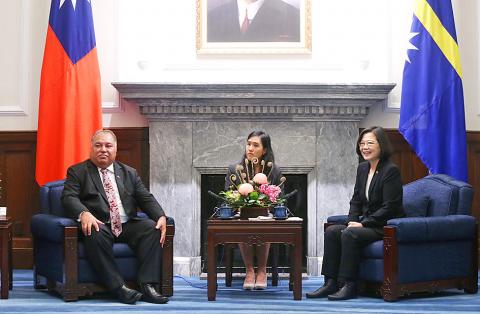
Photo: CNA
“Rejection of the ‘one country, two systems’ framework is the most important ‘Taiwan consensus’ of this year,” she said.
Taiwan also believes that sitting down for a discussion is the best way to solve a problem, Tsai said, adding that talks with China should occur with no political preconditions.
Taiwan would work with international partners with similar ideologies and contribute to the world based on this belief, she added.
Separately, Dr She for Democracy, a group of more than 800 pro-democracy female doctors, bought half-page ads on the front pages of yesterday’s editions of the Chinese-language Liberty Times (the sister newspaper of the Taipei Times) and Apple Daily in support of Tsai.
The ad, which featured a pink background, read: “Defend Taiwan’s democracy. We support President Tsai Ing-wen.”
It was signed “810 female doctors from all over Taiwan” and listed their names.
The group said on Facebook that it strongly believes that Taiwan’s democratic values and sovereignty are worthy of the attention and protection of everyone who lives in the nation.
It said that the greatest wish of its members as doctors, mothers, daughters, sisters and wives is for their elders to live peacefully and for their children to grow up happily.
However, recent upheaval and the spread of fake news have aroused their concern, it said, adding that they feel threatened by Chinese President Xi Jinping’s (習近平) remarks and Beijing’s alleged efforts to conceal information about African swine fever.
The group was referring to Xi on Wednesday last week saying in a speech that China is willing to talk with any party in Taiwan to push forward the political process as long as it accepts the “one China” principle.
China “will not renounce the use of force or give up the option to use all necessary measures” to serve that end and crack down on Taiwanese independence, he said.
As democracy is a worldwide trend and universal value, the group said that it was willing to join the international community in defending the values and dignity of democracy, adding that Tsai has expressed their views clearly with her insistence on Taiwan’s sovereignty.
Netizens praised and thanked the group for its comments.
One netizen called the group’s statement a display of the “Taiwanese spirit,” while another said that they were almost moved to tears.
In related news, the edition of the Ministry of National Defense Political Warfare Bureau’s weekly publication Our Voice released on Monday said that Xi’s speech was filled with contradictions and contained traces of the Chinese Communist Party’s (CCP) “united front” tactics.
The political goal hidden behind the concepts of “one country, two systems,” “peaceful unification” and “integrated development” is to carry out unification according to the CCP’s wishes, it added.
Military personnel should recognize that adopting a “one country, two systems” framework would mean destroying the Republic of China, and defend the freedom, democracy and sovereignty of the nation’s 23 million people, it said.
Additional reporting by Aaron Tu

The National Chungshan Institute of Science and Technology yesterday showcased its locally developed variants of the Vision 60 robotic patrol dog, which it plans to deploy on the nation’s outlying territories in the South China Sea. The variants were produced under the Joint Lab project — created by the institute and domestic companies — and assembled with domestically produced motors, lenses and artificial intelligence (AI) systems alongside licensed tech from the US, Missile and Rocket Systems Research Division deputy director Jen Kuo-kang (任國光) told the media event at a military base in Taipei’s Dazhi (大直) area. Taiwan has built up its strengths

RIGHT DIRECTION: Taiwan’s efforts to prevent forced labor include a proposal to ‘fully prohibit’ employers from withholding workers’ documents, an official said Taiwan is to establish a mechanism to restrict imports of goods linked to forced labor, the Executive Yuan said yesterday, after the US proposed imposing additional tariffs on Taiwanese goods over labor concerns. “The Ministry of Labor and the Ministry of Economic Affairs are to establish an interministerial review procedure,” Executive Yuan spokesperson Michelle Lee (李慧芝) said at a news briefing in Taipei. “The government is to use the Foreign Trade Act [貿易法] as the legal basis to restrict imports of goods produced with forced labor” and bring its supply chain governance more in line with international standards on human rights, resilience

NOT IMMEDIATE: Taiwan has a chance to appeal the proposed 10 percent tariff before it starts, while other countries face a 12.5 percent tariff from the trade office Taiwan is among 60 economies determined by the US to have failed to impose or enforce a ban on the importation of goods produced with forced labor, according to a notice released on Tuesday by the Office of the US Trade Representative (USTR), which proposed imposing an additional 10 percent or more tariff on them. The USTR in a statement said that following an investigation, it had determined under Section 301 of the Trade Act of 1974 that the failure of the 60 economies to impose and effectively enforce a prohibition on the importation of goods produced with forced labor is
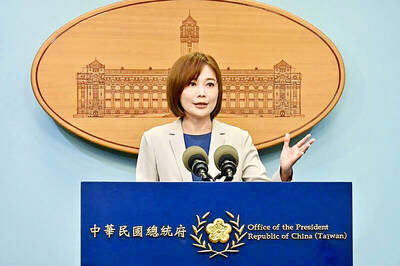
TIT-FOR-TAT: The US allegedly revoked the visa of a Chinese national working at Xinhua News Agency in the US in response to Beijing’s expulsion of Vivian Wang The Presidential Office yesterday condemned China for expelling a New York Times correspondent from Beijing following the newspaper’s interview with President William Lai (賴清德), saying the move highlighted Beijing’s suppression of press freedom and its threat to international news media. Taiwan has noted a series of recent incidents in which Beijing used similar tactics to “threaten and pressure international media outlets and journalists,” Presidential Office spokeswoman Karen Kuo (郭雅慧) said in a statement. “This concerns not only press freedom and freedom of expression, but also the safety of journalists, and Taiwan and relevant partners are paying close attention to the situation,” she


 RSS
RSS