


President Tsai Ing-wen (蔡英文) on Monday urged European nations to support liberal, democratic Taiwan at a time when a rising China is affecting the global landscape.
In a recorded speech at a seminar held at the European Parliament in Brussels, Tsai said China is undermining the “status quo” across the Taiwan Strait and its rapid rise is changing the global order in place since the end of World War II.
At the opening of the Taiwan-sponsored seminar titled “China Factor: Resistance is Futile? — Taiwan as a Case Study,” Tsai said in a video that Taiwan is aware of the challenges posed by China and that its actions have “not served to drive Taiwan to Beijing, but encouraged us to look at where our friends and partners are, in countries that share our values and interests.”
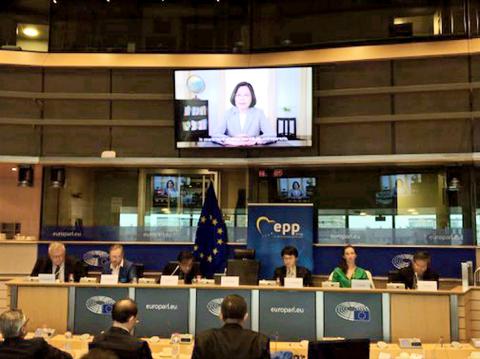
Photo: CNA
Since 2016, China has stepped up its pressure on democratic Taiwan and tried hard to squeeze its economy and international space, Tsai said.
China has been working to destabilize Taiwan and undermine Taiwanese trust in the nation’s democratic institutions, she said.
However, China’s actions have only strengthened Taiwan’s resolve that freedom and democracy, not fear, would continue to determine the future of the nation’s 23 million people, she said.
“At this critical juncture in human history, Taiwan understands, better than any country in the world, how important it is that those values survive,” Tsai said. “As a small democracy trying to engage with the world’s most powerful non-democratic country, Taiwan is resilient and determined to safeguard our precious democracy.”
However, these challenges are not for Taiwan alone and the nation is seeking support from friends and partners that share the same values, she said.
“We do need your support. A liberal democratic order can only survive if like-minded countries, including our European partners, work together for the greater good,” she said. “I’m calling on all like-minded countries to display the same spirit that led to the founding of a union across Europe in 1951: the clear-eyed sense that only by coming together can we protect our values and our future,” she said.
The speech, which lasted about 4 minutes, 30 seconds, received plenty of applause from the audience at the seminar, which was hosted by the European Federation of Taiwanese Associations.
In response to Tsai’s speech, Ivan Stefanec, a Slovak member of the European Parliament, said the EU and Taiwan have forged close ties and that the union should pay more attention to democratic development in Taiwan and Asia.
He called for more exchanges between Taiwan and the EU in economics, education and culture.
Stefanec, who has visited Taiwan several times and is familiar with cross-strait relations, said China’s rise is a very important issue not only in global economics, but also in international politics, so the EU needs to keep an eye on the latest developments.

NO-LIMITS PARTNERSHIP: ‘The bottom line’ is that if the US were to have a conflict with China or Russia it would likely open up a second front with the other, a US senator said Beijing and Moscow could cooperate in a conflict over Taiwan, the top US intelligence chief told the US Senate this week. “We see China and Russia, for the first time, exercising together in relation to Taiwan and recognizing that this is a place where China definitely wants Russia to be working with them, and we see no reason why they wouldn’t,” US Director of National Intelligence Avril Haines told a US Senate Committee on Armed Services hearing on Thursday. US Senator Mike Rounds asked Haines about such a potential scenario. He also asked US Defense Intelligence Agency Director Lieutenant General Jeffrey Kruse

NOVEL METHODS: The PLA has adopted new approaches and recently conducted three combat readiness drills at night which included aircraft and ships, an official said Taiwan is monitoring China’s People’s Liberation Army (PLA) exercises for changes in their size or pattern as the nation prepares for president-elect William Lai’s (賴清德) inauguration on May 20, National Security Bureau (NSB) Director-General Tsai Ming-yen (蔡明彥) said yesterday. Tsai made the comment at a meeting of the Legislative Yuan’s Foreign Affairs and National Defense Committee, in response to Democratic Progressive Party (DPP) Legislator Wang Ting-yu’s (王定宇) questions. China continues to employ a carrot-and-stick approach, in which it applies pressure with “gray zone” tactics, while attempting to entice Taiwanese with perks, Tsai said. These actions aim to help Beijing look like it has
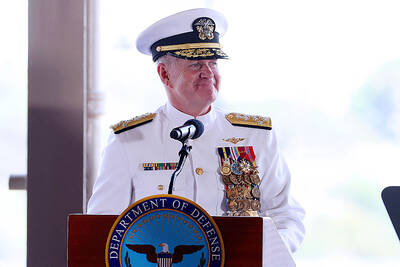
China’s intrusive and territorial claims in the Indo-Pacific region are “illegal, coercive, aggressive and deceptive,” new US Indo-Pacific Commander Admiral Samuel Paparo said on Friday, adding that he would continue working with allies and partners to keep the area free and open. Paparo made the remarks at a change-of-command ceremony at Joint Base Pearl Harbor-Hickam in Hawaii, where he took over the command from Admiral John Aquilino. “Our world faces a complex problem set in the troubling actions of the People’s Republic of China [PRC] and its rapid buildup of forces. We must be ready to answer the PRC’s increasingly intrusive and

INSPIRING: Taiwan has been a model in the Asia-Pacific region with its democratic transition, free and fair elections and open society, the vice president-elect said Taiwan can play a leadership role in the Asia-Pacific region, vice president-elect Hsiao Bi-khim (蕭美琴) told a forum in Taipei yesterday, highlighting the nation’s resilience in the face of geopolitical challenges. “Not only can Taiwan help, but Taiwan can lead ... not only can Taiwan play a leadership role, but Taiwan’s leadership is important to the world,” Hsiao told the annual forum hosted by the Center for Asia-Pacific Resilience and Innovation think tank. Hsiao thanked Taiwan’s international friends for their long-term support, citing the example of US President Joe Biden last month signing into law a bill to provide aid to Taiwan,


 RSS
RSS