


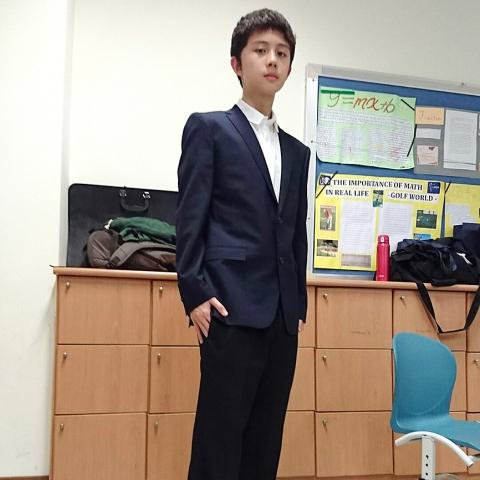
Taiwanese student Sun An-tso (孫安佐), accused of threatening to carry out a shooting at his suburban Philadelphia high school, on Tuesday pleaded guilty to a federal firearms charge, with a sentence due to be delivered in December.
Sun, 18, was arraigned in federal court, where he entered the guilty plea.
District Judge Nitza Quinones Alejandro scheduled sentencing for Dec. 11, but Sun’s attorney, Robert Keller, asked that the date be moved up once the pre-sentencing report is finished.
Screengrab from Facebook
According to a court statement, the plea deal was reached last week, with Sun agreeing to forgo his right to a grand jury and defend himself in court. He also agreed to be deported and to not re-enter the US without permission.
Sun on June 4 plead guilty in Delaware County Court to the state’s charges of making “terroristic threats” in exchange for having a “possession of an instrument of crime” charge dropped. He was sentenced to four to 23 months, but was immediately paroled and remanded to federal custody to face a charge of an alien in possession of ammunition.
Quinones could sentence Sun to up to 10 years in prison and up to US$250,000 in fines.
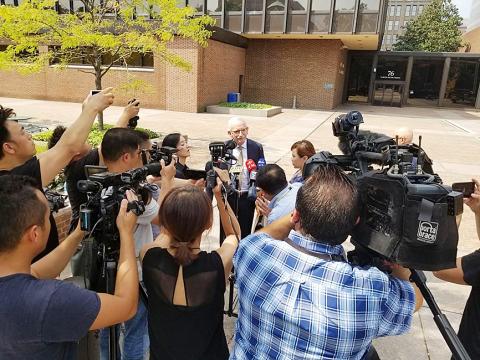
Photo: Retaken from Delaware County Daily Times, Chung Chih-kai, Taipei Times
Keller said after court on Tuesday that he hopes to show up for the sentencing hearing with a plane ticket.
As long as Sun’s parents produce an airplane ticket for him in court when the sentence is announced, he will be escorted by US marshals to an airport on the judge’s order, without having to go through the Immigration and Customs Enforcement agency’s time-consuming procedures, Keller said.
“That’s going to be the mantra, the cry, when he gets to sentencing. Let this boy go home,” he said.
Sun was arrested on March 26 after school authorities were told he had talked about a May 1 shooting at Monsignor Bonner and Archbishop Prendergast High School in Upper Darby, west of Philadelphia. He called the talk a joke, but authorities found weapons and more than 1,600 rounds of ammunition in the home where he was staying.
Keller on Tuesday objected to the US Attorney’s office including the allegation that Sun had told a classmate not to come to school on May 1 because he was planning a shooting.
The judge overruled his objection, but Keller said that he would raise it again during sentencing. He accused prosecutors of “going overboard” in trying to prove their case.
Keller said Sun’s parents, actor and film director Sun Peng (孫鵬) and actress Di Ying (狄鶯), were in Philadelphia and had been visiting their son weekly, but chose not to go to court on Tuesday to try to remove some of the spotlight from their son.
“I think the huge mistake that this young child made was he didn’t understand the dynamics of what’s going on in the United States,” Keller said after court. “He now gets it ... and it’s time for this kid to go home.”
In his office’s statement on Tuesday, US Attorney William McSwain held Sun’s parents liable.
“It should be obvious that no child should be stockpiling an arsenal — or have any access to firearms or other dangerous weapons — without their parents’ or guardians’ knowledge,” he said. “Every parent needs to be involved and actively aware of what is going on in their child’s life.”
Additional reporting by CNA
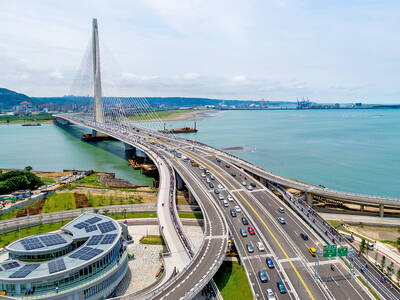
The Ministry of Transportation and Communications yesterday inaugurated the Danjiang Bridge across the Tamsui River in New Taipei City, saying that the structure would be an architectural icon and traffic artery for Taiwan. Feted as a major engineering achievement, the Danjiang Bridge is 920m long, 211m tall at the top of its pylon, and is the longest single-pylon asymmetric cable-stayed bridge in the world, the government’s Web site for the structure said. It was designed by late Iraqi-British architect Zaha Hadid. The structure, with a maximum deck of 70m, accommodates road and light rail traffic, and affords a 200m navigation channel for boats,

Taiwan Semiconductor Manufacturing Co (TSMC, 台積電), the world’s largest foundry service provider, yesterday said that global semiconductor revenue is projected to hit US$1.5 trillion in 2030, after the figure exceeds US$1 trillion this year, as artificial intelligence (AI) demand boosts consumption of token and compute power. “We are still at the beginning of the AI revolution, but we already see a significant impact across the whole semiconductor ecosystem,” TSMC deputy cochief operating officer Kevin Zhang (張曉強) said at the company’s annual technology symposium in Hsinchu City. “It is fair to say that in the past decade, smartphones and other mobile devices were
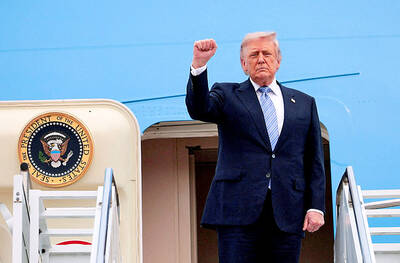
US-CHINA SUMMIT: MOFA welcomed US reassurance of no change in its Taiwan policy; Trump said he did not comment when Xi talked of opposing independence US President Donald Trump yesterday said he has not made a decision on whether to move forward with a major arms package for Taiwan after hearing concerns about it from Chinese President Xi Jinping (習近平). Trump’s comments on Taiwan came as he flew back to Washington after wrapping up critical talks in which both leaders said important progress was made in stabilizing US-China relations even as deep differences persist between the world’s two biggest powers on Iran and Taiwan. “I will make a determination,” Trump said, adding: “I’ll be making decisions. But, you know, I think the last thing we need right
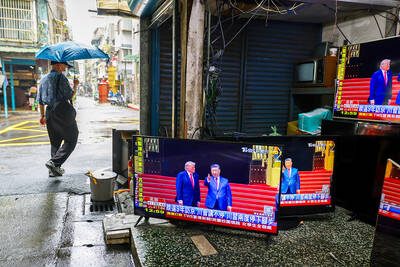
TAIWAN ISSUE: US treasury secretary Scott Bessent said on the first day of meetings that ‘it wouldn’t be a US-China summit without the Taiwan issue coming up’ There were no surprises on the first day of the summit between US President Donald Trump and Chinese President Xi Jinping (習近平), the Mainland Affairs Council (MAC) said yesterday, as the government reiterated that cross-strait stability is crucial to the Asia-Pacific region, as well as the world. As the two presidents met for a highly anticipated summit yesterday, Chinese state media reported that Xi warned Trump that missteps regarding Taiwan could push their two countries into “conflict.” Trump arrived in China with accolades for his host, calling Xi a “great leader” and “friend,” and extending an invitation to visit the White House


 RSS
RSS