


More than 40 percent of the public believes that the Democratic Progressive Party’s (DPP) candidates will win in November’s mayoral and county commissioner elections, a poll published yesterday by the Taiwan NextGen Foundation showed.
According to the survey, 45.3 percent believe that the DPP’s candidates will win in the Nov. 24 nine-in-one elections, while 49.1 percent think that the party will win the majority of seats across the nation.
The poll showed that overall, 65.1 percent of respondents are satisfied with the administrative performance of the mayor or commissioner in their city or county of residence, while 24.8 percent are dissatisfied.
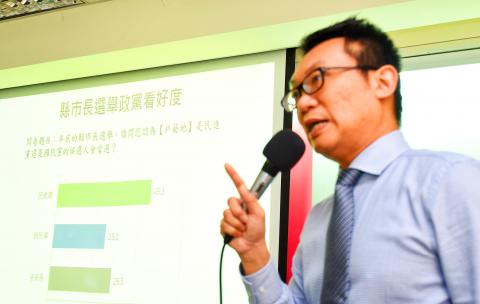
Photo: Liu Hsin-de, Taipei Times
The highest average satisfaction rate of 67.1 percent was in cities or counties that have a DPP member as an administrative head, followed by 63 percent in areas with a Chinese Nationalist Party (KMT) head and 60.4 percent in areas with an independent head.
Asked about their voting preference, about 35.9 percent said they would consider voting for the DPP’s candidate, while 27.6 percent said they would consider the KMT’s candidate first.
However, 25.2 percent said they believe the KMT’s candidate will win.
A cross-analysis of the data showed that more than 41 percent intended to support the party that the mayor or commissioner of their city or county of residence is a member of.
In areas with independent administrative heads — Taipei and Hualien and Kinmen counties, the party support rates showed a fairly even distribution among the DPP (24.6 percent), the KMT (25.7 percent) and independents (24.5 percent).
The survey found that 33.6 percent would prefer voting for the DPP’s candidate, 28.5 percent for the KMT’s candidate and 4.9 percent would prefer independent candidates.
Former DPP spokeswoman Wu Pei-yi (吳沛憶), who is to run in the party’s primary for a city councilor seat in Taipei’s Zhongzheng (中正) and Wanhua (萬華) districts, said it seems that most people will vote for DPP or KMT candidates.
However, about 8.4 percent of respondents said they would support third-party or independent candidates in the councilor elections and this combined force might have a big influence on the councilors’ votes, she said, adding that many of the candidates are aged between 25 and 35 and have entered politics through the Sunflower movement.
Foundation chairman Wang Zhin-sheng (王智盛) said that nearly 30 percent of pan-green camp supporters were unwilling to name their preferred party in the election, which might indicate that they are waiting to see the DPP’s nominee for the Taipei mayoral election.


RESILIENCE: Taiwan plays a key role in semiconductors, energy, information infrastructure and advanced manufacturing, AIT Director Raymond Greene said Taiwan’s continued investment in deterrence and resilience remains vital, especially in uncrewed systems and other emerging technologies, American Institute in Taiwan (AIT) Director Raymond Greene said yesterday. Greene made the remarks at the annual National Strategic Summit on Supply Chain Resilience held by the Research Institute for Democracy, Society and Emerging Technology (DSET), a government-backed think tank. As Taiwan last year became the US’ fourth-largest trading partner and supply chain security is becoming more important, cooperation in emerging technologies continues to deepen between the two countries, he said. The US is committed to accelerating innovation, building key infrastructure, strengthening cooperation

The National Chungshan Institute of Science and Technology yesterday showcased its locally developed variants of the Vision 60 robotic patrol dog, which it plans to deploy on the nation’s outlying territories in the South China Sea. The variants were produced under the Joint Lab project — created by the institute and domestic companies — and assembled with domestically produced motors, lenses and artificial intelligence (AI) systems alongside licensed tech from the US, Missile and Rocket Systems Research Division deputy director Jen Kuo-kang (任國光) told the media event at a military base in Taipei’s Dazhi (大直) area. Taiwan has built up its strengths

RIGHT DIRECTION: Taiwan’s efforts to prevent forced labor include a proposal to ‘fully prohibit’ employers from withholding workers’ documents, an official said Taiwan is to establish a mechanism to restrict imports of goods linked to forced labor, the Executive Yuan said yesterday, after the US proposed imposing additional tariffs on Taiwanese goods over labor concerns. “The Ministry of Labor and the Ministry of Economic Affairs are to establish an interministerial review procedure,” Executive Yuan spokesperson Michelle Lee (李慧芝) said at a news briefing in Taipei. “The government is to use the Foreign Trade Act [貿易法] as the legal basis to restrict imports of goods produced with forced labor” and bring its supply chain governance more in line with international standards on human rights, resilience
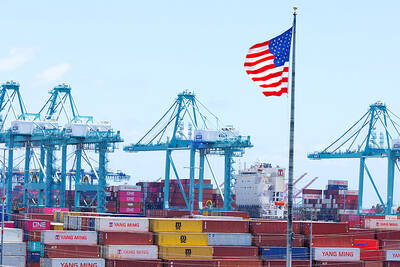
NOT IMMEDIATE: Taiwan has a chance to appeal the proposed 10 percent tariff before it starts, while other countries face a 12.5 percent tariff from the trade office Taiwan is among 60 economies determined by the US to have failed to impose or enforce a ban on the importation of goods produced with forced labor, according to a notice released on Tuesday by the Office of the US Trade Representative (USTR), which proposed imposing an additional 10 percent or more tariff on them. The USTR in a statement said that following an investigation, it had determined under Section 301 of the Trade Act of 1974 that the failure of the 60 economies to impose and effectively enforce a prohibition on the importation of goods produced with forced labor is


 RSS
RSS