


National Taiwan University (NTU) president-elect Kuan Chung-ming (管中閔) yesterday said the Ministry of Education must make a decision on his appointment by the end of the month.
Kuan, who was originally scheduled to take office on Feb. 1, has been embroiled in several scandals since word of his selection by the university’s election committee at the beginning of January.
While he was cleared of initial conflict of interest claims during the selection process and plagiarism complaints, he is now being investigated for potential breaches of the Classified National Security Information Protection Act (國家機密保護法).
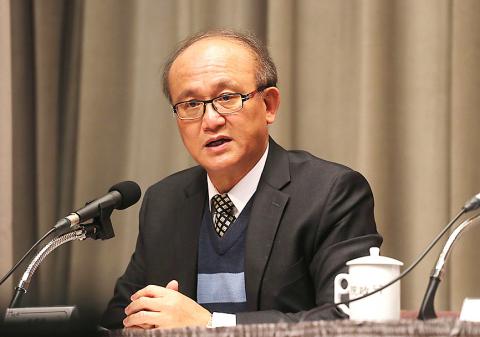
Photo: CNA
“It has been more than two-and-a-half months since NTU’s presidential election committee on Jan. 5 elected me as president and submitted a request to the ministry for my appointment,” Kuan said in a statement, asking the ministry to make a decision about his appointment by the end of the month.
Government agencies and the media have constantly been creating groundless and false allegations against him and the ministry has been shirking its responsibility, Kuan said.
Kuan’s statement came the same day that Minister of Justice Chiu Tai-san (邱太三) announced that the Taipei District Prosecutors’ Office has opened an investigation into Kuan’s alleged breaches of the act.
Web site newtalk.tw on Friday last week reported that Kuan has taught at several Chinese institutions since 2005, including Xiamen University, Xian Jiaotong University and Huazhong University of Science and Technology.
Local media have speculated that he went to China to teach without requesting approval from the government agencies he headed at the time, a requirement under the act, which stipulates that officials who have handled classified information must obtain approval before departing the nation within three years after retirement or resignation.
Kuan served as a minister without portfolio from 2012 to 2015, Council for Economic Planning and Development minister from 2013 to 2014 and National Development Council minister from 2014 to 2015.
Given that Article 26 of the act allows agencies to shorten the period for which approval must be requested, prosecutors are investigating whether Kuan contravened the act by teaching in China almost immediately after resigning from his National Development Council post.
Questions have also been raised about whether Kuan’s work for Chinese schools contravened other laws and regulations, including the Act Governing the Appointment of Educators (教育人員任用條例), the Act Governing Relations Between the People of the Taiwan Area and the Mainland Area (台灣地區與大陸地區人民關係條例) and the Principles Governing the Handling of Part-time Employment by Full-time Instructors at Public Schools of All Levels (公立各級學校專任教師兼職處理原則).
The ministry is to decide the Kuan issue after evaluating the outcome of the university’s school affairs meeting tomorrow, Deputy Minister of Education Lin Teng-chiao (林騰蛟) said yesterday.
Asked if the ministry plans to form a task force to probe claims that Kuan taught in China, Lin said that as Kuan is a full-time professor at NTU, it was the responsibility of the univerity’s personnel department to deal with the matter.

‘NO SECURITY RISK’: The Railway Bureau reassured the public that the technicians’ activities were limited to technical guidance and did not involve sensitive systems The Railway Bureau yesterday said it had invited eight Chinese technicians to assist with an airport MRT construction project. The bureau issued the confirmation after an Internet user said Chinese nationals had entered the construction zone of Taiwan Taoyuan International Airport’s Terminal 3 project. They asked why “individuals from an enemy state” were allowed access to such a major national infrastructure project, which raised serious concerns over Taiwan’s industrial safety, sensitive systems and information security. The bureau’s Northern Region Engineering Branch Office said subcontractor Taiwan Handle Industrial Co (台灣手把工業) of the Taoyuan airport MRT’s “Contract No. CU05 Project A14 Station Civil, MEP &

A US uncrewed surface vessel (USV) encountered multiple Chinese warships during an autonomous transit of the Taiwan Strait, US defense company Seasats said in a statement on Wednesday. Seasats announced that a Lightfish USV had completed the first autonomous transit of the Taiwan Strait. Over five days, the USV traversed the entire length of the Strait while constantly monitoring surface vessel traffic, the company said. The Lightfish encountered multiple Chinese warships, one of which was a Chinese People’s Liberation Army Navy (PLAN) Type 056 corvette, it said. The Chinese vessels were operating “well within Taiwan’s exclusive economic zone without transmitting their identity via the
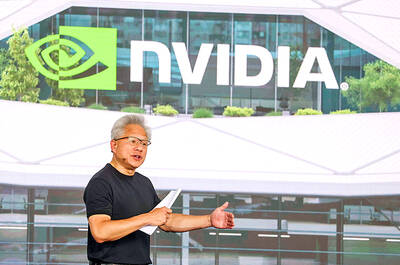
‘BOOMING’: ’ The number of partners we have here is incredible. You can see from their stock prices. They’re doing so well, they’re so happy,’ Jensen Huang said Nvidia Corp’s spending in Taiwan has ballooned to about US$150 billion a year, 10 times the US$10 billion to US$15 billion the company spent five years ago, Nvidia chief executive officer Jensen Huang (黃仁勳) said yesterday, suggesting Taiwan’s strategic importance in the global artificial intelligence (AI) supply chain. “Taiwan is the epicenter of the AI revolution. This is where the chips come, packaging comes. This is where the systems are made. This is where AI supercomputers were created,” Huang said at a meeting for the company’s employees in Beitou-Shilin Technology Park (北投士林科技園區) in Taipei, the planned site of Nvidia’s Taipei headquarters. “Taiwan
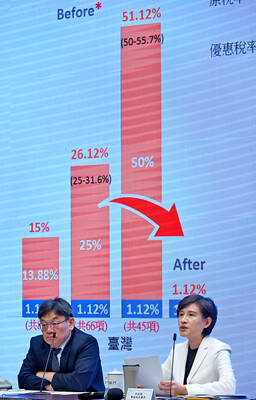
GREATER REACH? Auto parts and wood products would face tariffs of up to 15%, matching those targeting the EU, Japan and South Korea, Vice Premier said The US has announced that preferential tariff treatment for Taiwan’s non-semiconductor Section 232 goods would take effect retroactively from May 1, the Executive Yuan said yesterday. The US government yesterday posted a notice on the Federal Register’s public inspection Web site previewing tariff concessions for Taiwan under a memorandum of understanding (MOU) on Taiwan-US investment after two months of negotiations. The MOU signed on Jan. 15 stipulated three major preferential tariff arrangements: a 15 percent “reciprocal” tariff rate for Taiwan without stacking most-favored nation (MFN) rates; preferential Section 232 treatment for semiconductors and related products; and preferential Section 232 treatment for non-semiconductor


 RSS
RSS