


About 200 people yesterday marched in downtown Taipei to commemorate the 1959 Tibetan Uprising, calling for an end to China’s oppression of Tibet.
Before the march, Tibetan rights advocates, including Democratic Progressive Party legislators Kolas Yotaka and Yu Mei-nu (尤美女), New Power Party Taipei city councilor nominee Lin Ying-meng (林穎孟) and members of the Human Rights Network for Tibet and Taiwan, the Taiwan Association for Human Rights and other groups rallied in front of a Pacific Sogo Department Store in Daan District (大安) in support of Tibetans fighting for freedom and human rights.
“On this day in 1959, tens of thousands of Tibetans — including monks, nuns and laypeople — held a peaceful protest against Chinese rule,” Tibet Religious Foundation of His Holiness the Dalai Lama chairman Dawa Tsering said.
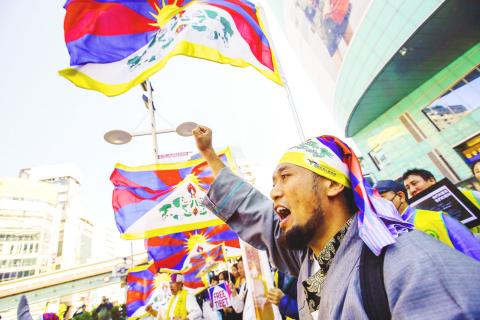
PHOTO: EPA
“The Chinese government responded by launching a violent crackdown and killed many Tibetans. It was a day in Tibetan history that will always be remembered,” Dawa Tsering added.
Following the 1959 crackdown, Tibetans have continued to fight for their freedom and has organized many protests, he said.
In addition to being the 59th anniversary of the uprising, this year also marks the 30th anniversary of a 1988 movement opposing communism and the 10th anniversary of the 2008 Tibetan unrest, he added.
Since 2009, 152 Tibetans have self-immolated to protest Chinese suppression, he said, adding that on Wednesday, 44-year-old Tsekho Tugchak set himself on fire.
He expressed gratitude for people fighting for the Tibetan cause in Taiwan and around the world and called on Chinese President Xi Jinping (習近平) to review China’s Tibet policies and meet with the Dalai Lama to discuss ways to resolve problems in the region.
Taiwan Tibetan Welfare Association president Tashi Tsering also urged the Chinese government to allow Tibet’s spiritual leader to return home.
“The Dalai Lama and other Tibetans need to be able to return home,” he said, adding that they need a Tibet where the Dalai Lama lives, and where they can practice their religion and learn about their culture and language.
“We want Tibet to go back to how it used to be, not the empty shell it has become,” he added.
Taiwanese must continue asking what more they can do to help Tibet, Kolas said.
Although Taiwan has in the past two years amended its Immigration Act (入出國及移民法) to allow Tibetan exiles to legally reside in the nation and has abolished the Mongolian and Tibetan Affairs Commission, “which was a remnant of colonialism,” there is still much more Taiwanese can do, she said.
Participants sang the Tibetan national anthem and walked to Taipei 101 in Xinyi District (信義), carrying a large portrait of the Dalai Lama and Tibetan snow lion flags, shouting “free Tibet.”
An exhibition on the 2008 Tibetan unrest is on display at Liberty Square until Wednesday, when another event to mark the day is scheduled to take place at the square.

‘NO SECURITY RISK’: The Railway Bureau reassured the public that the technicians’ activities were limited to technical guidance and did not involve sensitive systems The Railway Bureau yesterday said it had invited eight Chinese technicians to assist with an airport MRT construction project. The bureau issued the confirmation after an Internet user said Chinese nationals had entered the construction zone of Taiwan Taoyuan International Airport’s Terminal 3 project. They asked why “individuals from an enemy state” were allowed access to such a major national infrastructure project, which raised serious concerns over Taiwan’s industrial safety, sensitive systems and information security. The bureau’s Northern Region Engineering Branch Office said subcontractor Taiwan Handle Industrial Co (台灣手把工業) of the Taoyuan airport MRT’s “Contract No. CU05 Project A14 Station Civil, MEP &

A US uncrewed surface vessel (USV) encountered multiple Chinese warships during an autonomous transit of the Taiwan Strait, US defense company Seasats said in a statement on Wednesday. Seasats announced that a Lightfish USV had completed the first autonomous transit of the Taiwan Strait. Over five days, the USV traversed the entire length of the Strait while constantly monitoring surface vessel traffic, the company said. The Lightfish encountered multiple Chinese warships, one of which was a Chinese People’s Liberation Army Navy (PLAN) Type 056 corvette, it said. The Chinese vessels were operating “well within Taiwan’s exclusive economic zone without transmitting their identity via the
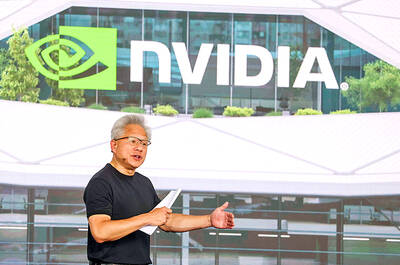
‘BOOMING’: ’ The number of partners we have here is incredible. You can see from their stock prices. They’re doing so well, they’re so happy,’ Jensen Huang said Nvidia Corp’s spending in Taiwan has ballooned to about US$150 billion a year, 10 times the US$10 billion to US$15 billion the company spent five years ago, Nvidia chief executive officer Jensen Huang (黃仁勳) said yesterday, suggesting Taiwan’s strategic importance in the global artificial intelligence (AI) supply chain. “Taiwan is the epicenter of the AI revolution. This is where the chips come, packaging comes. This is where the systems are made. This is where AI supercomputers were created,” Huang said at a meeting for the company’s employees in Beitou-Shilin Technology Park (北投士林科技園區) in Taipei, the planned site of Nvidia’s Taipei headquarters. “Taiwan
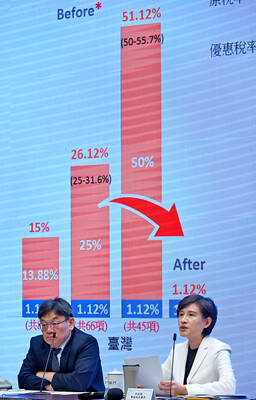
GREATER REACH? Auto parts and wood products would face tariffs of up to 15%, matching those targeting the EU, Japan and South Korea, Vice Premier said The US has announced that preferential tariff treatment for Taiwan’s non-semiconductor Section 232 goods would take effect retroactively from May 1, the Executive Yuan said yesterday. The US government yesterday posted a notice on the Federal Register’s public inspection Web site previewing tariff concessions for Taiwan under a memorandum of understanding (MOU) on Taiwan-US investment after two months of negotiations. The MOU signed on Jan. 15 stipulated three major preferential tariff arrangements: a 15 percent “reciprocal” tariff rate for Taiwan without stacking most-favored nation (MFN) rates; preferential Section 232 treatment for semiconductors and related products; and preferential Section 232 treatment for non-semiconductor


 RSS
RSS