


The Cabinet has approved a plan to subsidize the construction and design costs of residential rooftop solar systems, starting next year, as part of its efforts to boost solar power generation.
A stimulus package introduced yesterday would offer subsidies to households installing rooftop solar systems, covering 40 percent of construction costs and 100 percent of design costs, from next year to 2020, Minister of Economic Affairs Shen Jong-chin (沈榮津) said.
The government would also offer subsidies for the construction of public solar power stations in remote areas and Aboriginal lands, covering 100 percent of design costs, Shen said.
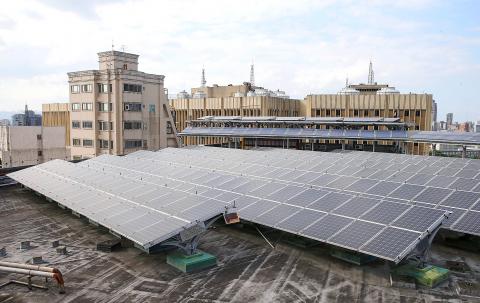
Photo: CNA
It would offer a subsidy of up to NT$600,000 for each power station for the construction of power lines, and would promise to purchase the extra electricity generated, Shen added.
The package is part of the government’s efforts to phase out nuclear power and increase the share of renewable energy to 20 percent of the nation’s power supplies by 2025.
The government hopes to increase the power generation capacity of rooftop solar systems from 410 megawatts at present to 3,000 megawatts by 2020, Shen said.
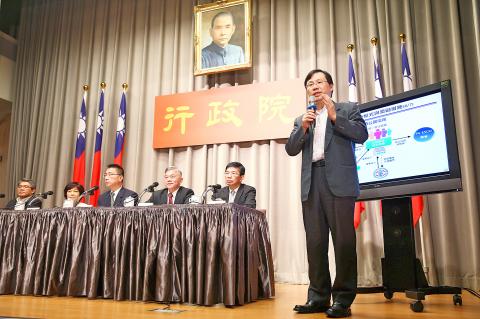
Photo: CNA
The government would first target homes with the goal of converting communities into solar power plants, and then encourage people living in remote areas to install rooftop solar systems and build public power stations, he said.
It would also require private companies that consume more than 800 kilowatts of electricity per month to construct rooftop solar power systems, Shen said.
“The domestic market will be bolstered with the development of rooftop systems. The solar panel industry, iron factories, electricians and the shipping industry will all benefit,” Shen said.
The package also eases building restrictions on illegal rooftop structures.
Owners of illegal structures would not be able to apply for a license to build solar systems, but the Cabinet is planning to lift the ban to allow solar panels to be placed on such structures if the combined height does not exceed 4.5m, Deputy Minister of the Interior Hua Ching-chun (花敬群) said.
“However, that does not mean illegal structures will be legalized. Those structures are still illegal even if they are topped with solar panels, but the solar panels could be kept even if the structures are demolished,” Executive Yuan spokesman Hsu Kuo-yung (徐國勇) said.
Premier William Lai (賴清德) said that the growth of renewable energy can create jobs and increase Taiwan’s global influence.
The Cabinet also plans to establish a legal platform to eliminate gray areas in the law for start-ups and innovators in a bid to build a friendly investment environment.
The platform, to be led by the National Development Council, is to smooth out legal uncertainties encountered by businesses that are developing a new business model.
The Cabinet said that in principle it would allow everything that is not prohibited by the law.
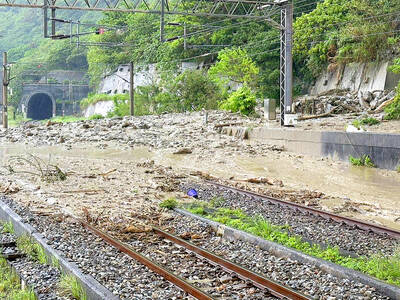
ROLLER-COASTER RIDE: More than five earthquakes ranging from magnitude 4.4 to 5.5 on the Richter scale shook eastern Taiwan in rapid succession yesterday afternoon Back-to-back weather fronts are forecast to hit Taiwan this week, resulting in rain across the nation in the coming days, the Central Weather Administration said yesterday, as it also warned residents in mountainous regions to be wary of landslides and rockfalls. As the first front approached, sporadic rainfall began in central and northern parts of Taiwan yesterday, the agency said, adding that rain is forecast to intensify in those regions today, while brief showers would also affect other parts of the nation. A second weather system is forecast to arrive on Thursday, bringing additional rain to the whole nation until Sunday, it
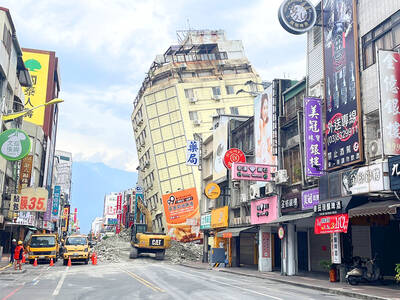
LANDSLIDES POSSIBLE: The agency advised the public to avoid visiting mountainous regions due to more expected aftershocks and rainfall from a series of weather fronts A series of earthquakes over the past few days were likely aftershocks of the April 3 earthquake in Hualien County, with further aftershocks to be expected for up to a year, the Central Weather Administration (CWA) said yesterday. Based on the nation’s experience after the quake on Sept. 21, 1999, more aftershocks are possible over the next six months to a year, the agency said. A total of 103 earthquakes of magnitude 4 on the local magnitude scale or higher hit Hualien County from 5:08pm on Monday to 10:27am yesterday, with 27 of them exceeding magnitude 5. They included two, of magnitude

OVERWHELMING SUPPORT: The bill with US$2 billion in Foreign Military Financing Program funds and US$1.9 billion to replenish defense articles passed the House 385-34 Taiwan is to continue working with the US to ensure peace in the Taiwan Strait, the Ministry of National Defense said yesterday after the US House of Representatives approved a US$95 billion foreign aid package with funding for Taiwan. The bills were passed with bipartisan support in a rare Saturday session after votes had been delayed for months by House Republicans. After clearing the House, the bills — containing US$8 billion for Taiwan and the Indo-Pacific region, along with US$60.8 billion for Kyiv, and US$26 billion for Israel and humanitarian aid for civilians in conflict zones — would be combined into a

The navy next month is expected to commission into service two more domestically built Tuo Chiang-class stealth missile corvettes, a source said yesterday. The Hsu Chiang (旭江, PGG-621) and the Wu Chiang (武江, PGG-623) would be officially commissioned in a ceremony early next month, the source said, speaking on condition of anonymity. The corvettes, launched in February and June last year respectively, were delivered to the navy in February. They are the third and fourth Tuo Chiang-class stealth missile corvettes to be produced. The Tuo Chiang-class corvette is a domestically designed and manufactured class of fast and stealthy multipurpose corvette built for the


 RSS
RSS