


World No. 1 Tai Tzu-ying (戴資穎) yesterday led Taiwan to gold in badminton, while roller sports athletes also topped the podium at the Taipei Summer Universiade.
Local athletes also excelled against international competition to pick up medals in weightlifting.
Taiwan’s medal tally at press time last night was 15 golds, 19 silvers and 12 bronzes to retain third place behind South Korea and Japan.
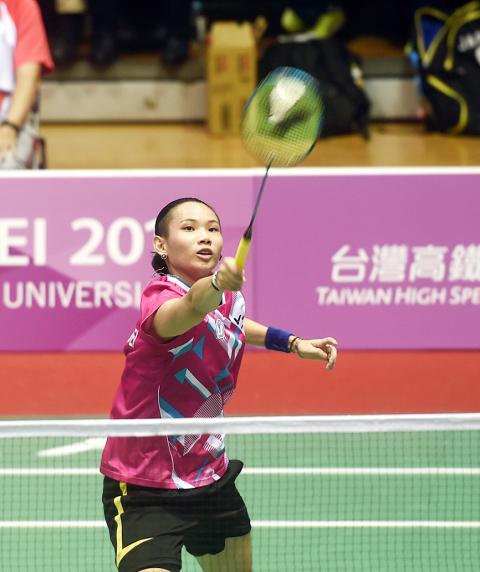
Photo: Fang Pin-chao, Taipei Times
Much of the attention yesterday was on “Badminton Queen” Tai, with tickets to the events at the Taipei Gymnasium sold out.
Tai has won numerous international titles, but rarely plays major competitions at home. She missed the World Badminton Championships in Scotland to play in Taipei.
Fans cheered the loudest for Tai as she impressed with her repertoire of trick shots and led her team to 3-0 victories in the mixed team event against Thailand in the morning’s semis and Japan in the evening’s final.
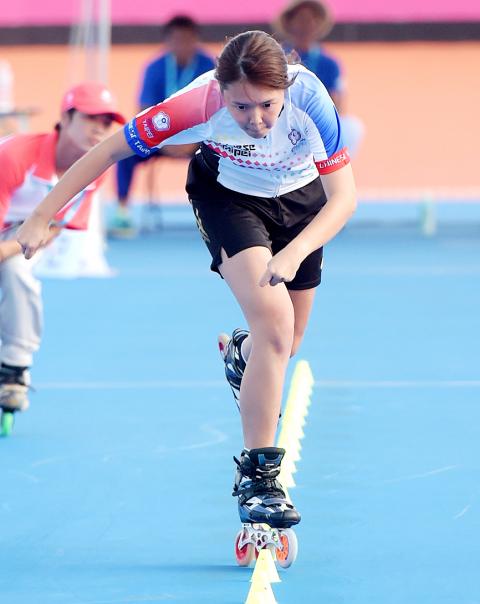
Photo: Huang Yao-cheng, Taipei Times
It was Taiwan’s first gold medal in the event at a Universiade.
In her match against Japan’s Natsumi Shimoda in the final, Tai won 21-8, 21-13, while the men’s duo of Lee Yang (李洋) and Lee Jhe-huei (李哲輝) won 21-5, 21-15 against Katsuki Tamate and Kenya Mitsuhashi.
Wang Tzu-wei (王子維) beat Kenta Nishimoto in the individual men’s match of the team final 19-21, 21-17, 21-10.
The individual and doubles matches are to begin tomorrow, with the medals to be decided on Tuesday next week.
“It is a great feeling to hear fans with such enthusiastic support for our team. This is our home-field advantage,” Tai said. “The match for the men finished too fast, so I did not have enough time to warm up and had to make quick adjustments to take to the court.”
“They were good matches for me, although I made some unforced errors, but I am very happy to help Taiwan capture this gold medal,” she said.
A native of Kaohsiung, Tai is enrolled at the University of Taipei.
Earlier this year she won Taiwan’s first title at the Badminton Asia Championships in Wuhan, China.
In roller sports, Taiwan’s Liang Hsuan-Min (梁瑄旼) took gold in the women’s slalom, while Wang Chia-wei (王佳葳) won silver, with Russia’s Kristina Lysenko third.
“I spent a year working toward this gold medal and it has paid off today,” Liang said. “I have lost to Wang [Chia-wei] many times in the past, so I am really happy.”
Liang said she was grateful to her mother and those who had traveled from Tainan to support her.
Wang Chia-wei said that she was looking to improve.
“I was disappointed with the result, but I want to keep improving and use this experience toward training for competitions next month,” she said.
In weightlifting, Taiwan’s Chen Shih-chieh (陳世杰) pocketed silver in the men’s 105kg category with a snatch of 190kg and 225kg in clean and jerk for 415kg in total, while Lo Ying-yuan (羅楹湲) took the bronze in the women’s 90kg category with a snatch of 105kg and 130kg in the clean and jerk for 235kg.
In athletics, Hsiang Chun-hsien (向俊賢) cleared 2.26m to grab bronze for Taiwan in the high jump, with Germany’s Falk Wendrich winning gold and Italy’s Marco Fassinotti taking silver.
Additional reporting by Deirdre Yeo

The National Chungshan Institute of Science and Technology yesterday showcased its locally developed variants of the Vision 60 robotic patrol dog, which it plans to deploy on the nation’s outlying territories in the South China Sea. The variants were produced under the Joint Lab project — created by the institute and domestic companies — and assembled with domestically produced motors, lenses and artificial intelligence (AI) systems alongside licensed tech from the US, Missile and Rocket Systems Research Division deputy director Jen Kuo-kang (任國光) told the media event at a military base in Taipei’s Dazhi (大直) area. Taiwan has built up its strengths

RIGHT DIRECTION: Taiwan’s efforts to prevent forced labor include a proposal to ‘fully prohibit’ employers from withholding workers’ documents, an official said Taiwan is to establish a mechanism to restrict imports of goods linked to forced labor, the Executive Yuan said yesterday, after the US proposed imposing additional tariffs on Taiwanese goods over labor concerns. “The Ministry of Labor and the Ministry of Economic Affairs are to establish an interministerial review procedure,” Executive Yuan spokesperson Michelle Lee (李慧芝) said at a news briefing in Taipei. “The government is to use the Foreign Trade Act [貿易法] as the legal basis to restrict imports of goods produced with forced labor” and bring its supply chain governance more in line with international standards on human rights, resilience

NOT IMMEDIATE: Taiwan has a chance to appeal the proposed 10 percent tariff before it starts, while other countries face a 12.5 percent tariff from the trade office Taiwan is among 60 economies determined by the US to have failed to impose or enforce a ban on the importation of goods produced with forced labor, according to a notice released on Tuesday by the Office of the US Trade Representative (USTR), which proposed imposing an additional 10 percent or more tariff on them. The USTR in a statement said that following an investigation, it had determined under Section 301 of the Trade Act of 1974 that the failure of the 60 economies to impose and effectively enforce a prohibition on the importation of goods produced with forced labor is
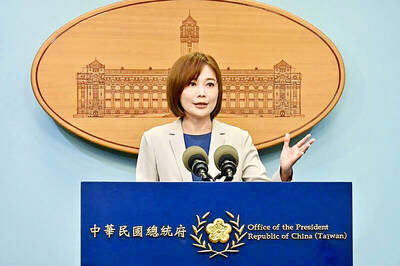
TIT-FOR-TAT: The US allegedly revoked the visa of a Chinese national working at Xinhua News Agency in the US in response to Beijing’s expulsion of Vivian Wang The Presidential Office yesterday condemned China for expelling a New York Times correspondent from Beijing following the newspaper’s interview with President William Lai (賴清德), saying the move highlighted Beijing’s suppression of press freedom and its threat to international news media. Taiwan has noted a series of recent incidents in which Beijing used similar tactics to “threaten and pressure international media outlets and journalists,” Presidential Office spokeswoman Karen Kuo (郭雅慧) said in a statement. “This concerns not only press freedom and freedom of expression, but also the safety of journalists, and Taiwan and relevant partners are paying close attention to the situation,” she


 RSS
RSS