


The Han Kuang field exercises this year are to simulate a Chinese attack on the Ching Chuan Kang (清泉崗) Air Base in Taichung, a senior Ministry of National Defense official said yesterday.
An exercise to repel an amphibious invasion is to be staged on Thursday next week in Penghu County by all branches of the armed forces, followed the next day by the “assault” on Ching Chuan Kang Air Base, the official said on condition of anonymity.
The air base is to come under attack from the north, south and east, the official said.
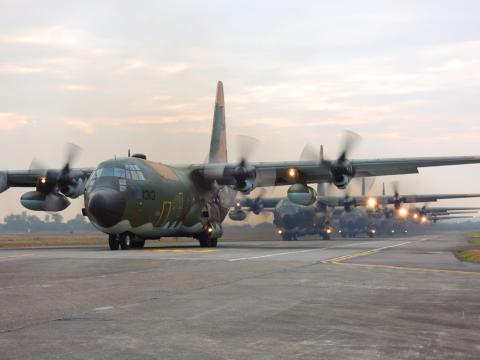
Photo: Lo Tian-pin, Taipei Times
An air-land scenario has been devised to address the growing threat of a multi-directional Chinese attack launched from the sea against high-value military targets, the official said.
It is likely that China’s People’s Liberation Army (PLA) has included those options in case of a cross-strait war because PLA aviation exercises are increasingly conducted in air and sea space to the east, north and south of Taiwan, the official said.
The defense of the base will be the final stage of the field exercises, and is to take place under the assumption that Chinese missile strikes on Taiwan’s air and naval bases and political-military centers have degraded the nation’s radar and air-defense systems, the official said.
Under that hypothesis, the PLA might launch additional strikes via long-range bombers and carrier-based planes on Taiwan proper, the official said.
The ministry’s initial plan to defend the airbase included only simulated attacks by Chinese airborne units, but on May 1 senior commanders added air attacks by fighters and bombers to the mix, the official said.
According to an air traffic notice from the military, a pair of Dassault Mirage 2000 fighters from the Hsinchu Air Base would first act as combat air patrol, before becoming the aggressor and reconnoitering the air space over Taichung.
Four AIDC F-CK-1s from the Tainan Air Base are to simulate air attacks on the Taichung base, while four F-16s based in Hualien are to cross the Central Mountain Range to attack it.
A mixed air squadron based in Pingtung County is to conduct a simulated attack by airborne troops.
The invaders are to launch a paratroop attack by dropping six planeloads of special operations forces as well as supplies and vehicles.
Defensive actions are to involve all branches, including interceptions by air force fighters and army surface-to-air missiles.
Army and marines ground troops will conduct anti-airborne missions and counterattacks to retake the base, the official said.
This story has been updated since it was first published to correct the romanized name of the drills to Han Kuang.
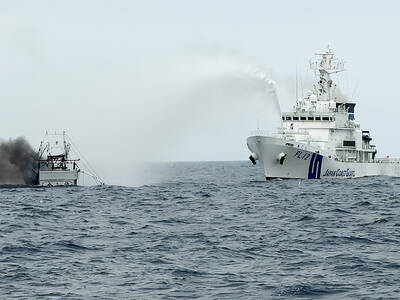
CREDIT-GRABBER: China said its coast guard rescued the crew of a fishing vessel that caught fire, who were actually rescued by a nearby Taiwanese boat and the CGA Maritime search and rescue operations do not have borders, and China should not use a shipwreck to infringe upon Taiwanese sovereignty, the Coast Guard Administration (CGA) said yesterday. The coast guard made the statement in response to the China Coast Guard (CCG) saying it saved a Taiwanese fishing boat. The Chuan Yu No. 6 (全漁6號), a fishing vessel registered in Keelung, on Thursday caught fire and sank in waters northeast of Diaoyutai Islands (釣魚台). The vessel left Keelung’s Badouzih Fishing Harbor (八斗子漁港) at 3:35pm on Sunday last week, with seven people on board — a 62-year-old Taiwanese captain surnamed Chang (張) and six

LEVERAGE: China did not ‘need to fire a shot’ to deny Taiwan airspace over Africa when it owns ‘half the continent’s debt,’ a US official said, calling it economic warfare The EU has raised concerns about overflight rights following the delay of President William Lai’s (賴清德) planned state visit to the Kingdom of Eswatini after three African nations denied overflight clearance for his charter at the last minute. Taiwanese allies Paraguay and Saint Kitts and Nevis, as well as several US lawmakers and the Inter-Parliamentary Alliance on China (IPAC) condemned China for allegedly pressuring the countries. Lai was scheduled to fly directly to Taiwan’s only African ally from yesterday to Sunday to celebrate the 40th anniversary of King Mswati III’s accession and his 58th birthday, but Seychelles, Mauritius and Madagascar suddenly revoked

RISKY BUSINESS: The ‘incentives’ include initiatives that get suspended for no reason, creating uncertainty and resulting in considerable losses for Taiwanese, the MAC said China’s “incentives” failed to sway sentiment in Taiwan, as willingness to work in China hit a record low of 1.6 percent, a Ministry of Labor survey showed. The Directorate-General of Budget, Accounting and Statistics (DGBAS) also reported that the number of Taiwanese workers in China has nearly halved from a peak of 430,000 in 2012 to an estimated 231,000 in 2024. That marked a new low in the proportion of Taiwanese going abroad to work. The ministry’s annual survey on “Labor Life and Employment Status” includes questions respondents’ willingness to seek employment overseas. Willingness to work in China has steadily declined from
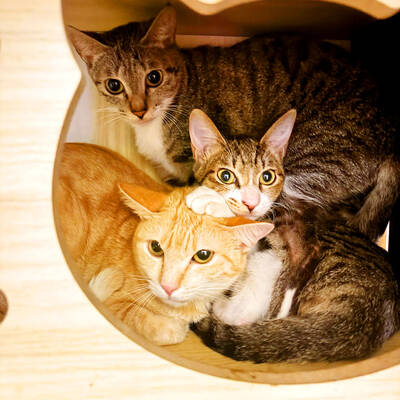
The number of pet cats in Taiwan surpassed that of pet dogs for the first time last year, reaching 1,742,033, a 32.8 percent increase from 2023, the Ministry of Agriculture said yesterday, citing a survey. By contrast, the number of pet dogs declined slightly by 1.2 percent over the same period to 1,462,528, the ministry said. Despite the shift, households with dogs still slightly outnumber those with cats by 1.2 percent. However, while the number of households with multiple dogs has remained relatively stable, households keeping more than two cats have increased, contributing to the overall rise in the feline population. The trend


 RSS
RSS