


The nation will remain committed to cross-strait peace despite increasing military threats from China, which is expected to project its military power beyond the first island chain on a regular basis, Minister of National Defense Feng Shih-kuan (馮世寬) said yesterday.
As China is building new aircraft carriers, the East China and Yellow seas will no longer be enough for the Chinese People’s Liberation Army (PLA) to conduct training on open seas, and long-distance military operations beyond the first island chain, and even near the second island chain, would become common, Feng told a forum on national security strategy hosted by Tamkang University in New Taipei City.
China’s military power has grown exponentially, with its aircraft carrier group and bomber fleets capable of conducting training around and beyond Taiwan’s airspace, he said.
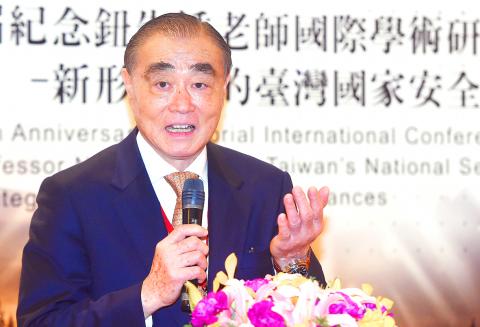
Photo: Liao Chen-huei, Taipei
“Each of [the PLA’s] distant sea training exercises and operations circling Taiwan has mounted pressure on us, and we have been forced to raise the level of combat readiness,” Feng said.
He called on the public to be prepared for a Chinese military presence around Taiwan’s airspace, as the PLA has broken through the first island chain during exercises and will continue to do so on a regular basis.
The decades-long peace across the Taiwan Strait has been maintained with extreme caution on Taiwan’s part, he said.
The nation’s armed forces are under strict orders not to launch any pre-emptive attack under any circumstance, even if that means soldiers on the front line have to be sacrificed, Feng said.
“We are committed to the political promise of maintaining the ‘status quo’ across the Taiwan Strait. We do not provoke China and do everything we can to prevent conflict,” Feng said.
Taiwan would not develop nuclear weapons to deter China, he said.
“We are not North Korea. It is not that we do not have the ability [to develop nuclear weapons], but we will never follow in the footsteps of North Korea and create a nuclear crisis as a bargaining chip,” Feng said.
Maintaining peace across the Strait has been the government’s top priority, the success of which is contingent on a flexible use of military, economic, political and diplomatic means, and a deepened democracy, he added.
The nation has to improve its asymmetric and electronic warfare capabilities with locally developed weapons, Feng said, adding that the aerospace, shipbuilding and information sectors will be the core of the government’s focus when building up the defense industry.
Taiwan has to establish good rapport with first island chain nations to survive in the increasingly precarious international environment, he said.
The nation has contributed to the peaceful development of the first island chain and Southeast Asia, but the contribution has gone unrecognized, Feng added.
He urged Beijing to drop its belligerent attitude and help attain regional peace and development, but added that China would not stop its saber-rattling against Taiwan until a new framework is established across the Strait.
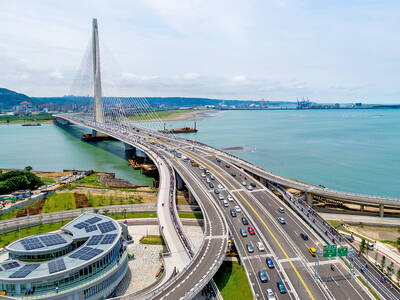
The Ministry of Transportation and Communications yesterday inaugurated the Danjiang Bridge across the Tamsui River in New Taipei City, saying that the structure would be an architectural icon and traffic artery for Taiwan. Feted as a major engineering achievement, the Danjiang Bridge is 920m long, 211m tall at the top of its pylon, and is the longest single-pylon asymmetric cable-stayed bridge in the world, the government’s Web site for the structure said. It was designed by late Iraqi-British architect Zaha Hadid. The structure, with a maximum deck of 70m, accommodates road and light rail traffic, and affords a 200m navigation channel for boats,
Taiwan Semiconductor Manufacturing Co (TSMC, 台積電), the world’s largest foundry service provider, yesterday said that global semiconductor revenue is projected to hit US$1.5 trillion in 2030, after the figure exceeds US$1 trillion this year, as artificial intelligence (AI) demand boosts consumption of token and compute power. “We are still at the beginning of the AI revolution, but we already see a significant impact across the whole semiconductor ecosystem,” TSMC deputy cochief operating officer Kevin Zhang (張曉強) said at the company’s annual technology symposium in Hsinchu City. “It is fair to say that in the past decade, smartphones and other mobile devices were
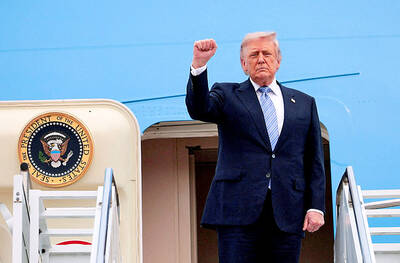
US-CHINA SUMMIT: MOFA welcomed US reassurance of no change in its Taiwan policy; Trump said he did not comment when Xi talked of opposing independence US President Donald Trump yesterday said he has not made a decision on whether to move forward with a major arms package for Taiwan after hearing concerns about it from Chinese President Xi Jinping (習近平). Trump’s comments on Taiwan came as he flew back to Washington after wrapping up critical talks in which both leaders said important progress was made in stabilizing US-China relations even as deep differences persist between the world’s two biggest powers on Iran and Taiwan. “I will make a determination,” Trump said, adding: “I’ll be making decisions. But, you know, I think the last thing we need right

TAIWAN ISSUE: US treasury secretary Scott Bessent said on the first day of meetings that ‘it wouldn’t be a US-China summit without the Taiwan issue coming up’ There were no surprises on the first day of the summit between US President Donald Trump and Chinese President Xi Jinping (習近平), the Mainland Affairs Council (MAC) said yesterday, as the government reiterated that cross-strait stability is crucial to the Asia-Pacific region, as well as the world. As the two presidents met for a highly anticipated summit yesterday, Chinese state media reported that Xi warned Trump that missteps regarding Taiwan could push their two countries into “conflict.” Trump arrived in China with accolades for his host, calling Xi a “great leader” and “friend,” and extending an invitation to visit the White House


 RSS
RSS