


President Tsai Ing-wen (蔡英文) yesterday announced the declassification of all historical records relating to the 228 Incident, saying that the measure is critical to establishing the truth and expediting transitional justice.
“Pushing for transitional justice is one of the most important missions for Taiwan’s democracy, but we often have to discern the truth from the mists, with the most crucial yet complicated task being uncovering and collecting the relevant documents, which are scattered across various government agencies,” Tsai said on Facebook.
Tsai’s Facebook post came after the government released a press release touting similar moves, in which it said the speedy declassification of confidential files was aimed at meeting the public’s expectation of transitional justice.
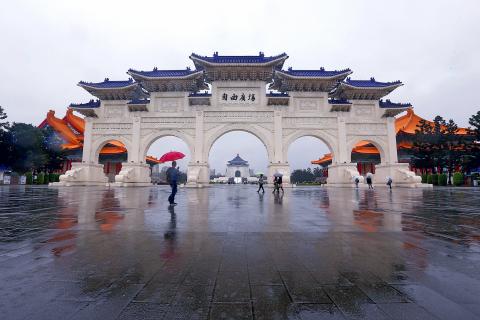
Photo: CNA
Tsai said collecting such material is also fundamental to the government’s efforts to compile a report on transitional justice, “as many traces of history can be found in past government documents, which reveal the names of the people involved, related incidents or other key elements.”
Of the National Achieves Administration’s documents relating to the 228 Incident — which total 1.37 million pages — 4,617 documents were classified, but they have all now been declassified in their entirety, Tsai said.
“In addition, the related political files containing a total of 990,000 pages from 83 different government divisions were listed as pending transfer [to the administration]. The transfer process is expected to be completed by the end of June,” Tsai said.
The Cabinet plans to allocate additional funds to the National Archives Administration to facilitate a three-year-long investigation and collection of political materials relating to the 228 Incident and the Period of National Mobilization for Suppression of the Communist Rebellion, which is to begin on March 1, Tsai said.
“That will provide the foundation for the writing of our investigative report on transitional justice,” she said.
The 228 Incident refers to a crackdown launched by the then-Chinese Nationalist Party (KMT) regime against civilian demonstrations following an incident in Taipei on Feb. 27, 1947. The event marked the beginning of the White Terror era, during which thousands of Taiwanese were arrested, imprisoned and executed. Historians estimate as many as 30,000 people were killed.
Presidential Office spokesman Alex Huang (黃重諺) said the latest development, goals and purposes of the government’s transitional justice commitment are expected to be the focal points of Tsai’s first speech on the 228 Incident as president.
“Pushing for transitional justice is a necessary process for any democratic nation undergoing a transition from authoritarian rule… It is the government’s responsibility to deal with illegitimate party assets, uncover the truth about human rights violations and problematic policies enacted during the rule of the authoritarian regime, and to restore people’s rights,” Huang said.
The transitional justice bill and the political archives bill have been listed as the Democratic Progressive Party caucus’ priorites in the current legislative session, Huang said.
After the passage of the bills into law, an investigative report on the White Terror era is to be published and a truth and reconciliation commission established, Huang said.

‘NO SECURITY RISK’: The Railway Bureau reassured the public that the technicians’ activities were limited to technical guidance and did not involve sensitive systems The Railway Bureau yesterday said it had invited eight Chinese technicians to assist with an airport MRT construction project. The bureau issued the confirmation after an Internet user said Chinese nationals had entered the construction zone of Taiwan Taoyuan International Airport’s Terminal 3 project. They asked why “individuals from an enemy state” were allowed access to such a major national infrastructure project, which raised serious concerns over Taiwan’s industrial safety, sensitive systems and information security. The bureau’s Northern Region Engineering Branch Office said subcontractor Taiwan Handle Industrial Co (台灣手把工業) of the Taoyuan airport MRT’s “Contract No. CU05 Project A14 Station Civil, MEP &

A US uncrewed surface vessel (USV) encountered multiple Chinese warships during an autonomous transit of the Taiwan Strait, US defense company Seasats said in a statement on Wednesday. Seasats announced that a Lightfish USV had completed the first autonomous transit of the Taiwan Strait. Over five days, the USV traversed the entire length of the Strait while constantly monitoring surface vessel traffic, the company said. The Lightfish encountered multiple Chinese warships, one of which was a Chinese People’s Liberation Army Navy (PLAN) Type 056 corvette, it said. The Chinese vessels were operating “well within Taiwan’s exclusive economic zone without transmitting their identity via the
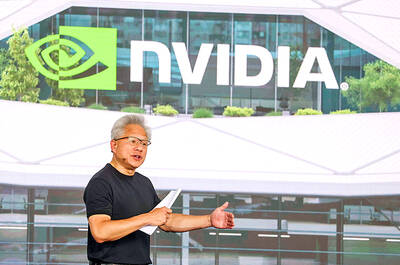
‘BOOMING’: ’ The number of partners we have here is incredible. You can see from their stock prices. They’re doing so well, they’re so happy,’ Jensen Huang said Nvidia Corp’s spending in Taiwan has ballooned to about US$150 billion a year, 10 times the US$10 billion to US$15 billion the company spent five years ago, Nvidia chief executive officer Jensen Huang (黃仁勳) said yesterday, suggesting Taiwan’s strategic importance in the global artificial intelligence (AI) supply chain. “Taiwan is the epicenter of the AI revolution. This is where the chips come, packaging comes. This is where the systems are made. This is where AI supercomputers were created,” Huang said at a meeting for the company’s employees in Beitou-Shilin Technology Park (北投士林科技園區) in Taipei, the planned site of Nvidia’s Taipei headquarters. “Taiwan
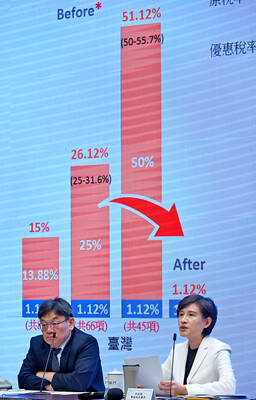
GREATER REACH? Auto parts and wood products would face tariffs of up to 15%, matching those targeting the EU, Japan and South Korea, Vice Premier said The US has announced that preferential tariff treatment for Taiwan’s non-semiconductor Section 232 goods would take effect retroactively from May 1, the Executive Yuan said yesterday. The US government yesterday posted a notice on the Federal Register’s public inspection Web site previewing tariff concessions for Taiwan under a memorandum of understanding (MOU) on Taiwan-US investment after two months of negotiations. The MOU signed on Jan. 15 stipulated three major preferential tariff arrangements: a 15 percent “reciprocal” tariff rate for Taiwan without stacking most-favored nation (MFN) rates; preferential Section 232 treatment for semiconductors and related products; and preferential Section 232 treatment for non-semiconductor


 RSS
RSS