


The government yesterday expressed its regret over Sao Tome and Principe’s decision to cut its 19-year-old diplomatic ties with Taiwan, acknowledging that “gambling behavior” by the African nation was prompted by Taipei’s denial of its request for an exorbitant amount of financial aid.
Speaking at an impromptu news conference in Taipei, Minister of Foreign Affairs David Lee (李大維) said that to safeguard the nation’s dignity, Taiwan would immediately cut its diplomatic ties with Sao Tome and Principe, shutter its embassy and halt any cooperative programs with the African nation.
“Since the establishment of diplomatic ties in May 1997, Taipei has assisted Sao Tome and Principe in promoting national development, with our bilateral cooperation touching upon the areas of public health, medicine, agriculture, basic infrastructure, energy and education,” Lee said.
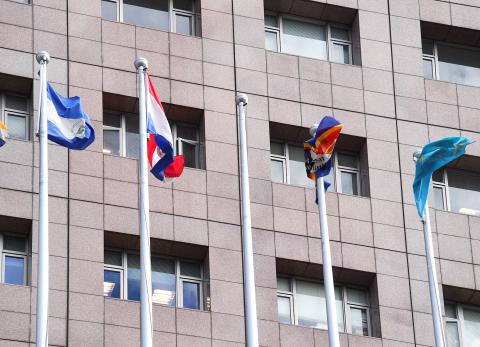
Photo: CNA
Singling out Taiwan’s antimalarial scheme in the African nation, Lee said thanks to continuous efforts by Taiwan’s malaria prevention counseling delegation, malaria incidence in Sao Tome and Principe fell from 50 percent in 2003 to 1.01 percent last year.
Despite Taipei’s determination to do its utmost to help its diplomatic allies promote national development, Lee said Sao Tome and Principe’s financial hole is simply too deep for Taiwan to deal with.
“Accordingly, it disregarded its nearly 20-year friendship with us and approached both sides of the Taiwan Strait to seek the highest bidder. We regret and deplore Sao Tome and Principe’s reckless and unfriendly decision,” Lee said.
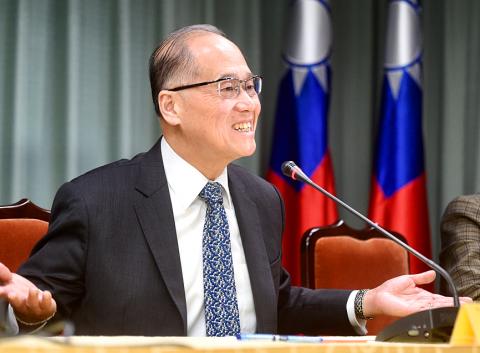
Photo: Chien Jung-fong, Taipei Times
He added that the incident would not cease Taipei’s resolve to expand the nation’s international space and push its “steadfast diplomacy.”
Asked to confirm media reports that Sao Tome and Principe had asked the government for NT$6.4 billion (US$199.9 million), Lee declined to reveal the actual amount.
“It did ask for an astronomical number, but we refused to play the checkbook-diplomacy game,” Lee said.
“We would rather initiate programs that actually improve the welfare of the people of Sao Tome and Principe. The African nation’s need for money to fill its financial hole is neither Taiwan’s responsibility, nor is it something we are willing to do,” Lee added.
Asked whether Beijing had attempted to lure Sao Tome and Principe with money, Lee said the government did not have that information, but it was regrettable that Beijing would take advantage of the African nation’s financial position to consolidate its “one China” principle.
Lee also denied the severance of ties was due to the President Tsai Ing-wen’s (蔡英文) refusal to adhere to the so-called “1992 consensus,” which refers to a tacit understanding between the Chinese Nationalist Party (KMT) and the Chinese Communist Party that both sides of the Taiwan Strait acknowledge there is “one China,” with each side having its own interpretation of what “China” means.
“Frankly speaking, if we look at the case of the Gambia, which broke its diplomatic ties with Taiwan in November 2013 and established a formal relationship with Beijing in March this year, that all occurred when the precondition of the ‘1992 consensus’ was met,” Lee said, referring to then-president Ma Ying-jeou’s (馬英九) adherence to the “1992 consensus.”
On the possibility that a domino effect could be set off with the nation’s other diplomatic allies, particularly the Vatican, Lee said given the nation’s diplomatic situation, that pressure would be omnipresent.
Nevertheless, the Vatican, unlike secular nations, does not require financial aid, Lee said.
Meanwhile, the Mainland Affairs Council yesterday issued a strongly worded statement denouncing Beijing resorting to “checkbook diplomacy” in attempting to reinforce its “one China” policy and inducing Sao Tome and Principe to cut diplomatic ties with Taiwan.
“We hereby express our strong discontent and regret over the incident, which has hurt the feelings of Taiwanese, destabilized the Taiwan Strait and runs counter to Beijing’s oft-stated goal of pushing for the peaceful development of cross-strait relations,” the council said.
Stressing that the government has repeatedly demonstrated its goodwill since the Tsai administration took office in May, the council said it disapproved of China’s rigid mindset and its return to the “old path of confrontation,” urging Beijing to solemnly contemplate the possible consequences of its actions.

‘NO SECURITY RISK’: The Railway Bureau reassured the public that the technicians’ activities were limited to technical guidance and did not involve sensitive systems The Railway Bureau yesterday said it had invited eight Chinese technicians to assist with an airport MRT construction project. The bureau issued the confirmation after an Internet user said Chinese nationals had entered the construction zone of Taiwan Taoyuan International Airport’s Terminal 3 project. They asked why “individuals from an enemy state” were allowed access to such a major national infrastructure project, which raised serious concerns over Taiwan’s industrial safety, sensitive systems and information security. The bureau’s Northern Region Engineering Branch Office said subcontractor Taiwan Handle Industrial Co (台灣手把工業) of the Taoyuan airport MRT’s “Contract No. CU05 Project A14 Station Civil, MEP &

A US uncrewed surface vessel (USV) encountered multiple Chinese warships during an autonomous transit of the Taiwan Strait, US defense company Seasats said in a statement on Wednesday. Seasats announced that a Lightfish USV had completed the first autonomous transit of the Taiwan Strait. Over five days, the USV traversed the entire length of the Strait while constantly monitoring surface vessel traffic, the company said. The Lightfish encountered multiple Chinese warships, one of which was a Chinese People’s Liberation Army Navy (PLAN) Type 056 corvette, it said. The Chinese vessels were operating “well within Taiwan’s exclusive economic zone without transmitting their identity via the

Taiwan is still in the process of assessing the possibility of recruiting workers from Eswatini, the Ministry of Foreign Affairs said yesterday, adding that its goal is to help Eswatini upgrade its vocational training centers. If there are plans to recruit workers from Eswatini, safeguarding national security, protecting public health and ensuring the employment rights of Taiwanese would be prerequisites, Department of West Asian and African Affairs Director-General Yen Chia-liang (顏嘉良) told a news conference. Key considerations would also include filling labor shortages in specific industries, and fostering bilateral professional and technical exchanges, he said. Yen was asked about the progress of labor

‘BOOMING’: ’ The number of partners we have here is incredible. You can see from their stock prices. They’re doing so well, they’re so happy,’ Jensen Huang said Nvidia Corp’s spending in Taiwan has ballooned to about US$150 billion a year, 10 times the US$10 billion to US$15 billion the company spent five years ago, Nvidia chief executive officer Jensen Huang (黃仁勳) said yesterday, suggesting Taiwan’s strategic importance in the global artificial intelligence (AI) supply chain. “Taiwan is the epicenter of the AI revolution. This is where the chips come, packaging comes. This is where the systems are made. This is where AI supercomputers were created,” Huang said at a meeting for the company’s employees in Beitou-Shilin Technology Park (北投士林科技園區) in Taipei, the planned site of Nvidia’s Taipei headquarters. “Taiwan


 RSS
RSS