


The Chinese Nationalist Party (KMT) yesterday said it had paid overdue salaries to party staffers using loans totaling NT$90 million (US$2.85 million) taken out by KMT Chairwoman Hung Hsiu-chu (洪秀柱) in her own name.
Speaking at a news conference at KMT headquarters in Taipei in the afternoon, KMT Vice Chairman Steve Chan (詹啟賢) said he and Hung had looked everyway for money in an effort to solve the party’s paycheck dilemma before Hung leaves for Beijing later this month.
“Our solution was to have Chairwoman Hung take out two loans totaling NT$90 million in her own name. The money was wired to the accounts of our party staffers half an hour ago. We always put words into action,” he said.
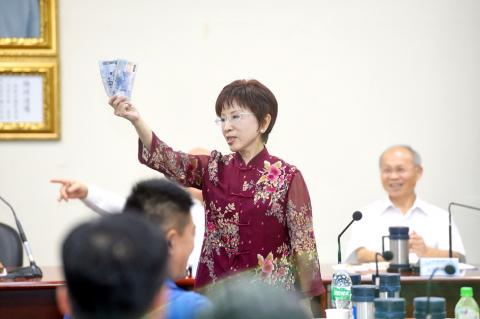
Photo: George Tsorng, Taipei Times
Chan said the loans were taken out in Hung’s name rather than under the KMT’s to avoid the money being frozen by the Ill-gotten Party Assets Settlement Committee after it was deposited into the party’s bank account.
The KMT had been forced to delay paying salaries after the Executive Yuan-affiliated committee froze the party’s main bank account late last month over the issuance of 10 cashier’s checks worth a collective NT$520 million.
To ease the party’s financial straits, KMT headquarters launched two fundraising initiatives earlier this week, one of which urged members to pay a “special party fee” of at least NT$2,000, while the other encouraged them to give a smaller donation of NT$1,000 to the party.
Chan said one of the NT$45 million loans was from the 90-odd-year-old mother of a well-known Taiwanese businessman.
“The story about how this loan came about is very touching. I recently talked to one of my friends in the business community about the KMT’s salary conundrum. Although he was more than willing to help us out, he was not in the country at the time,” Chan said.
He said that after his friend’s mother learned about the matter, she said that as her late husband was a KMT member, she would be more than happy to loan the money to the KMT without collateral and interest to help the party.
Chan later revealed the businessman to be Hon Hai Precision Industry Co (鴻海精密) chairman Terry Gou (郭台銘).
As for the other creditor, Chan said the person asked to remain anonymous because he prefers to keep a low profile.
Separately yesterday, the youth wing of the Taiwan Solidarity Union (TSU) clashed with members of the pro-unification Concentric Patriotism Association in front of KMT headquarters, as the former accused Hung of “kissing the ass of the Chinese Communist Party” (CCP) and possibly accepting donations from CCP-controlled Taiwanese enterprises.
“Many Chinese netizens have claimed willingness to dig into their pockets and wanted to donate money to the KMT after the party repeatedly drew public attention to its financial situation. This trend has given rise to speculation that Hung’s upcoming meeting with Chinese President Xi Jinping (習近平) could prompt her to accept funds from the CCP or Taiwanese businesspeople who are at the CCP’s beck and call,” TSU Department of Social Movements director Chang Chao-lin (張兆林) said.
Additional reporting by Shih Hsiao-kuang

CARROT AND STICK: While unrelenting in its military threats, China attracted nearly 40,000 Taiwanese to over 400 business events last year Nearly 40,000 Taiwanese last year joined industry events in China, such as conferences and trade fairs, supported by the Chinese government, a study showed yesterday, as Beijing ramps up a charm offensive toward Taipei alongside military pressure. China has long taken a carrot-and-stick approach to Taiwan, threatening it with the prospect of military action while reaching out to those it believes are amenable to Beijing’s point of view. Taiwanese security officials are wary of what they see as Beijing’s influence campaigns to sway public opinion after Taipei and Beijing gradually resumed travel links halted by the COVID-19 pandemic, but the scale of
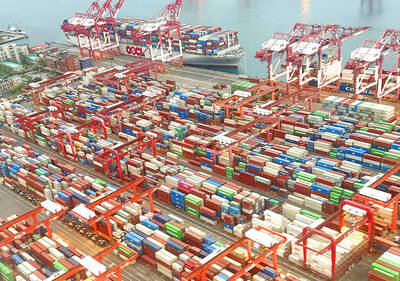
TRADE: A mandatory declaration of origin for manufactured goods bound for the US is to take effect on May 7 to block China from exploiting Taiwan’s trade channels All products manufactured in Taiwan and exported to the US must include a signed declaration of origin starting on May 7, the Bureau of Foreign Trade announced yesterday. US President Donald Trump on April 2 imposed a 32 percent tariff on imports from Taiwan, but one week later announced a 90-day pause on its implementation. However, a universal 10 percent tariff was immediately applied to most imports from around the world. On April 12, the Trump administration further exempted computers, smartphones and semiconductors from the new tariffs. In response, President William Lai’s (賴清德) administration has introduced a series of countermeasures to support affected
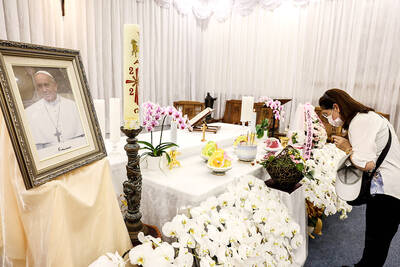
Pope Francis is be laid to rest on Saturday after lying in state for three days in St Peter’s Basilica, where the faithful are expected to flock to pay their respects to history’s first Latin American pontiff. The cardinals met yesterday in the Vatican’s synod hall to chart the next steps before a conclave begins to choose Francis’ successor, as condolences poured in from around the world. According to current norms, the conclave must begin between May 5 and 10. The cardinals set the funeral for Saturday at 10am in St Peter’s Square, to be celebrated by the dean of the College
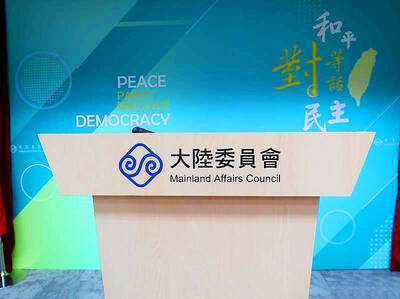
CROSS-STRAIT: The vast majority of Taiwanese support maintaining the ‘status quo,’ while concern is rising about Beijing’s influence operations More than eight out of 10 Taiwanese reject Beijing’s “one country, two systems” framework for cross-strait relations, according to a survey released by the Mainland Affairs Council (MAC) on Thursday. The MAC’s latest quarterly survey found that 84.4 percent of respondents opposed Beijing’s “one country, two systems” formula for handling cross-strait relations — a figure consistent with past polling. Over the past three years, opposition to the framework has remained high, ranging from a low of 83.6 percent in April 2023 to a peak of 89.6 percent in April last year. In the most recent poll, 82.5 percent also rejected China’s


 RSS
RSS