


The recession among Taiwanese tourism agencies dependent on low-cost Chinese group tours highlights a flawed business model and a lack of diversity in their consumer base, senior members of the Tourist Guide Association said.
Government aid packages are not likely to have a lasting effect without structural reforms in the industry, they said.
A common business model for such agencies — known as “one dragon” services — is to attract Chinese travelers with at-cost or at-loss fees, then try to make a profit by taking the tour groups to inexpensive hotels, restaurants and shops, and taking a cut from the proceeds of each venue, industry sources said.
The model was designed to take advantage of the phenomenal growth in Chinese tourism that occurred under former president Ma Ying-jeou’s (馬英九) administration, but the recent decline in group tours amid Beijing-imposed restrictions has raised serious doubts about its sustainability, the sources said.
According to the government, from 2008 to 2009, the number of Chinese tourists rose from 329,000 to 972,000. The number of Chinese visitors increased annually by about 600,000 before reaching a peak last year of 4,184,100.
Out of the 400 agencies in Taiwan that primarily serve Chinese tour groups, about 100 depend on such groups, and it is estimated that 4,000 buses had been purchased in the past eight years by bus lines catering to Chinese group tours, government records show.
Four hundred new hotels have opened since 2008 — the equivalent of 39,000 rooms — 243 in the past two years alone, the records show.
However, as the Chinese tourism boom dwindled, Tourist Guide Association chairman Wu Yong-yi (伍永益) and director Huang Kuan-chung (黃冠中) said that the business model it encouraged did little to improve the income or labor conditions of industry employees and retarded the growth of service quality.
Over the past eight years, even as business boomed, pay for tour guides and bus drivers deteriorated, with guides who used to receive between NT$1,000 and NT$2,000 (US$32 and US$64) per tour now getting between NT$500 and NT$800, Huang said.
Of the 50,000 Chinese-language tour guides who have been certified by the Examination Yuan since 2008, only about 29,000 are still working in the industry, and just 2,000 actually lead tour groups, averaging no more than two tours per month, Wu said.
To rescue the tourism industry, structural reforms in its business model, diversification of its customer base, and improvements to the labor conditions and pay are urgently needed, Wu and Huang said.
According to Wu, the industry needs to entice more Taiwanese to travel domestically, by making better use of cultural heritage sites and natural attractions, and improving the quality of service to the level of models used for international tour groups.
The government also need to loosen the restrictions on employing Chinese-language certified guides on overseas tours, so that they might lead tours to Southeast Asia with the help of locally employed translators, as guides fluent in Southeast Asian languages are scarce, Wu said.
“The government’s proposal to inject NT$30 billion into the tourism industry can keep the industry on life support, but it will not solve its underlying problems. Those funds will fall to the hands of tour agency and bus line bosses, but not the tour guides or drivers they employ, and certainly none will go toward improving the quality of service in the industry,” Huang said.
The government should instead invest in enhancing the quality of tourism, by building better attractions and weaning the industry off its addiction to the “one dragon” model, Huang said.
The government should consider using the money to attract internationally renowned theme parks or other tourism-oriented businesses to Taiwan, he said.

‘NO SECURITY RISK’: The Railway Bureau reassured the public that the technicians’ activities were limited to technical guidance and did not involve sensitive systems The Railway Bureau yesterday said it had invited eight Chinese technicians to assist with an airport MRT construction project. The bureau issued the confirmation after an Internet user said Chinese nationals had entered the construction zone of Taiwan Taoyuan International Airport’s Terminal 3 project. They asked why “individuals from an enemy state” were allowed access to such a major national infrastructure project, which raised serious concerns over Taiwan’s industrial safety, sensitive systems and information security. The bureau’s Northern Region Engineering Branch Office said subcontractor Taiwan Handle Industrial Co (台灣手把工業) of the Taoyuan airport MRT’s “Contract No. CU05 Project A14 Station Civil, MEP &

A US uncrewed surface vessel (USV) encountered multiple Chinese warships during an autonomous transit of the Taiwan Strait, US defense company Seasats said in a statement on Wednesday. Seasats announced that a Lightfish USV had completed the first autonomous transit of the Taiwan Strait. Over five days, the USV traversed the entire length of the Strait while constantly monitoring surface vessel traffic, the company said. The Lightfish encountered multiple Chinese warships, one of which was a Chinese People’s Liberation Army Navy (PLAN) Type 056 corvette, it said. The Chinese vessels were operating “well within Taiwan’s exclusive economic zone without transmitting their identity via the
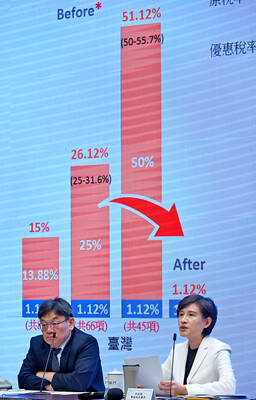
GREATER REACH? Auto parts and wood products would face tariffs of up to 15%, matching those targeting the EU, Japan and South Korea, Vice Premier said The US has announced that preferential tariff treatment for Taiwan’s non-semiconductor Section 232 goods would take effect retroactively from May 1, the Executive Yuan said yesterday. The US government yesterday posted a notice on the Federal Register’s public inspection Web site previewing tariff concessions for Taiwan under a memorandum of understanding (MOU) on Taiwan-US investment after two months of negotiations. The MOU signed on Jan. 15 stipulated three major preferential tariff arrangements: a 15 percent “reciprocal” tariff rate for Taiwan without stacking most-favored nation (MFN) rates; preferential Section 232 treatment for semiconductors and related products; and preferential Section 232 treatment for non-semiconductor

TIT-FOR-TAT: The US allegedly revoked the visa of a Chinese national working at Xinhua News Agency in the US in response to Beijing’s expulsion of Vivian Wang The Presidential Office yesterday condemned China for expelling a New York Times correspondent from Beijing following the newspaper’s interview with President William Lai (賴清德), saying the move highlighted Beijing’s suppression of press freedom and its threat to international news media. Taiwan has noted a series of recent incidents in which Beijing used similar tactics to “threaten and pressure international media outlets and journalists,” Presidential Office spokeswoman Karen Kuo (郭雅慧) said in a statement. “This concerns not only press freedom and freedom of expression, but also the safety of journalists, and Taiwan and relevant partners are paying close attention to the situation,” she


 RSS
RSS