


Rescuers in eastern China yesterday searched for survivors after a tornado and hailstorm killed at least 98 people as it swept over a city’s outskirts, destroying buildings, smashing trees and flipping vehicles onto their roofs.
The tornado hit a densely populated area of farms and factories on Thursday near the city of Yancheng, Jiangsu Province, about 800km south of Beijing.
Jiangsu Governor Shi Taifeng yesterday said that the death toll had risen to 98 people, with 800 others injured, according to the official China News Service.
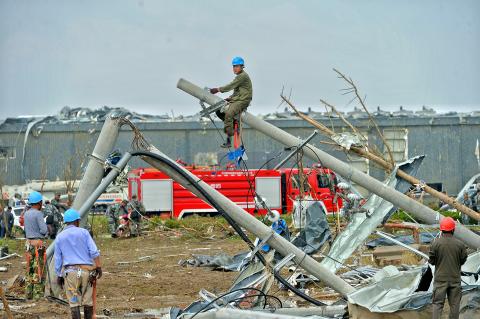
Photo: Reuters
Earlier, the state-run Xinhua news agency said 200 people were critically injured.
Rescuers worked to carry injured villagers into ambulances and deliver food and water to others, Xinhua reported yesterday, although state broadcaster CCTV said that roads were blocked with trees, downed power lines and other debris.
Heavy rain and the possibility of further hailstorms and more tornadoes complicated rescue efforts.
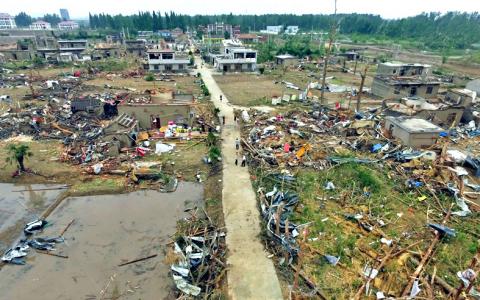
Photo: AFP
In badly hit Xintu village, survivors grieved over lost relatives and surveyed the damage wrought on their homes.
“The people inside tried to run outside, but the wind was too strong so they couldn’t,” villager Wang Shuqing told a reporter. “My family members were all inside, they all died. The police then came and took the bodies out, I can’t bear it.”
The disaster has been declared a national-level emergency, and on a trip to Uzbekistan, Chinese President Xi Jinping (習近平) ordered Chinese government bodies to provide all necessary assistance.
Tents and other emergency supplies were being sent from Beijing, while schools and other facilities were used to shelter survivors, CCTV said.
The network showed people carrying the injured to hospitals, cars and trucks lying upside down, street light poles snapped in half, and steel electricity pylons crumpled and lying on their side. Power and telephone communications were knocked out over a broad area.
“I heard the gales and ran upstairs to shut the windows,” Xinhua quoted Xie Litian, 62, as saying. “I had hardly reached the top of the stairs when I heard a boom and saw the entire wall with the windows on it torn away.”
The roof then collapsed as he raced downstairs, Xie said.
After sheltering in a corner for 20 minutes, he emerged to find the neighborhood transformed into a wasteland.
“It was like the end of the world,” he said.
Jiangsu is a coastal province north of Shanghai. Yancheng is a city of more than 8 million people.
The Jiangsu provincial fire and rescue service said on its microblog that the storm was accompanied by hail.
Crews were dispatched to evacuate workers and secure chemicals and other potentially dangerous items at a sprawling solar panel factory in a Yancheng suburb, it said.
No chemical leaks have been reported, CCTV said.
Photographs showed a wrecked three-story school with large trees strewn on its playing field. Its windows had been blown out and its roof and upper floor torn off, along with those of numerous other buildings.
Bodies were shown lying in the open or buried in rubble. At least one hog farm was hit, its livestock covered in bricks and roofing material.
The reports said the tornado struck at about 2:30pm and hit Funing and Sheyang counties on the city’s outskirts the hardest, with winds of up to 125kph.
Tornados occasionally strike southern China during the summer, but rarely with the scale of death and damage caused by the one on Thursday.

SILENCING CRITICS: In addition to blocking Taiwan, China aimed to prevent rights activists from speaking out against authoritarian states, a Cabinet department said The Ministry of Foreign Affairs (MOFA) yesterday condemned transnational repression by Beijing after RightsCon, a major digital human rights conference scheduled to be held in Zambia this week, was abruptly canceled due to Chinese pressure over Taiwanese participation. This year’s RightsCon, the world’s largest conference discussing issues “at the intersection of human rights and technology,” was scheduled to take place from tomorrow to Friday in Lusaka, and expected to draw 2,600 in-person attendees from 150 countries, along with 1,100 online participants. However, organizers were forced to cancel the event due to behind-the-scenes pressure from China, the ministry said, expressing its “strongest condemnation”

DELAYED BUT DETERMINED: The president’s visit highlights Taiwan’s right to international engagement amid regional pressure from China President Willaim Lai (賴清德) yesterday arrived in Eswatini, more than a week after his planned visit to Taiwan’s sole African ally was suspended because of revoked overflight permits. “The visit, originally scheduled for April 22, was postponed due to unforeseen external factors,” Lai wrote on social media. “After several days of careful arrangements by our diplomatic and national security teams, we successfully arrived today.” Lai said he looked forward to further deepening Taiwan-Eswatini relations through closer cooperation in the economy, agriculture, culture and education, as well as advancing the nation’s international partnerships. The president was initially scheduled to arrive in time to celebrate
Iran’s Islamic Revolutionary Guard Corp (IRGC) yesterday said the US faced a choice between an “impossible” military operation or a “bad deal” with Tehran, after US President Donald Trump disparaged Iran’s latest peace proposal. Negotiations between the two countries have been deadlocked since a ceasefire came into effect on April 8, with only one round of direct peace talks held so far. Iran’s Tasnim and Fars news agencies reported that Tehran had submitted a 14-point proposal to mediator Pakistan, but Trump was quick to cast doubt on it. “I will soon be reviewing the plan that Iran has just sent to us, but

A group affiliated with indicted Chinese immigrant Xu Chunying (徐春鶯) is to be dissolved for monitoring Chinese immigrants in Taiwan, a source said yesterday. Xu, the secretary-general of the Cross-Strait Marriage and Family Service Alliance, was indicted on March 24 on charges of violating the Anti-Infiltration Act (反滲透法). The alliance “illegally monitored" Chinese immigrants living in Taiwan on behalf of the Chinese Communist Party (CCP) and the Ministry of the Interior is expected to dissolve the organization in the coming days under provisions of the Civil Associations Act (人民團體法), the source said. Xu, who married a Taiwanese in 1993 and became a Republic


 RSS
RSS