


After four years of on-and-off negotiations, Hon Hai Precision Industry Co (鴻海精密) yesterday announced a plan to strategically invest ¥388.8 billion (US$3.46 billion) in Japan’s Sharp Corp for a controlling stake of 66 percent.
Hon Hai and Sharp are scheduled to ink the agreement and host a press conference to provide more details in Osaka, Japan, on Saturday, the two companies said in a joint statement.
“I am very excited about the strategic alliance. I believe we can work together to explore Sharp’s potentials, and to face and conquer challenges,” Hon Hai chairman Terry Gou (郭台銘) said in the statement.
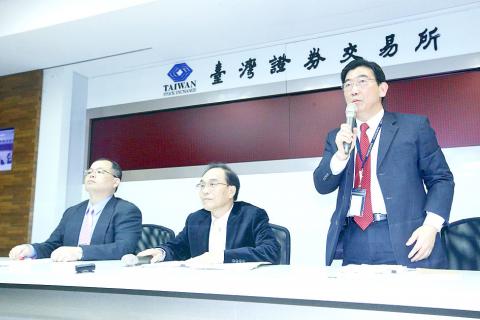
Photo: CNA
Hon Hai, along with its affiliated companies and Gou himself, are to pay ¥288.8 billion, or ¥88 per common share, for a 66 percent stake in Sharp, Hon Hai vice chairman Tai Cheng-wu (戴正吳) told a press conference at the Taiwan Stock Exchange (TWSE).
Hon Hai is also to invest another ¥100 billion, or ¥88 per share, to purchase Sharp’s class C shares, Tai said.
Sharp is to issue 3.28 billion new common shares and 11.36 million class C shares to Hon Hai and its affiliated companies, and the class C shares can be converted to common shares by July 1 next year, Tai added.
“The investment in Sharp’s Class-C shares has strategic meaning for us to help Sharp develop innovative technologies. We have plans for that investment,” Tai said.
Under the agreement, Hon Hai is to hold a 44.55 percent stake in Sharp, the Taiwanese company’s metal casing subsidiary Foxconn Technology Co (鴻準) is to have a 13 percent share in Sharp, while Gou is to personally hold an 8.45 percent stake via his LCD plant in Sakai, Japan.
The ¥88 per share is 25.42 percent lower than Sharp’s earlier plan of ¥118 per share.
On Feb. 25, Sharp said it would issue about US$4.4 billion in new shares, or ¥118 per share, to Hon Hai, but the Taiwanese company put the deal on hold for more than a month after it discovered the Japanese company had previously undisclosed potential liabilities.
Tai denied speculation that Hon Hai bargained to cut the offer to Sharp due to the Japanese company’s financial status.
“We did not slash the price. The result is under mutual consent. This is a reasonable offer and we hold responsibility to our shareholders regarding any investments we make,” Tai told reporters on the sidelines of the news conference.
Tai said that Hon Hai would not need to take bank loans for the nearly ¥400 billion investment in Sharp.
“We do not need to borrow money from the banks… Hon Hai has more than NT$600 billion (US$18.5 billion) cash,” Tai said.
Given that Hon Hai directly holds less than a 45 percent stake in Sharp, the Japanese company’s earnings would be booked in Hon Hai’s non-operating segment instead of in Hon Hai’s consolidated revenues, he said.
Hon Hai yesterday reported a net income of NT$146.86 billion for last year, up 12.51 percent from NT$130.53 billion made in the previous year, owing to a better product mix, continued efforts in industrial automation and strong demand for its consumer electronics products.
That marks the highest annual net income performance in the company’s history, according to a company filing with the stock exchange.
Hon Hai’s earnings per share were NT$9.42 last year, compared with NT$8.4 per share in 2014. Gross margin increased by 0.22 percentage points to 7.15 percent, while operating margin grew by 0.26 percentage points to 3.66 percent last year.
Sharp also said after the market’s close that it expects an operating loss of 170 billion yen for the fiscal year ending on March 31, reversing an earlier forecast for a profit of 10 billion yen. Sharp’s stock rose 3.9 percent to 135 yen in Tokyo trading.
Additional reporting by Bloomberg

‘NO SECURITY RISK’: The Railway Bureau reassured the public that the technicians’ activities were limited to technical guidance and did not involve sensitive systems The Railway Bureau yesterday said it had invited eight Chinese technicians to assist with an airport MRT construction project. The bureau issued the confirmation after an Internet user said Chinese nationals had entered the construction zone of Taiwan Taoyuan International Airport’s Terminal 3 project. They asked why “individuals from an enemy state” were allowed access to such a major national infrastructure project, which raised serious concerns over Taiwan’s industrial safety, sensitive systems and information security. The bureau’s Northern Region Engineering Branch Office said subcontractor Taiwan Handle Industrial Co (台灣手把工業) of the Taoyuan airport MRT’s “Contract No. CU05 Project A14 Station Civil, MEP &

The National Chungshan Institute of Science and Technology yesterday showcased its locally developed variants of the Vision 60 robotic patrol dog, which it plans to deploy on the nation’s outlying territories in the South China Sea. The variants were produced under the Joint Lab project — created by the institute and domestic companies — and assembled with domestically produced motors, lenses and artificial intelligence (AI) systems alongside licensed tech from the US, Missile and Rocket Systems Research Division deputy director Jen Kuo-kang (任國光) told the media event at a military base in Taipei’s Dazhi (大直) area. Taiwan has built up its strengths

NOT IMMEDIATE: Taiwan has a chance to appeal the proposed 10 percent tariff before it starts, while other countries face a 12.5 percent tariff from the trade office Taiwan is among 60 economies determined by the US to have failed to impose or enforce a ban on the importation of goods produced with forced labor, according to a notice released on Tuesday by the Office of the US Trade Representative (USTR), which proposed imposing an additional 10 percent or more tariff on them. The USTR in a statement said that following an investigation, it had determined under Section 301 of the Trade Act of 1974 that the failure of the 60 economies to impose and effectively enforce a prohibition on the importation of goods produced with forced labor is

TIT-FOR-TAT: The US allegedly revoked the visa of a Chinese national working at Xinhua News Agency in the US in response to Beijing’s expulsion of Vivian Wang The Presidential Office yesterday condemned China for expelling a New York Times correspondent from Beijing following the newspaper’s interview with President William Lai (賴清德), saying the move highlighted Beijing’s suppression of press freedom and its threat to international news media. Taiwan has noted a series of recent incidents in which Beijing used similar tactics to “threaten and pressure international media outlets and journalists,” Presidential Office spokeswoman Karen Kuo (郭雅慧) said in a statement. “This concerns not only press freedom and freedom of expression, but also the safety of journalists, and Taiwan and relevant partners are paying close attention to the situation,” she


 RSS
RSS