


People yesterday took to the streets in Taipei to demand better food safety and protesting against Ting Hsin International Group (頂新國際集團), which was involved in an adulterated cooking oil scandal.
The rally began at 2:15pm on Ketagalan Boulevard to the sound of a rap song created for the event with lyrics including: “We want food safety, to feel safe when we eat,” “Taiwan is famous for delicious food, but now even China is banning tainted food from Taiwan” and “We are against ‘black-hearted’ food.”
The event was initiated by Chang Jen-chi (張仁吉), who last year launched an online campaign to boycott Ting Hsin products.
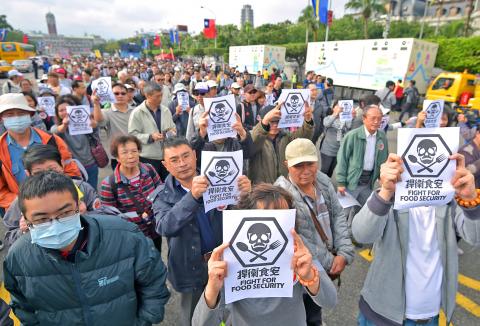
Photo: Wang Min-wei, Taipei Times
Protesters criticized the not-guilty ruling handed down to former Ting Hsin employees by the Changhua District Court late last month over alleged breaches of the Act Governing Food Safety and Sanitation (食品安全衛生管理法) after the firm was accused of using animal feed-grade oil and fat in cooking oil meant for human consumption in 2013.
“We urge amendments to the act so that anyone who has been found guilty in a food safety case is barred from operating a food company ever again,” Chang said, adding that the ban should also apply to close relatives of those found guilty.
“We are not only against Ting Hsin, but we also demand food safety,” Revolution Congress convener Wang Yi-kai (王奕凱) said.
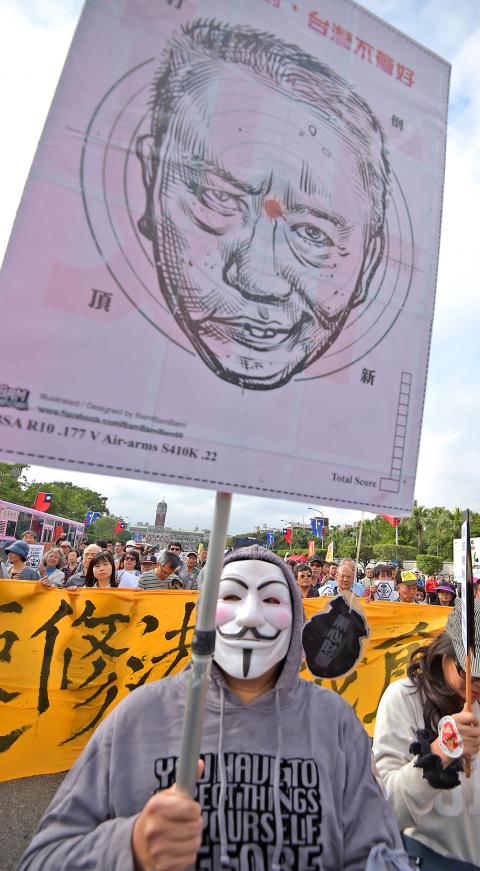
Photo: Wang Min-wei, Taipei Times
“It is because Ting Hsin has food safety problems that we want to terminate it,” which is a way to demand food safety, said Wang, who helped organize the protest. “We want companies to know that society has the power to resist them, so companies will not keep looking for loopholes in the law.”
In response to questions about Wei Chuan Foods Corp (味全食品工業), a subsidiary of Ting Hsin, Chang said that “because Ting Hsin has a stake of about 40 percent stake in Wei Chuan, for every NT$100 spent buying Lin Feng Ying (林鳳營) milk made by Wei Chuan, Ting Hsin makes NT$40.”
“We do not want Ting Hsin to make any money,” Chang said, referring to protests earlier in the week where Costco stores were targeted in a milk-buying-and-refund campaign.
On Facebook, the organizers invited Wei Chuan managing director Michael Su (蘇守斌) to join the parade and said the firm should buy back its shares from Ting Hsin.
A protester wearing a striped shirt mimicking jail clothing displaying the words “prisoner” and “guilty” said that having lived abroad for 23 years, he had seen several executives involved in food scandals apologize to the public and face judicial punishment.
The man, surnamed Wu (吳), said he felt that the Ting Hsin case had left Taiwanese feeling cheated, as those things had not happened in this case.
A man surnamed Wang (王) said he felt that the government had not done its job properly and had protected Ting Hsin.
“I feel hopelessness over the court’s ruling,” he said.
The protesters walked nearby streets chanting: “Food scandals revealed one after another, the people must take to the streets for justice” before returning to the start point in front of the Presidential Office Building at about 4pm.
There, participants were invited to speak.
Before the event ended at about 5:30pm, Wang Yi-kai said that they had communicated face-to-face with Executive Yuan officials earlier in the day concerning the demands of the public over food safety.
He said the demands included amendments to regulations, a new investigation into the Ting Hsin case, cooperation with other nations to initiate action against producers of unethical food, protection of labor rights for employees of unethical companies and bolstering laws to prevent conflicts of interest by government officials in food scandals, as well as increasing bonuses for people who report food safety problems.
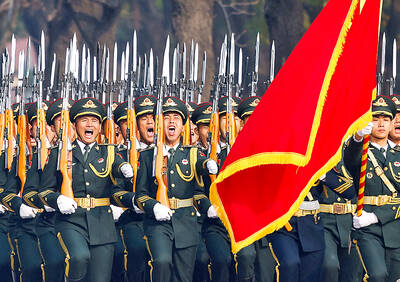
Conflict with Taiwan could leave China with “massive economic disruption, catastrophic military losses, significant social unrest, and devastating sanctions,” a US think tank said in a report released on Monday. The German Marshall Fund released a report titled If China Attacks Taiwan: The Consequences for China of “Minor Conflict” and “Major War” Scenarios. The report details the “massive” economic, military, social and international costs to China in the event of a minor conflict or major war with Taiwan, estimating that the Chinese People’s Liberation Army (PLA) could sustain losses of more than half of its active-duty ground forces, including 100,000 troops. Understanding Chinese
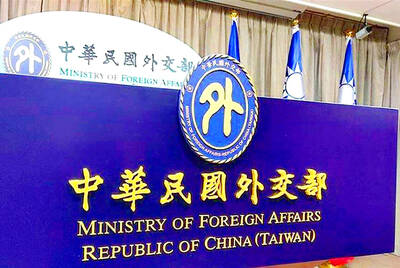
The Ministry of Foreign Affairs (MOFA) yesterday said it is closely monitoring developments in Venezuela, and would continue to cooperate with democratic allies and work together for regional and global security, stability, and prosperity. The remarks came after the US on Saturday launched a series of airstrikes in Venezuela and kidnapped Venezuelan President Nicolas Maduro, who was later flown to New York along with his wife. The pair face US charges related to drug trafficking and alleged cooperation with gangs designated as terrorist organizations. Maduro has denied the allegations. The ministry said that it is closely monitoring the political and economic situation

UNRELENTING: China attempted cyberattacks on Taiwan’s critical infrastructure 2.63 million times per day last year, up from 1.23 million in 2023, the NSB said China’s cyberarmy has long engaged in cyberattacks against Taiwan’s critical infrastructure, employing diverse and evolving tactics, the National Security Bureau (NSB) said yesterday, adding that cyberattacks on critical energy infrastructure last year increased 10-fold compared with the previous year. The NSB yesterday released a report titled Analysis on China’s Cyber Threats to Taiwan’s Critical Infrastructure in 2025, outlining the number of cyberattacks, major tactics and hacker groups. Taiwan’s national intelligence community identified a large number of cybersecurity incidents last year, the bureau said in a statement. China’s cyberarmy last year launched an average of 2.63 million intrusion attempts per day targeting Taiwan’s critical
AGING: As of last month, people aged 65 or older accounted for 20.06 percent of the total population and the number of couples who got married fell by 18,685 from 2024 Taiwan has surpassed South Korea as the country least willing to have children, with an annual crude birthrate of 4.62 per 1,000 people, Ministry of the Interior data showed yesterday. The nation was previously ranked the second-lowest country in terms of total fertility rate, or the average number of children a woman has in her lifetime. However, South Korea’s fertility rate began to recover from 2023, with total fertility rate rising from 0.72 and estimated to reach 0.82 to 0.85 by last year, and the crude birthrate projected at 6.7 per 1,000 people. Japan’s crude birthrate was projected to fall below six,


 RSS
RSS