


Aung San Suu Kyi’s party yesterday secured a landslide election victory in Myanmar, propelling the pro-democracy movement to power after a 25-year struggle against authoritarian rule.
It promises a new dawn for a country asphyxiated by half a century of army rule that battered the economy and repressed its people.
In a reflection of rapid changes that have swept the nation, confirmation of the win came five years to the day since Aung San Suu Kyi was released from house arrest by the then-military government.

Photo: AFP
She has now led her National League for Democracy (NLD) party to a massive popular mandate with more than 80 percent of seats going to the movement.
The NLD sailed through the two-thirds majority it needs to rule, claiming 364 parliamentary seats with a number of results yet to be declared.
The election has won praise from observers for its smooth, peaceful passing, in a country where democratic milestones have usually met with violence and repression.
“We have been ready to form a new government for many years,” party spokesman Nyan Win told reporters after the result.
Aung San Suu Kyi, 70, has not spoken to the party faithful since Monday.
In Yangon, there were no immediate signs of celebration after the party figurehead urged restraint from supporters, aware of the threat of a backlash in a nation where the army’s writ remains large.
Under Myanmar’s complex political system, the NLD has to wait until March next year for the transfer of power.
That gap has left some party loyalists nervous at the potential for political chicanery by an army establishment that wields substantial power, despite its chastening at the polls.
However, the comfortable majority gives Aung San Suu Kyi’s party control of the lower and upper houses, allowing it to elect the president and form a government.
Aung San Suu Kyi is barred from the presidency by a junta-scripted constitution, which also guarantees the army a 25 percent bloc of seats.
She has already vowed to govern from “above the president” saying she will circumnavigate the charter ban by backing a proxy to run for the top office.
The win represents a huge stride in Aung San Suu Kyi’s decades-long journey from political prisoner, held under house arrest for 15 years by the former junta, to the heart of power.
Many NLD supporters have waited 25 years for their vote to count.
“I’m so happy ... Aung San Suu Kyi will do more for us than the current government,” 66-year-old street vendor Moe Thu said.
Buoyed by her party’s sweep of the polls, Aung San Suu Kyi has called for “national reconciliation talks” with Burmese President Thein Sein and army chief Min Aung Hlaing.
Both men have congratulated the NLD on its election performance and have vowed to abide by the result as well as help a peaceful transition of power.
Lower house speaker Shwe Mann has also been invited to talks, but his political stock appears low after losing his seat and falling out with many senior figures from the ruling Union Solidarity and Development Party (USDP).
The USDP, which is made up of former military cadres, has been mauled at the election.
Yet the president, a former general who swapped his uniform for civilian clothes to lead the government in 2011, has won praise for steering the reforms that culminated in Sunday’s peaceful poll.
UN Secretary General Ban Ki-moon congratulated Aung San Suu Kyi for her election win, but also hailed the “courage and vision” of Thein Sein for “leadership in the reform process.”
Those reforms have seen many political prisoners released, the restoration of basic freedoms and the economy resuscitated after years of madcap junta planning.
The international community has welcomed the election, with US President Barack Obama calling both Aung San Suu Kyi and the president to offer his congratulations.
Obama has spent great efforts on helping Myanmar’s transition from authoritarian rule to an emergent democracy, visiting the nation twice in the past four years.
Yet the country’s military is not about to disappear. It retains major influence with its parliamentary bloc, which effectively assures a veto over constitutional change.
It also has key ministerial posts reserved under the charter.
Many NLD supporters remain deeply suspicious of the army and its political allies, who are notorious for dirty tricks and crackdowns that have left hundreds dead and thousands jailed.
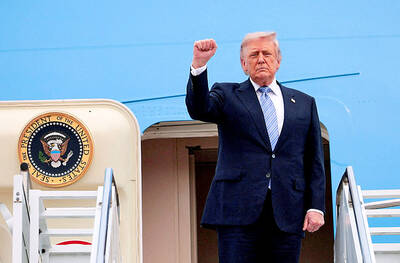
US-CHINA SUMMIT: MOFA welcomed US reassurance of no change in its Taiwan policy; Trump said he did not comment when Xi talked of opposing independence US President Donald Trump yesterday said he has not made a decision on whether to move forward with a major arms package for Taiwan after hearing concerns about it from Chinese President Xi Jinping (習近平). Trump’s comments on Taiwan came as he flew back to Washington after wrapping up critical talks in which both leaders said important progress was made in stabilizing US-China relations even as deep differences persist between the world’s two biggest powers on Iran and Taiwan. “I will make a determination,” Trump said, adding: “I’ll be making decisions. But, you know, I think the last thing we need right
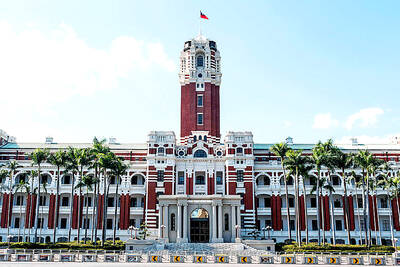
SECURITY: Taipei presses the US for arms supplies, saying the arms sales are not only a reflection of the US security commitment to Taiwan but also serve as a mutual deterrent against regional threats Taiwan is committed to preserving the cross-strait “status quo” and contributing to regional peace and stability, the Presidential Office said yesterday. “It is an undeniable fact that the Republic of China is a sovereign and independent democratic nation,” Presidential Office spokeswoman Karen Kuo (郭雅慧) reiterated, adding that Beijing has no right to claim sovereignty over Taiwan. The statements came after US President Donald Trump warned against Taiwanese independence. Trump wrapped up a state visit to Beijing on Friday, during which Chinese President Xi Jinping (習近平) had pressed him not to support Taiwan. Taiwan depends heavily on US security backing to deter China from carrying
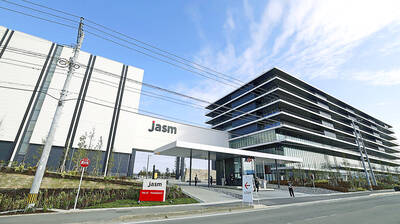
The subsidiary of Taiwan Semiconductor Manufacturing Co (TSMC, 台積電) in Kumamoto, Japan, turned a profit in the first quarter of this year, marking the first time the first fab of the unit has become profitable since mass production started at the end of 2024. According to the contract chipmaker’s financial statement released on Friday, Japan Advanced Semiconductor Manufacturing Inc (JASM), a joint venture running the fab in Kumamoto, posted NT$951 million (US$30.19 million) in profit in the January-to-March period, compared with a loss of NT$1.39 billion in the previous quarter, and a loss of NT$3.25 billion in the first quarter of
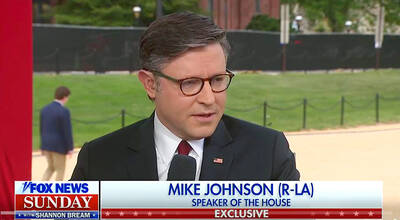
RESOLUTE BACKING: Two Republican senators are planning to introduce legislation that would impose immediate sanctions on China if it attempts to invade Taiwan US House of Representatives Speaker Mike Johnson on Sunday reaffirmed US congressional support for Taiwan, saying the US and “all freedom-loving people” have a stake in preventing China from seizing Taiwan by force. Johnson made the remarks in an interview with Fox News Sunday on US President Donald Trump’s summit with Chinese President Xi Jinping (習近平) last week. In an interview that aired on Friday on Fox News, just as Trump wrapped up a high-stakes visit to China, he said he has yet to green-light a new US$14 billion arms package to Taiwan and that it “depends on China.” “It’s a very good


 RSS
RSS