


The US yesterday defied China by sending a warship close to artificial islands China is building in disputed waters, prompting Beijing to furiously denounce what it called a threat to its sovereignty.
The USS Lassen passed within 12 nautical miles (22.2km) — the normal limit of territorial waters around natural land — of at least one of the formations Beijing claims in the South China Sea.
Chinese authorities “monitored, shadowed and warned” the guided-missile destroyer in the Spratly islands (Nansha Islands, 南沙群島) — which Taiwan, Malaysia, the Philippines, Vietnam and Brunei also state claims to — Beijing said.
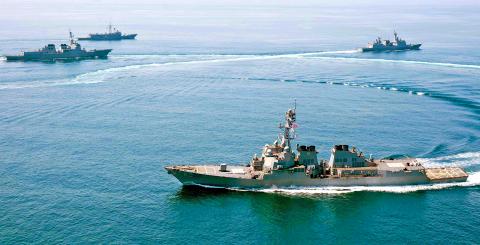
Photo: EPA
Washington’s long-awaited move to assert freedom of navigation might escalate the dispute over the strategically vital waters, where Beijing has been transforming reefs and outcrops into artificial islands with potential military use.
China claims sovereignty over almost the whole of the area, raising concerns it could one day seek to dictate who might transit its bustling sea lanes.
The dispute has raised fears of clashes in an area through which one-third of the world’s oil passes.
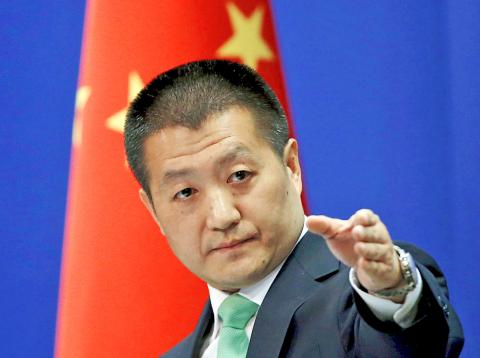
Photo: Reuters
The US action was part of the nation’s “routine operations in the South China Sea in accordance with international law,” a US official said.
“We will fly, sail and operate anywhere in the world that international law allows,” he added.
Chinese Ministry of Foreign Affairs spokesman Lu Kang (陸慷) blasted the exercise, saying the ship had “illegally entered” the waters near the islands “without receiving permission from the Chinese government.”
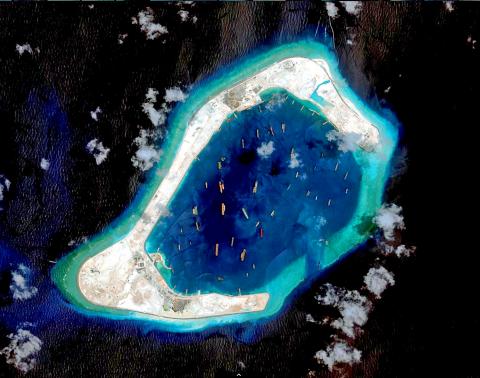
Photo: CNA
Beijing “resolutely opposes any country using freedom of navigation and overflight as a pretext for harming China’s national sovereignty and security interests,” he said, adding: “[China will] staunchly defend its territorial sovereignty.”
China’s Xinhua news agency condemned a “flagrant and baseless provocation” that added to regional instability.
However, despite the Chinese rhetoric, analysts said more such operations could be expected.
Beijing’s so far limited response showed that it had had “its bluff called,” said Rory Medcalf, director of the International Security Program at the Lowy Institute in Sydney.
“The US, and its allies and partners, should now help the Chinese leadership in saving face, by emphasizing that freedom of navigation operations are normal, not extraordinary,” he said.
There have been repeated confrontations in the area between Chinese vessels and boats from some of its neighbors who assert rights to the waters, particularly the Philippines and Vietnam.
Both are members of ASEAN, which has long called on China to negotiate a code of conduct in the region, as are fellow claimants Brunei and Malaysia. Taiwan also states claims over part of the sea.
Manila has infuriated the world’s second-largest economy by taking the dispute to a UN tribunal, and Philippine President Benigno Aquino III said the US action demonstrated that “the balance of power says that there is not just a single voice that must be adhered to.”
Beijing’s South China Sea reclamations have been seen as an attempt to assert its claims by establishing physical facts in the water, but Aquino said: “There is no de facto changing of the reality on the ground.”
Beijing has repeatedly said the construction work is primarily for civilian purposes, and Chinese President Xi Jinping (習近平), during a visit to Washington last month, pledged that the nation would not militarize the area.
However, satellite images of the islands published by the Washington-based Center for Strategic and International Studies (CSIS) show that Beijing has reclaimed millions of square meters of land in the Spratlys.
The pictures also show a host of facilities with the potential for military applications being developed, including as many as three runways, at least one of them 3,000m long.
The US, which is engaged in a foreign policy “pivot” to Asia, and China, which has the world’s largest military and is expanding the reach of its navy, are jockeying for position in the Pacific region.
Beijing regularly calls for a “new model of major country relations,” implying equality between the world’s top two economic and military powers.
The US’ operations yesterday were “not directed at any specific country,” the US official said.
“US forces operate in the Asia-Pacific region on a daily basis, including in the South China Sea,” he added.
The sail-by was “long overdue,” said Bonnie Glaser, a senior China expert at CSIS, adding that the exercises “should be done quietly, regularly and often.”
“There should be no media fanfare,” she said.
“The way this has been handled has left the Chinese believing that the US is challenging its sovereignty, rather than simply exercising freedom of the seas,” she added.
Later yesterday, Chinese Vice Minister of Foreign Affairs Zhang Yesui (張業遂) summoned US ambassador to China Max Baucus. Zhang called the US patrol “extremely irresponsible” and urged the US to cease actions that harm China’s sovereignty and security interests, China Central Television reported.

An Emirates flight from Dubai arrived at Taiwan Taoyuan International Airport yesterday afternoon, the first service of the airline since the US and Israel launched strikes against Iran on Saturday. Flight EK366 took off from the United Arab Emirates (UAE) at 3:51am yesterday and landed at 4:02pm before taxiing to the airport’s D6 gate at Terminal 2 at 4:08pm, data from the airport and FlightAware, a global flight tracking site, showed. Of the 501 passengers on the flight, 275 were Taiwanese, including 96 group tour travelers, the data showed. Tourism Administration Deputy Director-General Huang He-ting (黃荷婷) greeted Taiwanese passengers at the airport and

POSSIBILITIES EMERGE: With Taiwan’s victory and Japan’s narrow win over Australia, Taiwan now have a chance to advance if South Korea also beat the Aussies Taiwan has high hopes that the national baseball team would advance to the World Baseball Classic (WBC) quarter-finals after clinching a crucial 5-4 victory over South Korea in a nail-biting extra-inning game at the Tokyo Dome yesterday. Boosted by three home runs — two solo shots by Yu Chang (張育成) and Cheng Tsung-che (鄭宗哲) and a two-run homer by Stuart Fairchild — the triumph gave Taiwan a much-needed second victory in the five-team Pool C, where only the top two finishers would advance to the knockout stage in Miami, Florida. Entering extra innings with the game tied at four apiece, Taiwan scored
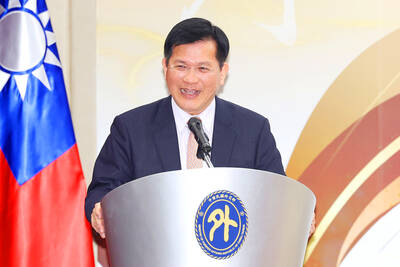
MISSION OF PEACE: The foreign minister urged Beijing to respect Taiwan’s existence as an independent nation, and work together to ensure peace and stability in the region Minister of Foreign Affairs Lin Chia-lung (林佳龍) yesterday rejected Chinese Minister of Foreign Affairs Wang Yi’s (王毅) comments about Taiwan, criticizing China as a “troublemaker” in the international community and a disruptor of cross-strait peace. Speaking at a news conference on the sidelines of the Chinese National People’s Congress, Wang said that Taiwan has always been a territory of China and that it would be impossible for it to become its own country. The “return” of Taiwan to China was the natural outcome of the Chinese people’s resistance against Japan in World War II, and that any pursuit of independence was “doomed
STRAIT OF HORMUZ: In the case of a prolonged blockade by Iran, Taiwan would look to sources of LNG outside the Middle East, including Australia and the US Taiwan would not have to ration power due to a shortage of natural gas, Minister of Economic Affairs Kung Ming-hsin (龔明鑫) said yesterday, after reports that the Strait of Hormuz was closed amid the conflict in the Middle East. The government has secured liquefied natural gas (LNG) supplies for this month and contingency measures are in place if the conflict extends into next month, Kung told lawmakers. Saying that 25 percent of Taiwan’s natural gas supplies are from Qatar, Chinese Nationalist Party (KMT) caucus secretary-general Lin Pei-hsiang (林沛祥) asked about the situation in light of the conflict. There would be “no problems” with


 RSS
RSS