


Zimbabwean President Robert Mugabe has crushed political opponents in his country, while democratic challengers and their supporters have faced intimidation, jail and worse.
Mugabe, whose ZANU-PF party controls the levers of power, has presided over economic policies that have resulted in rampant inflation and poverty. Widely condemned by Western governments, he is considered one of the most uncompromising rulers in Africa.
Now he can claim the honor of being awarded a Confucius Peace Prize, the Chinese answer to the Nobel Peace Prize.
A group based in Hong Kong that says it is the official organizer of the prize has selected Mugabe as this year’s recipient.
Among the finalists for the award were UN Secretary-General Ban Ki-moon, South Korean President Park Geun-hye and Microsoft founder and philanthropist Bill Gates.
The Confucius Peace Prize was established in late 2010 as a rejoinder to the Nobel Peace Prize that was awarded to Liu Xiaobo (劉曉波), a dissident Chinese literary critic who is serving a 11-year prison sentence on a charge of subversion. His wife, Liu Xia (劉霞), is under house arrest.
The Confucius Peace Prize ceremony is to be held in December.
Organizers say the Diaoyutai State Guesthouse in Beijing will be the venue if Mugabe, 91, agrees to attend. The prize comes with a financial reward of 500,000 yuan (US$80,000).
“The 21st-century interpretation of Confucianism is ‘universal harmony in the world,’” Qiao Wei (譙偉), a poet and the president of the judging committee of the peace prize, said in a telephone interview on Thursday. “Mugabe is the founding leader of Zimbabwe and has been trying to stabilize the country’s political and economic order ever since the country was first founded. He brought benefit to the people of Zimbabwe.”
Mugabe had his start in politics as a Pan-African nationalist who opposed minority white rule in the former British colony and country then known as Rhodesia. The Rhodesian government used brutal tactics to try to suppress nationalist movements, and Mugabe was imprisoned for more than 10 years, but the country finally achieved full independence from Britain in 1980.
Mugabe became prime minister and quickly set up an authoritarian system, including managing security forces that on occasion acted as death squads.
“As the president of Zimbabwe or the chairman of the African Union, he has always been pushing forward the cause of peace in Africa,” Qiao said. “He has been working hard even in his 90s. This shows he has ideals in his heart. He has been trying to support the independence of Africa. He has his ‘African Dream.’”
Qiao said that the Confucius Peace Prize committee and the Nobel committee had both looked to Africa for candidates this year.
The Nobel Peace Prize was awarded this month to the National Dialogue Quartet of Tunisia, a grass-roots pro-democracy group.
Critics in Zimbabwe and elsewhere were swift to condemn the honor given to Mugabe.
Qiao said he did not blame Mugabe for the soaring inflation that has crippled the country’s economy.
“Zimbabwe is a relatively small country in southern Africa,” he said. “It’s normal for the country to experience economic downturns for several or more than a dozen years. Even in many developed countries now, the economy is not ‘running’ all the time. It also halts or even goes backward.”
Last year, the Confucius Peace Prize was awarded to former Cuban president Fidel Castro. In 2011, Russian President Vladimir Putin won. The first recipient was former vice president Lien Chan (連戰). He learned of the prize when journalists called for comment.

‘NO SECURITY RISK’: The Railway Bureau reassured the public that the technicians’ activities were limited to technical guidance and did not involve sensitive systems The Railway Bureau yesterday said it had invited eight Chinese technicians to assist with an airport MRT construction project. The bureau issued the confirmation after an Internet user said Chinese nationals had entered the construction zone of Taiwan Taoyuan International Airport’s Terminal 3 project. They asked why “individuals from an enemy state” were allowed access to such a major national infrastructure project, which raised serious concerns over Taiwan’s industrial safety, sensitive systems and information security. The bureau’s Northern Region Engineering Branch Office said subcontractor Taiwan Handle Industrial Co (台灣手把工業) of the Taoyuan airport MRT’s “Contract No. CU05 Project A14 Station Civil, MEP &

A US uncrewed surface vessel (USV) encountered multiple Chinese warships during an autonomous transit of the Taiwan Strait, US defense company Seasats said in a statement on Wednesday. Seasats announced that a Lightfish USV had completed the first autonomous transit of the Taiwan Strait. Over five days, the USV traversed the entire length of the Strait while constantly monitoring surface vessel traffic, the company said. The Lightfish encountered multiple Chinese warships, one of which was a Chinese People’s Liberation Army Navy (PLAN) Type 056 corvette, it said. The Chinese vessels were operating “well within Taiwan’s exclusive economic zone without transmitting their identity via the
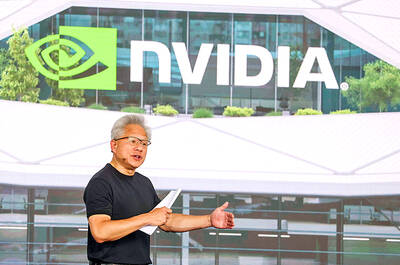
‘BOOMING’: ’ The number of partners we have here is incredible. You can see from their stock prices. They’re doing so well, they’re so happy,’ Jensen Huang said Nvidia Corp’s spending in Taiwan has ballooned to about US$150 billion a year, 10 times the US$10 billion to US$15 billion the company spent five years ago, Nvidia chief executive officer Jensen Huang (黃仁勳) said yesterday, suggesting Taiwan’s strategic importance in the global artificial intelligence (AI) supply chain. “Taiwan is the epicenter of the AI revolution. This is where the chips come, packaging comes. This is where the systems are made. This is where AI supercomputers were created,” Huang said at a meeting for the company’s employees in Beitou-Shilin Technology Park (北投士林科技園區) in Taipei, the planned site of Nvidia’s Taipei headquarters. “Taiwan
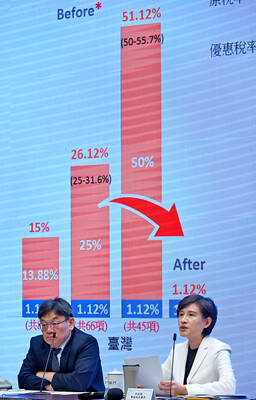
GREATER REACH? Auto parts and wood products would face tariffs of up to 15%, matching those targeting the EU, Japan and South Korea, Vice Premier said The US has announced that preferential tariff treatment for Taiwan’s non-semiconductor Section 232 goods would take effect retroactively from May 1, the Executive Yuan said yesterday. The US government yesterday posted a notice on the Federal Register’s public inspection Web site previewing tariff concessions for Taiwan under a memorandum of understanding (MOU) on Taiwan-US investment after two months of negotiations. The MOU signed on Jan. 15 stipulated three major preferential tariff arrangements: a 15 percent “reciprocal” tariff rate for Taiwan without stacking most-favored nation (MFN) rates; preferential Section 232 treatment for semiconductors and related products; and preferential Section 232 treatment for non-semiconductor


 RSS
RSS