


Newly anointed Chinese Nationalist Party (KMT) presidential candidate Eric Chu (朱立倫), who is also mayor of New Taipei City, yesterday asked whether Democratic Progressive Party presidential candidate Tsai Ing-wen’s (蔡英文) idea of the “status quo” with China encompasses a “two-state theory” or the DPP’s Taiwanese independence platform.
In an interview with the Chinese-language United Evening News, Chu said that Tsai must offer a clearer explanation of her take on the “status quo.”
When asked whether Legislative Speaker Wang Jin-pyng (王金平) would top the KMT’s list of recommended legislators-at-large, Chu said that Wang and the party had reached a consensus in which they would work as a team, adding that Wang is one of the KMT’s crucial assets.
Chu said he would provide a more complete account at a New Taipei City Council meeting today of his vow to serve out his term as mayor, as he is expected to quit that position to concentrate on his presidential bid.
After the KMT’s extempore party congress on Saturday annulled Deputy Legislative Speaker Hung Hsiu-chu’s (洪秀柱) nomination as its presidential candidate on Saturday, Chu said on Facebook that he had considered a presidential bid before last year’s nine-in-one elections.
“I have to say sorry to those who support or once supported me,” Chu wrote. “I understand your anger and disappointment, and need to bear its weight. My previous decision not to run for president betrayed many people’s expectations.”
“I believe that most of the negative emotions were incited by questions over whether I made the decision not to run because I was afraid to lose,” he said.
“Of course I thought about running, but the party wanted me to run for re-election [as mayor] and keep the stronghold in New Taipei City last year,” he said. “I announced my re-election bid and promised not to enter next year’s race.”
“It would be overestimating my ability to correctly predict fortunes if people think that I had could see that the KMT was going to take a drubbing and found an excuse to drop out,” he added.
The Facebook post spawned a string of memes making fun of its first sentences, which said: “I’ve just made a cup of coffee. Facing the computer screen with no cars or people on the streets; the night, along with quietness, has fallen. [I have remained] silent for too long; the damage has been done. Now it is time for me to straighten out some confusion.”
The message was posted after 8pm on Saturday, prompting netizens to ask why there would be “no cars nor people” on the streets.
“Where exactly do you live, Eric?” one asked.
“Do you live in Neihu?” asked another, an apparent reference to former KMT Taipei mayoral candidate Sean Lien (連勝文), who said last year that Neihu is “overwhelmingly dark” at night.
Netizens expressed concern over a possible aide posting the article on Chu’s behalf.
“It was apparently posted too early. I hope she is not fired,” one wrote.
In related news, KMT spokesman Yang Wei-chung (楊偉中) said Chu is considering a visit to the US, but the details are still being planned.
Media reports have said that Chu might make a one-week trip to the US next month, with a possible stop in Japan on his way back.
Additional reporting by CNA

‘NO SECURITY RISK’: The Railway Bureau reassured the public that the technicians’ activities were limited to technical guidance and did not involve sensitive systems The Railway Bureau yesterday said it had invited eight Chinese technicians to assist with an airport MRT construction project. The bureau issued the confirmation after an Internet user said Chinese nationals had entered the construction zone of Taiwan Taoyuan International Airport’s Terminal 3 project. They asked why “individuals from an enemy state” were allowed access to such a major national infrastructure project, which raised serious concerns over Taiwan’s industrial safety, sensitive systems and information security. The bureau’s Northern Region Engineering Branch Office said subcontractor Taiwan Handle Industrial Co (台灣手把工業) of the Taoyuan airport MRT’s “Contract No. CU05 Project A14 Station Civil, MEP &

A US uncrewed surface vessel (USV) encountered multiple Chinese warships during an autonomous transit of the Taiwan Strait, US defense company Seasats said in a statement on Wednesday. Seasats announced that a Lightfish USV had completed the first autonomous transit of the Taiwan Strait. Over five days, the USV traversed the entire length of the Strait while constantly monitoring surface vessel traffic, the company said. The Lightfish encountered multiple Chinese warships, one of which was a Chinese People’s Liberation Army Navy (PLAN) Type 056 corvette, it said. The Chinese vessels were operating “well within Taiwan’s exclusive economic zone without transmitting their identity via the
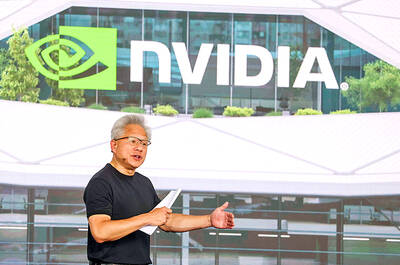
‘BOOMING’: ’ The number of partners we have here is incredible. You can see from their stock prices. They’re doing so well, they’re so happy,’ Jensen Huang said Nvidia Corp’s spending in Taiwan has ballooned to about US$150 billion a year, 10 times the US$10 billion to US$15 billion the company spent five years ago, Nvidia chief executive officer Jensen Huang (黃仁勳) said yesterday, suggesting Taiwan’s strategic importance in the global artificial intelligence (AI) supply chain. “Taiwan is the epicenter of the AI revolution. This is where the chips come, packaging comes. This is where the systems are made. This is where AI supercomputers were created,” Huang said at a meeting for the company’s employees in Beitou-Shilin Technology Park (北投士林科技園區) in Taipei, the planned site of Nvidia’s Taipei headquarters. “Taiwan
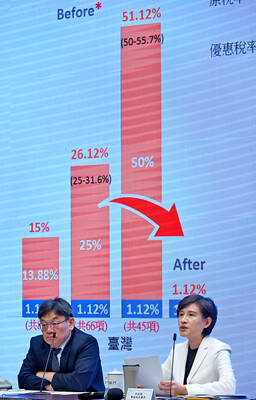
GREATER REACH? Auto parts and wood products would face tariffs of up to 15%, matching those targeting the EU, Japan and South Korea, Vice Premier said The US has announced that preferential tariff treatment for Taiwan’s non-semiconductor Section 232 goods would take effect retroactively from May 1, the Executive Yuan said yesterday. The US government yesterday posted a notice on the Federal Register’s public inspection Web site previewing tariff concessions for Taiwan under a memorandum of understanding (MOU) on Taiwan-US investment after two months of negotiations. The MOU signed on Jan. 15 stipulated three major preferential tariff arrangements: a 15 percent “reciprocal” tariff rate for Taiwan without stacking most-favored nation (MFN) rates; preferential Section 232 treatment for semiconductors and related products; and preferential Section 232 treatment for non-semiconductor


 RSS
RSS