


Taipei Mayor Ko Wen-je (柯文哲) yesterday expounded on his views on cross-strait relations at the Taipei-Shanghai forum, touting what he called the “2015 new standpoint,” which he said is built on “four reciprocal processes” and a motif that both sides of the Taiwan Strait are “one family.”
Ko made the remarks during his speech at the opening ceremony for the forum.
Ko started his speech by talking of the impermanence of the world today, before narrowing his subject down to what he described as the “long-lasting friendship” between Taipei and Shanghai.
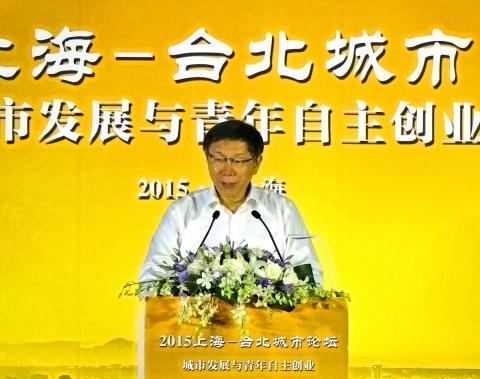
Photo: CNA
“This is an ever-changing world. Seven years ago, who would have thought that the iPhone would change the world? A year ago, who would have thought that I would become the mayor of Taipei? Just a month ago, who would have thought that I would be standing here in front of you today?” he said. “However, one thing remains unchanged, and that is the long-lasting friendship that Taipei and Shanghai have established.”
Ko said that his stance on cross-strait relations and the forum can be summarized as “one family across the Strait” and four “reciprocal” actions: to know each other, to understand each other, to respect each other and to work with each other.
He said that he has always abided by these principles to promote exchanges and increase goodwill across the Taiwan Strait, and that he hoped that Taipei and Shanghai would build on their “political common ground” and work together to boost cross-strait exchanges and push for peaceful development to serve the best interests of people on both sides of the Strait.
Responding to media queries after the speech, Ko said that he proposed the “2015 new standpoint” in March, and that he sees it as a new direction and starting point for cross-strait exchanges.
Asked whether he was concerned that his stance would spark controversy in Taiwan, he said: “I do not expect all political parties to accept it, but at least it would be tolerable. There has got to be something on the table so that everyone can engage in exchanges.”
He said that the greatest consensus formed between him and Shanghai Mayor Yang Xiong (楊雄) during the organization of the forum concerns the employment of a novel method in which “the public goes first; the government supports.”
“I believe that this method would also apply to future cross-strait exchanges. Through organizing forums, members of the public can discuss the issues among themselves. The government can then provide the necessary help according to the conclusions they reach,” he said, adding that the epiphany was his biggest reward during his visit to Shanghai.
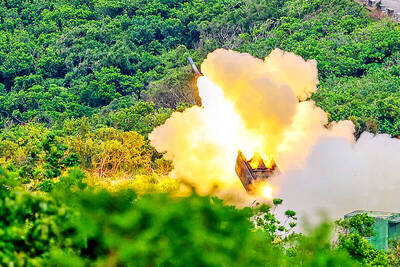
PRECISION STRIKES: The most significant reason to deploy HIMARS to outlying islands is to establish a ‘dead zone’ that the PLA would not dare enter, a source said A High Mobility Artillery Rocket System (HIMARS) would be deployed to Penghu County and Dongyin Island (東引) in Lienchiang County (Matsu) to force the Chinese military to retreat at least 100km from the coastline, a military source said yesterday. Taiwan has been procuring HIMARS and Army Tactical Missile Systems (ATACMS) from the US in batches. Once all batches have been delivered, Taiwan would possess 111 HIMARS units and 504 ATACMS, which have a range of 300km. Considering that “offense is the best defense,” the military plans to forward-deploy the systems to outlying islands such as Penghu and Dongyin so that

WHAT WAS ALL THAT FOR? Jaw Shaw-kong said that Cheng Li-wen had pushed for more drastic cuts and attacked him, just for the outcome to be nearly identical to his bill The legislature yesterday passed a supplementary budget bill to fund the purchase of separate packages of US military equipment, with the combined amount of spending capped at NT$780 billion (US$24.8 billion). The Chinese Nationalist Party (KMT) and Taiwan People’s Party (TPP) used their legislative majority to pass the bill, which runs until 2033 and has two main funding provisions. One was for NT$300 billion of arms sales already approved by the US for Taiwan on Dec. 17 last year, the other was for NT$480 billion for another arms package expected to be announced by Washington. The bill, which fell short of the NT$1.25

‘CLEAR MESSAGE’: The bill would set up an interagency ‘tiger team’ to review sanctions tools and other economic options to help deter any Chinese aggression toward Taiwan US Representative Young Kim has introduced a bill to deter Chinese aggression against Taiwan, calling for an interagency “tiger team” to preplan coordinated sanctions and economic measures in response to possible Chinese military or political action against Taiwan. “[Chinese President] Xi Jinping [習近平] has directed the People’s Liberation Army to be ready to invade Taiwan by 2027. China has a plan. America should have one too,” Kim said in a news release on Thursday last week. She introduced the “Deter PRC [People’s Republic of China] aggression against Taiwan act” to “ensure the US has a coordinated sanctions strategy ready should

A former television news host and six military personnel — active and retired — have been indicted on espionage charges, Kaohsiung prosecutors said yesterday. Lin Chen-you (林宸佑), a former CTi News host and YouTuber, last year allegedly made videos at the direction of a Chinese agent criticizing the Democratic Progressive Party’s recall campaign, the Ciaotou District Prosecutors’ Office told a news conference in Kaohsiung. He allegedly received 4,325 tether coins for the videos from an unidentified person surnamed Huang (黃), believed to be an agent of a hostile foreign power, they said. Lin, also known as Ma Te (馬德), has a show named


 RSS
RSS