


The Hualien District Prosecutors’ Office yesterday said it might open a probe into the Criminal Investigation Bureau for possibly leaking key information, after a magazine published two photographs purportedly taken during the murder of five siblings in Hualien County nine years ago — images that the office said it had not seen.
The photographs published yesterday by the Chinese-language Next Magazine showed a gloved man — purportedly the murder suspect and the father of the five slain children, Liu Chih-chun (劉志勤) — tying up a girl, said to be his eldest daughter, Liu Chi-chen (劉其臻), on a bed.
The magazine alleged that Liu Chih-chun’s wife, Lin Chen-mi (林真米), the other suspect, took the pictures.
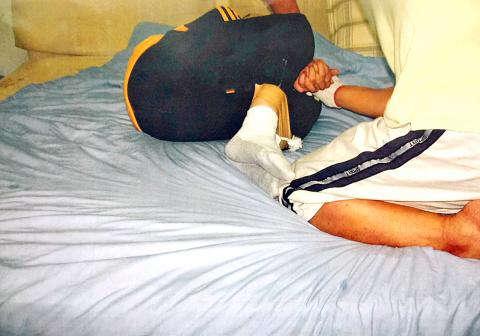
Photo: CNA
Head prosecutor Hsu Chien-jung (許建榮) said the office had not been given the photographs and immediately told the bureau to turn them over.
The bodies of the five children were discovered when police entered the couple’s house on Sept. 8, 2006, after neighbors complained of a foul odor coming from the residence.
The children were found strangled to death in the bathroom, with their hands and feet bound by wires.
A digital camera without a memory card was found at the murder scene and taken by the bureau as evidence, but technology to recover data in the camera’s internal memory emerged only recently, Hsu said.
The bureau restored about a dozen photographs, which were mostly regular family pictures unrelated to the slayings, except the two photographs published by Next Magazine, which are apparently crucial to the investigation and which the bureau should have submitted to the office, Hsu said.
The office ordered the bureau to turn over all the photographs it had restored, adding that it would investigate whether the bureau had violated the principle of secrecy during an investigation and whether it had withheld or improperly disclosed key information, Hsu said.
Rumors suggested that the crime scene photographs were extracted after investigators last week identified remains found on Tzuyun Mountain (慈雲山) as belonging to the couple.
However, the office combed through the files and evidence related to the case without finding the photographs published by the magazine, Hsu said.
According to Hsu, investigators said the couple probably committed suicide by ingesting pesticide on the remote mountainside, because they had no way to avoid capture and were driven to despair.
However, the couple’s cause of death and the motive behind the murders remains undetermined, he added.
The Ministry of Foreign Affairs (MOFA) yesterday said it is closely monitoring developments in Venezuela, and would continue to cooperate with democratic allies and work together for regional and global security, stability, and prosperity. The remarks came after the US on Saturday launched a series of airstrikes in Venezuela and kidnapped Venezuelan President Nicolas Maduro, who was later flown to New York along with his wife. The pair face US charges related to drug trafficking and alleged cooperation with gangs designated as terrorist organizations. Maduro has denied the allegations. The ministry said that it is closely monitoring the political and economic situation

UNRELENTING: China attempted cyberattacks on Taiwan’s critical infrastructure 2.63 million times per day last year, up from 1.23 million in 2023, the NSB said China’s cyberarmy has long engaged in cyberattacks against Taiwan’s critical infrastructure, employing diverse and evolving tactics, the National Security Bureau (NSB) said yesterday, adding that cyberattacks on critical energy infrastructure last year increased 10-fold compared with the previous year. The NSB yesterday released a report titled Analysis on China’s Cyber Threats to Taiwan’s Critical Infrastructure in 2025, outlining the number of cyberattacks, major tactics and hacker groups. Taiwan’s national intelligence community identified a large number of cybersecurity incidents last year, the bureau said in a statement. China’s cyberarmy last year launched an average of 2.63 million intrusion attempts per day targeting Taiwan’s critical
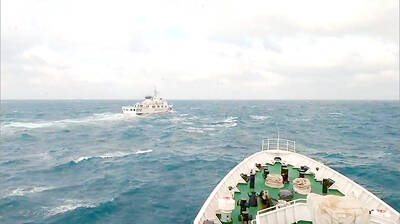
‘SLICING METHOD’: In the event of a blockade, the China Coast Guard would intercept Taiwanese ships while its navy would seek to deter foreign intervention China’s military drills around Taiwan this week signaled potential strategies to cut the nation off from energy supplies and foreign military assistance, a US think tank report said. The Chinese People’s Liberation Army (PLA) conducted what it called “Justice Mission 2025” exercises from Monday to Tuesday in five maritime zones and airspace around Taiwan, calling them a warning to “Taiwanese independence” forces. In a report released on Wednesday, the Institute for the Study of War said the exercises effectively simulated blocking shipping routes to major port cities, including Kaohsiung, Keelung and Hualien. Taiwan would be highly vulnerable under such a blockade, because it

Conflict with Taiwan could leave China with “massive economic disruption, catastrophic military losses, significant social unrest, and devastating sanctions,” a US think tank said in a report released on Monday. The German Marshall Fund released a report titled If China Attacks Taiwan: The Consequences for China of “Minor Conflict” and “Major War” Scenarios. The report details the “massive” economic, military, social and international costs to China in the event of a minor conflict or major war with Taiwan, estimating that the Chinese People’s Liberation Army (PLA) could sustain losses of more than half of its active-duty ground forces, including 100,000 troops. Understanding Chinese


 RSS
RSS