


Australia’s highest court yesterday ruled that the detention of asylum seekers from Sri Lanka on the high seas for almost a month was lawful, in a win for the government’s tough immigration policy.
The Australian High Court ruling means the group of 157 ethnic Tamils, who were picked up by an Australian customs boat in June last year after setting out from India, are not entitled to seek compensation.
Lawyers for the asylum seekers were disappointed with the decision, but said it was not unanimous and said the case succeeded in drawing attention to Australia’s secretive “Operation Sovereign Borders” activities.

Photo: Reuters
The UN refugee agency, which has criticized Australia’s treatment of asylum seekers, made submissions in the case.
“It took this case for the government to finally break its secrecy and confirm that it was detaining 157 people — including 50 children as young as one — on a boat somewhere on the high seas,” Human Rights Law Centre executive director Hugh de Kretser told reporters.
The case also prompted the government to promise not to return the group, who are being held in a detention center on the South Pacific island of Nauru, to India or Sri Lanka.
Australian Minister of Immigration Peter Dutton said the decision vindicated government policies.
He said that only one boat had reached Australia since the policies were implemented a year-and-a-half ago and authorities were seeing a decrease in the number of boats attempting the perilous voyage.
“We have stopped people drowning at sea, we have stopped the boats and this government is absolutely resolved the operation will continue,” Dutton told reporters in Canberra.
Australia received 16,000 asylum applications last year, just less than 0.5 percent of the 3.6 million lodged worldwide, UN figures show.
However, it is a polarizing political issue.
Conservative Australian Prime Minister Tony Abbott campaigned on a vow to “turn back the boats” before winning elections last year.
Following the High Court case, the government revised its immigration laws to reduce its obligations to follow international law and restrict the oversight of Australian courts.
The High Court’s 4-3 split in favor of the government meant the judgement needed to be analyzed to determine its full impact, lawyers said.
“There are points of law in which the majority agree with the minority,” said George Newhouse, a lawyer for the group.
“We need to distil those decisions and there may well not be a blank check to the government to do whatever they want to people in this position,” he added.
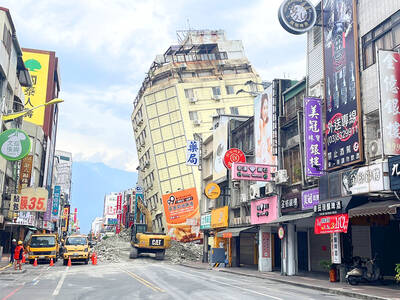
LANDSLIDES POSSIBLE: The agency advised the public to avoid visiting mountainous regions due to more expected aftershocks and rainfall from a series of weather fronts A series of earthquakes over the past few days were likely aftershocks of the April 3 earthquake in Hualien County, with further aftershocks to be expected for up to a year, the Central Weather Administration (CWA) said yesterday. Based on the nation’s experience after the quake on Sept. 21, 1999, more aftershocks are possible over the next six months to a year, the agency said. A total of 103 earthquakes of magnitude 4 on the local magnitude scale or higher hit Hualien County from 5:08pm on Monday to 10:27am yesterday, with 27 of them exceeding magnitude 5. They included two, of magnitude

A total of 41 US military personnel were stationed in Taiwan as of December last year, a US congressional report said on Friday last week ahead of Tuesday’s passage of an aid package that included US$8 billion for Taiwan. The Congressional Research Service in a report titled Taiwan Defense Issues for Congress said that according to the US Department of Defense’s Defense Manpower Data Center, 41 US military personnel were assigned for duty in Taiwan. Although the normalization of relations with the People’s Republic of China (PRC) in 1979 included a vow to withdraw a military presence from Taiwan, “observers have indicated
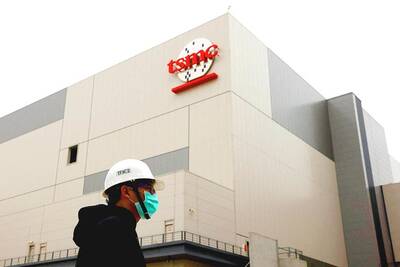
Taiwan Semiconductor Manufacturing Co (TSMC, 台積電) on Wednesday said that a new chip manufacturing technology called “A16” is to enter production in the second half of 2026, setting up a showdown with longtime rival Intel over who can make the fastest chips. TSMC, the world’s biggest contract manufacturer of advanced computing chips and a key supplier to Nvidia and Apple, announced the news at a conference in Santa Clara, California, where TSMC executives said that makers of artificial intelligence (AI) chips will likely be the first adopters of the technology rather than a smartphone maker. Analysts said that the technologies announced on
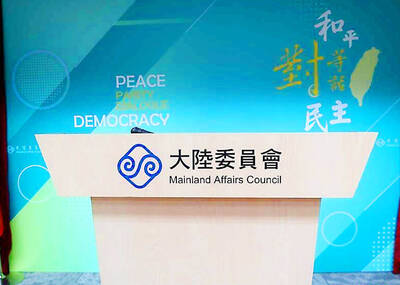
NO RECIPROCITY: Taipei has called for cross-strait group travel to resume fully, but Beijing is only allowing people from its Fujian Province to travel to Matsu, the MAC said The Mainland Affairs Council (MAC) yesterday criticized an announcement by the Chinese Ministry of Culture and Tourism that it would lift a travel ban to Taiwan only for residents of China’s Fujian Province, saying that the policy does not meet the principles of reciprocity and openness. Chinese Deputy Minister of Culture and Tourism Rao Quan (饒權) yesterday morning told a delegation of Chinese Nationalist Party (KMT) lawmakers in a meeting in Beijing that the ministry would first allow Fujian residents to visit Lienchiang County (Matsu), adding that they would be able to travel to Taiwan proper directly once express ferry


 RSS
RSS