


At least five people died after a car ferry caught fire in the Adriatic Sea, Greek and Italian officials said yesterday, as survivors described a terrifying ordeal that could easily have been much more deadly.
Four bodies were recovered from the waters around the stricken Norman Atlantic yesterday, a day after the body of a 62-year-old Greek man was pulled from the sea.
A 24-hour evacuation operation that proved to be extremely difficult was concluded shortly after midday, with the Italian navy saying only a skeleton crew of nine men had been left on board to prepare for the boat being towed to port.
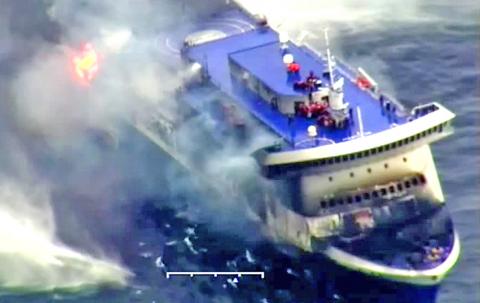
Photo: AFP
Wrapped in blankets and sporting bandages, 49 of the 478 passengers and crew who were on board the ferry when it caught fire shortly after dawn on Sunday disembarked from merchant ship Spirit of Pireus at the Italian port of Bari.
They and other evacuees told of how the fire had triggered panic that the crew appeared ill-prepared to deal with.
One of the first passengers off the merchant vessel in Bari told reporters he had thought he was going to die as parts of the boat became engulfed by thick smoke as the ferry traveled from Greece from Italy.
“We did not know what to do. The staff had no idea how to get people off the boat,” he said. “The lifeboats did not work, there was only one of them in the water and none of the crew were there to help people.”
Some of the rescued displayed mild symptoms of hypothermia, but doctors said they were mainly dealing with shock and trauma.
The evacuation was completed nearly 36 hours after a fire broke out on the car deck and left the huge vessel drifting dangerously in high seas off the coast of Albania.
With a second navy boat at the scene able to provide a landing deck for helicopters, the pace of the evacuation accelerated significantly yesterday. Once it was complete, questions began to be asked about how the fire started and why it was not contained.
Bari prosecutor Giuseppe Volpe announced a criminal investigation that will seek to establish if negligence contributed to the disaster.
The ferry’s owner, Italian Carlo Visentini, said he would cooperate.
He said that the vessel, which was leased to Greek operator ANEK ferries, had passed a technical inspection which included its firedoors on Dec. 19.
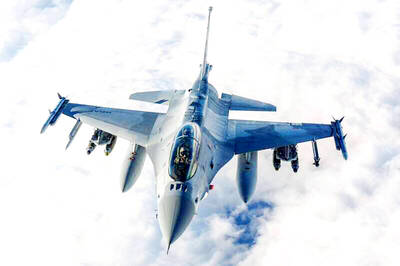
LONG FLIGHT: The jets would be flown by US pilots, with Taiwanese copilots in the two-seat F-16D variant to help familiarize them with the aircraft, the source said The US is expected to fly 10 Lockheed Martin F-16C/D Block 70/72 jets to Taiwan over the coming months to fulfill a long-awaited order of 66 aircraft, a defense official said yesterday. Word that the first batch of the jets would be delivered soon was welcome news to Taiwan, which has become concerned about delays in the delivery of US arms amid rising military tensions with China. Speaking on condition of anonymity, the official said the initial tranche of the nation’s F-16s are rolling off assembly lines in the US and would be flown under their own power to Taiwan by way

CHIP WAR: The new restrictions are expected to cut off China’s access to Taiwan’s technologies, materials and equipment essential to building AI semiconductors Taiwan has blacklisted Huawei Technologies Co (華為) and Semiconductor Manufacturing International Corp (SMIC, 中芯), dealing another major blow to the two companies spearheading China’s efforts to develop cutting-edge artificial intelligence (AI) chip technologies. The Ministry of Economic Affairs’ International Trade Administration has included Huawei, SMIC and several of their subsidiaries in an update of its so-called strategic high-tech commodities entity list, the latest version on its Web site showed on Saturday. It did not publicly announce the change. Other entities on the list include organizations such as the Taliban and al-Qaeda, as well as companies in China, Iran and elsewhere. Local companies need

CRITICISM: It is generally accepted that the Straits Forum is a CCP ‘united front’ platform, and anyone attending should maintain Taiwan’s dignity, the council said The Mainland Affairs Council (MAC) yesterday said it deeply regrets that former president Ma Ying-jeou (馬英九) echoed the Chinese Communist Party’s (CCP) “one China” principle and “united front” tactics by telling the Straits Forum that Taiwanese yearn for both sides of the Taiwan Strait to move toward “peace” and “integration.” The 17th annual Straits Forum yesterday opened in Xiamen, China, and while the Chinese Nationalist Party’s (KMT) local government heads were absent for the first time in 17 years, Ma attended the forum as “former KMT chairperson” and met with Chinese People’s Political Consultative Conference Chairman Wang Huning (王滬寧). Wang
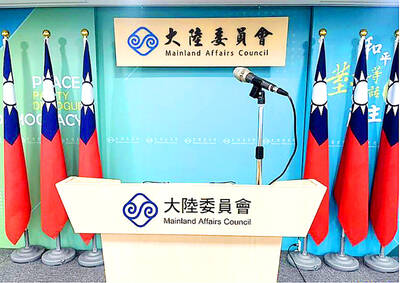
CROSS-STRAIT: The MAC said it barred the Chinese officials from attending an event, because they failed to provide guarantees that Taiwan would be treated with respect The Mainland Affairs Council (MAC) on Friday night defended its decision to bar Chinese officials and tourism representatives from attending a tourism event in Taipei next month, citing the unsafe conditions for Taiwanese in China. The Taipei International Summer Travel Expo, organized by the Taiwan Tourism Exchange Association, is to run from July 18 to 21. China’s Taiwan Affairs Office spokeswoman Zhu Fenglian (朱鳳蓮) on Friday said that representatives from China’s travel industry were excluded from the expo. The Democratic Progressive Party government is obstructing cross-strait tourism exchange in a vain attempt to ignore the mainstream support for peaceful development


 RSS
RSS