


Former Norwegian prime minister Gro Harlem Brundtland was awarded the first Tang Prize in Sustainable Development yesterday for “concept, leadership and implementation of sustainable development for the benefit of humanity.”
Brundtland, the “godmother of sustainable development,” chaired the World Commission on Environment and Development from 1984 to 1987. The commission — also called the Brundtland Commission in recognition of her leadership — coined the term “sustainable development” in a landmark report in 1987 titled Our Common Future.
The 75-year-old is to receive a cash prize of NT$40 million (US$1.33 million) and a research grant of up to NT$10 million to be used within five years, as well as a medal and a certificate at an award ceremony in September.
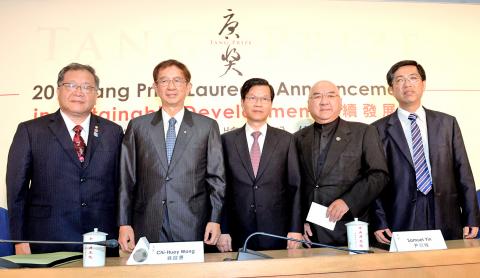
Photo: Lin Cheng-kung, Taipei Times
Our Common Future laid the groundwork for the 1992 Earth Summit in Rio de Janeiro, which produced a global action plan for sustainable development known as Agenda 21 and initiated the UN’s Framework Convention on Climate Change, which led to the 1997 Kyoto Protocol.
The report defined the term “sustainable development” as “development that meets the needs of the present without compromising the ability of future generations to meet their own needs.” The concept supports economic and social development, while also highlighting the importance of protecting the environment and natural resources.
In the report’s foreword, Brundtland wrote that the challenge of finding sustainable development paths should be the motivation for “a renewed search for multilateral solutions and a restructured international economic system of cooperation.”
“These challenges cut across the divides of national sovereignty, of limited strategies for economic gain and of separated disciplines of science,” she wrote, calling for “higher expectations, for common goals pursued together, for an increased political will to address our common future.”
The report compiled the views of hundreds of experts, scientists, industrialists and government and NGO representatives, as well as members of the public, and it continues to have a major impact on UN conferences, including the UN Conference on Sustainable Development and Conference of the Parties.
Born in 1939 in Oslo, Brundtland graduated with a medical degree from the University of Oslo and a holds master’s degree in public health from Harvard University.
She was Norwegian minister of the environment from 1974 to 1979 before becoming the first female Norwegian prime minister — and the youngest ever — in 1981.
She later served as director-general of the WHO from 1998 to 2003, during which time she was credited for helping to prevent the spread of SARS and gained recognition for successfully negotiating an agreement on tobacco control.
Brundtland served as UN special envoy on climate change from 2007 to 2010 and was on the UN secretary-general’s High-Level Panel on Global Sustainability from 2010 to 2012.
She serves as deputy chair of The Elders, a group of world leaders brought together in 2007 by former South African president Nelson Mandela to work for peace and human rights.
The Tang Prize was established in 2012 by entrepreneur Samuel Yin (尹衍樑) to honor leaders in four fields: sustainable development, biopharmaceutical science, Sinology and the rule of law.
The first prizes are being handed out this year.
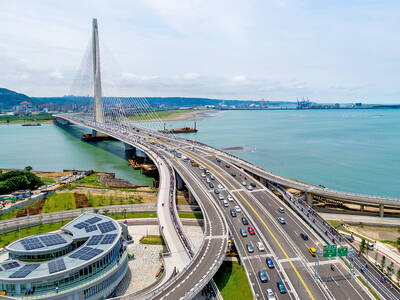
The Ministry of Transportation and Communications yesterday inaugurated the Danjiang Bridge across the Tamsui River in New Taipei City, saying that the structure would be an architectural icon and traffic artery for Taiwan. Feted as a major engineering achievement, the Danjiang Bridge is 920m long, 211m tall at the top of its pylon, and is the longest single-pylon asymmetric cable-stayed bridge in the world, the government’s Web site for the structure said. It was designed by late Iraqi-British architect Zaha Hadid. The structure, with a maximum deck of 70m, accommodates road and light rail traffic, and affords a 200m navigation channel for boats,
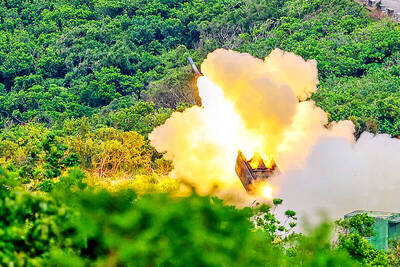
PRECISION STRIKES: The most significant reason to deploy HIMARS to outlying islands is to establish a ‘dead zone’ that the PLA would not dare enter, a source said A High Mobility Artillery Rocket System (HIMARS) would be deployed to Penghu County and Dongyin Island (東引) in Lienchiang County (Matsu) to force the Chinese military to retreat at least 100km from the coastline, a military source said yesterday. Taiwan has been procuring HIMARS and Army Tactical Missile Systems (ATACMS) from the US in batches. Once all batches have been delivered, Taiwan would possess 111 HIMARS units and 504 ATACMS, which have a range of 300km. Considering that “offense is the best defense,” the military plans to forward-deploy the systems to outlying islands such as Penghu and Dongyin so that
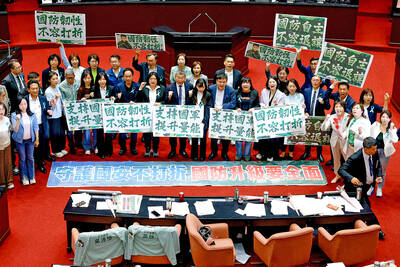
WHAT WAS ALL THAT FOR? Jaw Shaw-kong said that Cheng Li-wen had pushed for more drastic cuts and attacked him, just for the outcome to be nearly identical to his bill The legislature yesterday passed a supplementary budget bill to fund the purchase of separate packages of US military equipment, with the combined amount of spending capped at NT$780 billion (US$24.8 billion). The Chinese Nationalist Party (KMT) and Taiwan People’s Party (TPP) used their legislative majority to pass the bill, which runs until 2033 and has two main funding provisions. One was for NT$300 billion of arms sales already approved by the US for Taiwan on Dec. 17 last year, the other was for NT$480 billion for another arms package expected to be announced by Washington. The bill, which fell short of the NT$1.25
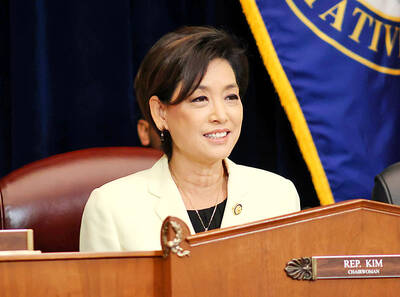
‘CLEAR MESSAGE’: The bill would set up an interagency ‘tiger team’ to review sanctions tools and other economic options to help deter any Chinese aggression toward Taiwan US Representative Young Kim has introduced a bill to deter Chinese aggression against Taiwan, calling for an interagency “tiger team” to preplan coordinated sanctions and economic measures in response to possible Chinese military or political action against Taiwan. “[Chinese President] Xi Jinping [習近平] has directed the People’s Liberation Army to be ready to invade Taiwan by 2027. China has a plan. America should have one too,” Kim said in a news release on Thursday last week. She introduced the “Deter PRC [People’s Republic of China] aggression against Taiwan act” to “ensure the US has a coordinated sanctions strategy ready should


 RSS
RSS