

Civic groups that took part in the occupation of the legislature during the Sunflower movement yesterday “declared war” on the government, saying they might take over the legislature again if the Chinese Nationalist Party (KMT) rushes to pass controversial legislations on cross-strait relations during the three-week legislative extraordinary session that began yesterday.
“We’re in the game with the government of President Ma Ying-jeou (馬英九) if reviews of the bills on free economic pilot zones, the cross-strait service trade agreement and an oversight mechanism to monitor cross-strait pacts are scheduled during the extra session,” Dennis Wei (魏揚), a member of the Black Island Youth Front, said outside the legislature in Taipei. “We are here to declare war on the government on this Friday the 13th.”
Behind him were three protesters with ropes around their necks and a banner above them that read “Free economic pilot zones equals suicide zones,” expressing their concern that the economic pilot zones would only benefit multinational corporations at the expense of workers.
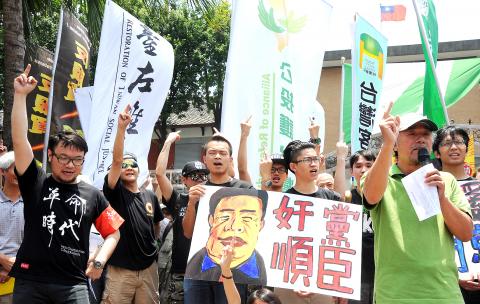
Photo: Liu Hsin-de, Taipei Times
Wei said the groups are opposed to the economic pilot zones plan and the service trade agreement because of their potential impact on the working class.
While they support legislation to establish an oversight mechanism for cross-strait negotiations and agreements, they believe that it needs more careful discussion and review, and should not be forcibly passed during the three-week extra session, he said.
Wei added that even KMT caucus whip Lin Hung-chih (林鴻池) has acknowledged that it would be difficult for the legislature to review so many bills in three weeks and said that “Ma should not try to force them through.”
“It’s especially ridiculous because the legislature is scheduled to review nominees for the Control Yuan and the Examination Yuan during the first two weeks of the three-week extra session, leaving the legislature with only one week to deal with the three controversial bills,” Wei said. “How is that possible?”
Lee Chun-ta (李俊達), one of the leaders of the Sunflower movement and the convener of the student activist group Democracy Tautin, said the government and the legislature should not overlook the groups’ determination.
“We will keep an eye on the legislature, and watch it from different angles,” Lee said. “We do not rule out taking over the legislature again if that is necessary.”
Lu Hung-chih (呂鴻志), a member of the Democracy Kuroshio, said the extra session was completely unnecessary.
“Extra sessions are supposed to deal with critical legislation. I don’t see how critical these three controversial bills are,” he said.
“The president doesn’t care about the voice of the people — he just does what he wants to because the KMT dominates the legislature,” Lu said.
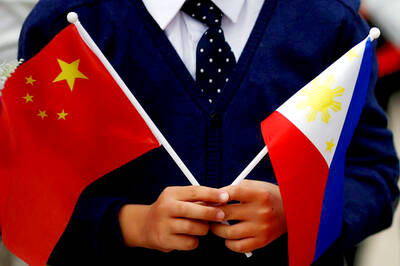
The Philippine Coast Guard yesterday said it has deployed its largest vessel and an aircraft to challenge a Chinese research ship operating off northern Batanes near Taiwan, adding that a Chinese coast guard vessel had also moved in. The Philippine operation “disrupted the vessel’s unauthorized marine scientific research and compelled it to leave its loitering position,” said Jay Tarriela, Philippine Coast Guard spokesperson on South China Sea issues. The Philippine Coast Guard said the BRP Teresa Magbanua and an aircraft were deployed to counter the Chinese vessel, which it said had remained about 37 nautical miles northwest of Itbayat Island since Monday. The
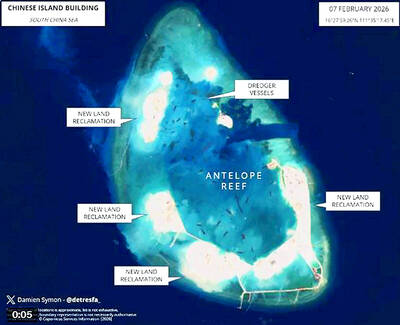
RUNWAY: Analysts said the first aircraft landing is expected by the middle of next year, while Chinese state media said it would serve civilian needs Chinese construction of a runway on Antelope Reef (Lingyang Reef, 羚羊礁) in the Paracel Islands (Xisha Islands, 西沙群島), is well under way with analysts estimating it could be completed by the middle of next year, strengthening Beijing’s military control over the disputed South China Sea. Satellite images reviewed by Reuters show grading work, piles of gravel and concrete, and compaction cranes in operation to build a full-scale runway that military attaches and security analysts say could be one of China’s most important offshore bases in the region. The images, taken on Friday last week by commercial satellite imagery provider Vantor, also show
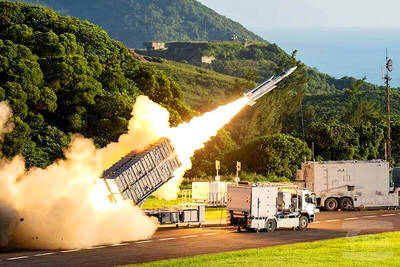
RESILIENCE: Keeping the defense industry’s assembly lines open would prove essential should the nation be involved in a prolonged conflict, a source said The Ministry of National Defense has prepared a NT$22 billion (US$692.3 million) program to acquire about 200 improved Hsiung Feng anti-ship missiles from next year to 2035, a source said. Commenting on condition of anonymity, a high-ranking defense official said the ministry’s plan for enhanced-capability Hsiung Feng II and Hsiung Feng III missiles would be funded as part of the regular defense budget. The 200 missiles would be added on top of the 1,400 missiles being funded via the Sea-Air Combat Power Improvement Plan, they said. The program is not about padding missile numbers, but expanding the capability to defeat

DEFENSE: The US House speaker dismissed speculation that Trump is using arms sales as a negotiating tactic with Beijing amid concern over delayed deliveries Taiwan is a partner whose “stability and independence” are important to US national security and the economy, US House of Representatives Speaker Mike Johnson said on Monday when asked about arms sales to Taipei in an interview with Fox Business. Asked whether US President Donald Trump was using a long-delayed US$14 billion arms deal as a negotiating tactic for trade with Beijing, Johnson said that he “wouldn’t read too much into that.” The delayed arms package is “related to the Iran conflict” and the need for missile stocks in the Middle East, he said. “If you look over [Trump’s] two terms, he will


 RSS
RSS