


Former premier Hau Pei-tsun (郝柏村) yesterday said it is not defeatist to ask fellow Chinese Nationalist Party (KMT) members to put more effort into the party and be more vigilant as the KMT is feeling more pressure than usual regarding the seven-in-one elections on Nov. 27.
Hau’s remarks were the second in as many days that he spoke on the topic, in an apparent defense of his son, Taipei Mayor Hau Lung-bin (郝龍斌), who last week was accused of “defeatism” by KMT members for saying that “someone should be held accountable if the party loses the elections.”
President Ma Ying-jeou (馬英九), who is also KMT chairman, warned against such comments, saying that people uttering words of no help to party solidarity should know their limits.

Photo: CNA
The 95-year-old former premier attempted to vindicate Hau Lung-bin’s comment in his speech at a Lunar New Year event held by the New Revolutionary Alliance (新同盟會) at the Armed Forces Officer’s Club in Taipei.
Ma and Vice President Wu Den-yih (吳敦義) also made an appearance at the event, but Hau Pei-tsun did not come face-to-face with Ma as he arrived after the president had left the venue.
Defeatism is capitulationism and the latter is characterized by Wang Jing-wei (汪精衛), better than by any Taiwanese figure, Hau Pei-tsun said.
Wang Jing-wei, a KMT member, formed a Japanese-supported collaborationist government in 1940 in China, when that country was at war with Japan, and is seen as a traitor by both the KMT and the Chinese Communist Party.
Hau Pei-tsun said that as the year-end elections approach, many harbor concerns over the KMT’s electoral outlook.
Someone who utters a warning about a looming electoral crisis is simply trying to caution party members and urge them to stay vigilant.
“How in the world is that a defeatist stance? Those who said that have no idea what defeatism means,” he said.
The senior Hau added that he has no problem with people criticizing his son, but claiming that the Taipei mayor is a defeatist is an outright mistake, an unjust accusation and “ignorant and childish.”
“Defeatism is a question of right and wrong, not of a family or an individual,” Hau Pei-tsun said.
He added that this year is a crucial year for the KMT and it must win in the coming elections.
He said that those who love Taiwan have to love the Republic of China (ROC) and only those who love the ROC truly love Taiwan.
ROC nationals are Chinese and those claiming that Taiwanese are not Chinese are the unworthy descendants of Zhonghua minzu (中華民族, Chinese ethnic group), he said.
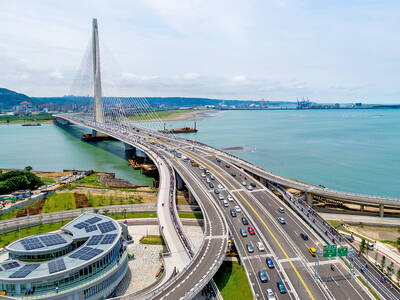
The Ministry of Transportation and Communications yesterday inaugurated the Danjiang Bridge across the Tamsui River in New Taipei City, saying that the structure would be an architectural icon and traffic artery for Taiwan. Feted as a major engineering achievement, the Danjiang Bridge is 920m long, 211m tall at the top of its pylon, and is the longest single-pylon asymmetric cable-stayed bridge in the world, the government’s Web site for the structure said. It was designed by late Iraqi-British architect Zaha Hadid. The structure, with a maximum deck of 70m, accommodates road and light rail traffic, and affords a 200m navigation channel for boats,
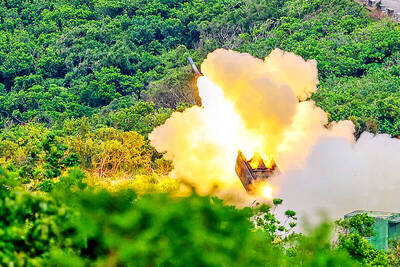
PRECISION STRIKES: The most significant reason to deploy HIMARS to outlying islands is to establish a ‘dead zone’ that the PLA would not dare enter, a source said A High Mobility Artillery Rocket System (HIMARS) would be deployed to Penghu County and Dongyin Island (東引) in Lienchiang County (Matsu) to force the Chinese military to retreat at least 100km from the coastline, a military source said yesterday. Taiwan has been procuring HIMARS and Army Tactical Missile Systems (ATACMS) from the US in batches. Once all batches have been delivered, Taiwan would possess 111 HIMARS units and 504 ATACMS, which have a range of 300km. Considering that “offense is the best defense,” the military plans to forward-deploy the systems to outlying islands such as Penghu and Dongyin so that

Taiwan Semiconductor Manufacturing Co (TSMC, 台積電), the world’s largest foundry service provider, yesterday said that global semiconductor revenue is projected to hit US$1.5 trillion in 2030, after the figure exceeds US$1 trillion this year, as artificial intelligence (AI) demand boosts consumption of token and compute power. “We are still at the beginning of the AI revolution, but we already see a significant impact across the whole semiconductor ecosystem,” TSMC deputy cochief operating officer Kevin Zhang (張曉強) said at the company’s annual technology symposium in Hsinchu City. “It is fair to say that in the past decade, smartphones and other mobile devices were
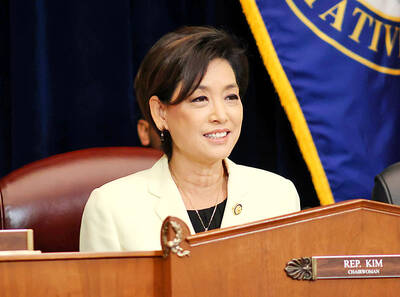
‘CLEAR MESSAGE’: The bill would set up an interagency ‘tiger team’ to review sanctions tools and other economic options to help deter any Chinese aggression toward Taiwan US Representative Young Kim has introduced a bill to deter Chinese aggression against Taiwan, calling for an interagency “tiger team” to preplan coordinated sanctions and economic measures in response to possible Chinese military or political action against Taiwan. “[Chinese President] Xi Jinping [習近平] has directed the People’s Liberation Army to be ready to invade Taiwan by 2027. China has a plan. America should have one too,” Kim said in a news release on Thursday last week. She introduced the “Deter PRC [People’s Republic of China] aggression against Taiwan act” to “ensure the US has a coordinated sanctions strategy ready should


 RSS
RSS