


Chinese coast guard ships yesterday sailed into disputed waters at the center of a bitter row with Tokyo, officials said, a day after China blasted Japanese lawmakers for visiting a controversial war shrine.
The four government vessels spent about two hours within the 12 nautical mile (22.2km) band around the Tokyo-controlled Senkaku Islands — which Taiwan calls the Diaoyutai Islands (釣魚台) and Beijing refers to as the Diaoyu Archipelago (釣魚群島) — in the East China Sea.
Japan said the vessels had left territorial waters by 12:30pm, but remained in the vicinity.
Following the incursion, the Japanese Foreign Ministry’s Asian and Oceanian Affairs Bureau Director-General Junichi Ihara lodged a protest with a senior diplomat at the Chinese embassy in Tokyo, Kyodo news agency reported.
Kyodo said seven ships were spotted just outside of the waters earlier yesterday, before the four Chinese coast guard vessels entered the disputed waters.
The incursion came after Beijing on Thursday summoned Japan’s ambassador to condemn a visit by nearly 100 Japanese lawmakers to the Yasukuni Shrine on the anniversary of Tokyo’s World War II surrender.
Japanese politicians’ visits to the site are seen as a slap in the face by neighboring nations, especially China and South Korea, which suffered from Tokyo’s imperialist expansion in the first half of the 20th century.
Yesterday’s incident was the latest in a series of incursions by Chinese ships as relations between Tokyo and Beijing plumb all-time lows.
Last week, the Japanese foreign ministry summoned Beijing’s envoy after Chinese ships spent more than a day in the disputed waters, their longest incursion since the long-simmering dispute erupted again last year after Tokyo nationalized some of the chain.
The islands — believed to harbor vast natural resources below their seabed — are seen as a potential flashpoint that some observers fear could lead to armed conflict between the Asian giants.
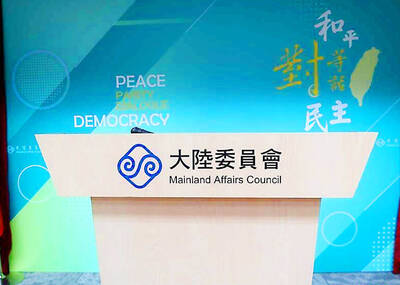
NO RECIPROCITY: Taipei has called for cross-strait group travel to resume fully, but Beijing is only allowing people from its Fujian Province to travel to Matsu, the MAC said The Mainland Affairs Council (MAC) yesterday criticized an announcement by the Chinese Ministry of Culture and Tourism that it would lift a travel ban to Taiwan only for residents of China’s Fujian Province, saying that the policy does not meet the principles of reciprocity and openness. Chinese Deputy Minister of Culture and Tourism Rao Quan (饒權) yesterday morning told a delegation of Chinese Nationalist Party (KMT) lawmakers in a meeting in Beijing that the ministry would first allow Fujian residents to visit Lienchiang County (Matsu), adding that they would be able to travel to Taiwan proper directly once express ferry

STUMPED: KMT and TPP lawmakers approved a resolution to suspend the rate hike, which the government said was unavoidable in view of rising global energy costs The Ministry of Economic Affairs yesterday said it has a mandate to raise electricity prices as planned after the legislature passed a non-binding resolution along partisan lines to freeze rates. Chinese Nationalist Party (KMT) lawmakers proposed the resolution to suspend the price hike, which passed by a 59-50 vote. The Taiwan People’s Party (TPP) voted with the KMT. Legislative Speaker Han Kuo-yu (韓國瑜) of the KMT said the resolution is a mandate for the “immediate suspension of electricity price hikes” and for the Executive Yuan to review its energy policy and propose supplementary measures. A government-organized electricity price evaluation board in March
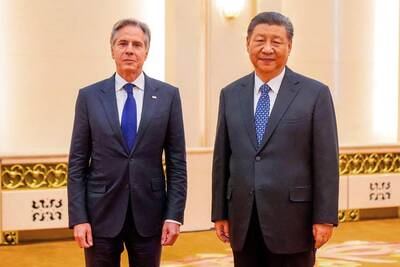
MANAGING DIFFERENCES: In a meeting days after the US president signed a massive foreign aid bill, Antony Blinken raised concerns with the Chinese president about Taiwan US Secretary of State Antony Blinken yesterday met with Chinese President Xi Jinping (習近平) and senior Chinese officials, stressing the importance of “responsibly managing” the differences between the US and China as the two sides butt heads over a number of contentious bilateral, regional and global issues, including Taiwan and the South China Sea. Talks between the two sides have increased over the past few months, even as differences have grown. Blinken said he raised concerns with Xi about Taiwan and the South China Sea, along with China’s support for Russia and its invasion of Ukraine, as well as other issues

FAST RELEASE: The council lauded the developer for completing model testing in only four days and releasing a commercial version for use by academia and industry The National Science and Technology Council (NSTC) yesterday released the latest artificial intelligence (AI) language model in traditional Chinese embedded with Taiwanese cultural values. The council launched the Trustworthy AI Dialogue Engine (TAIDE) program in April last year to develop and train traditional Chinese-language models based on LLaMA, the open-source AI language model released by Meta. The program aims to tackle the information bias that is often present in international large-scale language models and take Taiwanese culture and values into consideration, it said. Llama 3-TAIDE-LX-8B-Chat-Alpha1, released yesterday, is the latest large language model in traditional Chinese. It was trained based on Meta’s Llama-3-8B


 RSS
RSS