


Both the Ministry of National Defense and the Ministry of Justice said yesterday that Justin Lin (林毅夫), who defected to China in 1979 and later became a vice president at the World Bank, is still a fugitive wanted on treason charges, whose prosecution has not even begun.
Officials from the ministries made the remarks after the reform of the Code of Court Martial Procedure (軍事審判法), which subsequently reopened the debate over whether to allow the return of one of the country’s best-known defectors.
President Ma Ying-jeou (馬英九) yesterday promulgated an amendment to the court martial code, signaling that as of tomorrow, military personnel facing trial during times of peace will have their cases handled in civilian courts. The revised Code of Court Martial Procedure cleared the legislative floor on Tuesday last week with the support of lawmakers across the political divide.
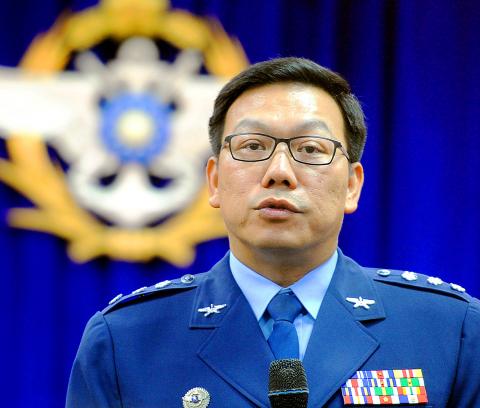
Photo: Fang Pin-chao, Taipei Times
The first phase of changes means that crimes of abuse or improper punishment of subordinates, prevention of filing grievances, obstruction of sexual autonomy or manslaughter committed by servicemen will be subject to the Code of Criminal Procedure (刑事訴訟法). Other offenses will likewise be subject to civilian trials starting five months later.
Under the revised law, ongoing cases currently under investigation, trial or execution by the military justice system must be turned over to civilian courts to be completed. With the newly adopted reform, the justice ministry and a civilian court will decide whether the warrant for Lin’s arrest has expired.
Defection to an enemy state is punishable by death, life imprisonment or a minimum of 10 years in prison under the Criminal Code of the Armed Forces (陸海空軍刑法).
The law’s statute of limitations is 20 years, but the defense ministry says Lin should continue to be listed as a fugitive because he has been in a constant state of defection.
Vice director of the defense ministry’s Judicial Department Colonel Shen Shih-wei (沈世偉) yesterday cited Article 80 of the Criminal Code, which states that prescription of prosecution begins when the alleged criminal offense is committed, but for a continued offender, the prescription of prosecution begins only when the conduct of the alleged offense ends.
Shen told a press conference held at the defense ministry yesterday that Lin’s act of treason has been continuing since he defected to China in 1979 and that after consulting with the justice ministry last year, the ministry ascertained that as a continued offender, Lin’s prescription of prosecution has not even begun.
Lin remains on the wanted list, Shen added.
Following the reform of the Code of Court Martial Procedure, Shen said that in the first stage, about 250 people would be transferred to civilian prisons.
In the second stage, general-level military personnel who are detained or are serving terms are expected to be transferred to civilian prisons five months later, he said, adding that cases of treason and other serious crimes, including Lin’s case, would be transferred to the civilian judiciary in the second stage, five months later.
Lin, 60, was born in Yilan. While serving as a captain in the army, Lin was held up as a role model for his decision to drop out of the prestigious National Taiwan University and join up.
However, he defected to China in 1979, by swimming from Kinmen to China’s Fujian Province.
Lin received a master’s degree in Marxist political economics from Peking University in 1982, and a doctorate in economics from the University of Chicago in 1986, becoming one of the first Chinese citizens to earn a doctoral degree during the early stages of economic reform in China.
In 2008, he was named a senior vice president and chief economist at the World Bank.
In May 2002, Lin filed an application from Beijing to return to Taiwan to attend his father’s funeral. The government approved his application, but warned that he could face charges of treason if he returned. Lin decided not to risk detention and did not attend his father’s funeral.
Additional reporting by CNA

SILENCING CRITICS: In addition to blocking Taiwan, China aimed to prevent rights activists from speaking out against authoritarian states, a Cabinet department said The Ministry of Foreign Affairs (MOFA) yesterday condemned transnational repression by Beijing after RightsCon, a major digital human rights conference scheduled to be held in Zambia this week, was abruptly canceled due to Chinese pressure over Taiwanese participation. This year’s RightsCon, the world’s largest conference discussing issues “at the intersection of human rights and technology,” was scheduled to take place from tomorrow to Friday in Lusaka, and expected to draw 2,600 in-person attendees from 150 countries, along with 1,100 online participants. However, organizers were forced to cancel the event due to behind-the-scenes pressure from China, the ministry said, expressing its “strongest condemnation”

DELAYED BUT DETERMINED: The president’s visit highlights Taiwan’s right to international engagement amid regional pressure from China President Willaim Lai (賴清德) yesterday arrived in Eswatini, more than a week after his planned visit to Taiwan’s sole African ally was suspended because of revoked overflight permits. “The visit, originally scheduled for April 22, was postponed due to unforeseen external factors,” Lai wrote on social media. “After several days of careful arrangements by our diplomatic and national security teams, we successfully arrived today.” Lai said he looked forward to further deepening Taiwan-Eswatini relations through closer cooperation in the economy, agriculture, culture and education, as well as advancing the nation’s international partnerships. The president was initially scheduled to arrive in time to celebrate

Iran’s Islamic Revolutionary Guard Corp (IRGC) yesterday said the US faced a choice between an “impossible” military operation or a “bad deal” with Tehran, after US President Donald Trump disparaged Iran’s latest peace proposal. Negotiations between the two countries have been deadlocked since a ceasefire came into effect on April 8, with only one round of direct peace talks held so far. Iran’s Tasnim and Fars news agencies reported that Tehran had submitted a 14-point proposal to mediator Pakistan, but Trump was quick to cast doubt on it. “I will soon be reviewing the plan that Iran has just sent to us, but

A group affiliated with indicted Chinese immigrant Xu Chunying (徐春鶯) is to be dissolved for monitoring Chinese immigrants in Taiwan, a source said yesterday. Xu, the secretary-general of the Cross-Strait Marriage and Family Service Alliance, was indicted on March 24 on charges of violating the Anti-Infiltration Act (反滲透法). The alliance “illegally monitored" Chinese immigrants living in Taiwan on behalf of the Chinese Communist Party (CCP) and the Ministry of the Interior is expected to dissolve the organization in the coming days under provisions of the Civil Associations Act (人民團體法), the source said. Xu, who married a Taiwanese in 1993 and became a Republic


 RSS
RSS