


While protesters against forced demolitions in Miaoli County’s Dapu Borough (大埔) demonstrated in front of the Presidential Office in Taipei yesterday, the county government sent in a demolition squad escorted by hundreds of police officers to tear down the Dapu houses, leading to waves of clashes.
“Stop the demolition. Keep the promise. Keep the houses,” almost 100 protesters supporting the resistance of four families in Dapu chanted as they ran through the police line toward the Presidential Office yesterday morning, upon hearing the news that the county government had started demolishing the houses while some members of the families and their supporters were in Taipei protesting.
At first, the police had the situation under control, but it soon became chaotic. A group of protesters walked into the middle of Ketagalan Boulevard and sat down, trying to paralyze traffic.
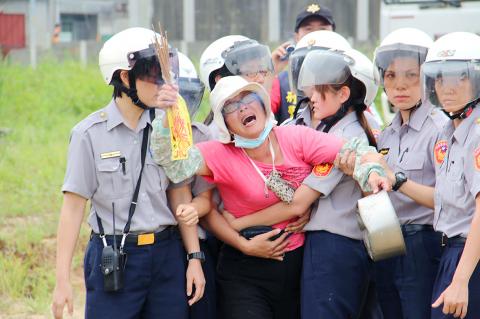
Photo: CNA
As officers tried to surround the protesters, another group of protesters came out from a park nearby with a giant banner, placing it in the middle of the road. Suddenly, three protesters ran toward the Presidential Office, reaching the barriers in front of it, only a few dozen meters away from the front entrance of the building.
More protesters followed, clashing with police and military police.
“My home, they are tearing down my home,” said Peng Hsiu-chun (彭秀春), a Dapu resident whose house was the first to be torn down during the county government’s surprise demolition yesterday, as she tried to move forward.
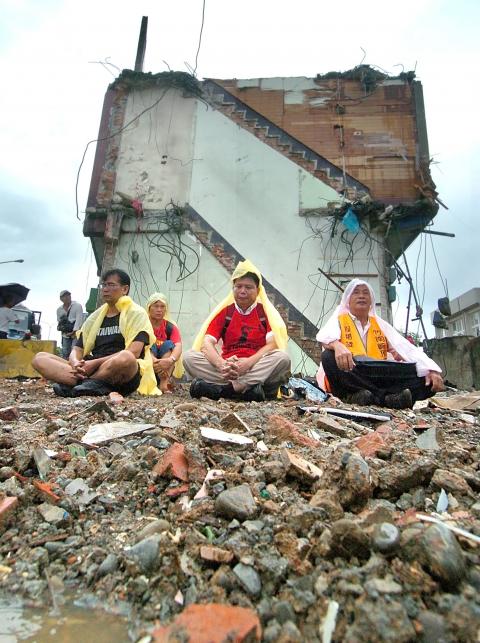
Photo: Fang Pin-chao, Taipei Times
The police responded by pushing her with their riot shields, pushing Peng to the ground, where she seemed to lose consciousness and was rushed to the hospital.
Peng’s husband, Chang Sen-wen (張森文), was also hospitalized earlier this month, reportedly because of the stress of the threat of the demolition, and remains in hospital in Taipei.
Meanwhile, conflicts broke out at several locations as young protesters and Taiwan Rural Front spokeswoman Frida Tsai (蔡培慧) attempted to go over the barrier into the Presidential Office.
“[President] Ma Ying-jeou (馬英九), come out. Stop the demolition,” they shouted.
“We are not unreasonable people,” Tsai said. “In fact, we’ve tried to negotiate with the government several times in a civilized and democratic way, but despite promises from Ma, [Premier] Jiang Yi-huah (江宜樺) and [Vice President] Wu Den-yih (吳敦義), the central government is doing nothing and allowing the county government to do whatever it wants.”
“What the county government is doing today is not only tearing down the houses, it’s also destroying the trust we have in the government and in justice,” Tsai added. “As you flatten the houses, be prepared for upcoming guerrilla-style protests. We will not give up.”
Yeh Hsiu-tao (葉秀桃), a Dapu resident and spokeswoman for the Dapu Self-Help Organization, accused the government of mentally torturing them.
“We’ve attended five negotiation meetings, and each time, it seemed so hopeful for us, but in the end, all the meeting conclusions are useless,” she said. “Ma always claims that he cherishes human rights, but where are our rights to property, to living and to survival?”
All the protesters were arrested by the police at about noon and several were charged with violating the Assembly and Parade Act (集會遊行法).
Meanwhile, in Dapu, demolition started a little before 10am by demolition squads escorted by more than 200 police officers. Prior to the forced demolition, the police blocked roads leading to the four houses, and removed residents and protesters — who had chained themselves to the houses — by force.
Dapu residents and their supporters began a sit-in demonstration on the land where their homes once stood immediately after the demolition work was completed and the police withdrew.
Separately yesterday, Wu dismissed criticism that he failed to keep his promise of keeping the homes in Dapu intact and said the government respected Miaoli County Commissioner Liu Cheng-hung’s (劉政鴻) authority in handling the case.
“The government has put emotional, rational and legal aspects of the case into consideration in handling the case. How is that breaking my promise?” Wu said.
Ninety-nine percent of the households were not against the county government’s plan, he added.
He said he has advised Liu to communicate with the Chang family regarding the Chang Pharmacy (張藥房) and suggested that the county government handle the case carefully.
“Liu had to act in accordance with the law and maintain justice for the residents of Miaoli County. I respect his decision,” Wu said.
In 2010, as premier, Wu had promised to preserve the four houses amid the government’s effort to resolve disputes over the county’s plan to expand a science park in the area.
He held a negotiation meeting with Liu and Jiang earlier this month to discuss the county government’s handling of the case. However, the meeting failed to resolve disputes and Liu remained firm that the four houses should be demolished.
To protest against the county government’s demolition of the buildings, a group of students interrupted Ma’s speech at an opening ceremony for a biotech exhibition at the Nangang Exhibition Hall, shouting: “Save Dapu.”
The protesting students were removed by the police as they continued to chant the slogan. Ma went on with his speech without commenting on the demolitions.
Democratic Progressive Party Chairman Su Tseng-chang (蘇貞昌) described the demolition as “state violence” that destroyed the Ma administration’s credibility and intensified people’s anger at, and disappointment in, the government.
“Vice President Wu and Premier Jiang, who pledged to keep the villagers’ houses intact, should step forward and stop the demolition,” Su said in Taipei earlier yesterday as the demolition was about to take place in Miaoli.
The demolitions showed that the government had not kept its promise and did not have compassion with underprivileged people, Su said.
Additional reporting by Chris Wang

‘NO SECURITY RISK’: The Railway Bureau reassured the public that the technicians’ activities were limited to technical guidance and did not involve sensitive systems The Railway Bureau yesterday said it had invited eight Chinese technicians to assist with an airport MRT construction project. The bureau issued the confirmation after an Internet user said Chinese nationals had entered the construction zone of Taiwan Taoyuan International Airport’s Terminal 3 project. They asked why “individuals from an enemy state” were allowed access to such a major national infrastructure project, which raised serious concerns over Taiwan’s industrial safety, sensitive systems and information security. The bureau’s Northern Region Engineering Branch Office said subcontractor Taiwan Handle Industrial Co (台灣手把工業) of the Taoyuan airport MRT’s “Contract No. CU05 Project A14 Station Civil, MEP &

The National Chungshan Institute of Science and Technology yesterday showcased its locally developed variants of the Vision 60 robotic patrol dog, which it plans to deploy on the nation’s outlying territories in the South China Sea. The variants were produced under the Joint Lab project — created by the institute and domestic companies — and assembled with domestically produced motors, lenses and artificial intelligence (AI) systems alongside licensed tech from the US, Missile and Rocket Systems Research Division deputy director Jen Kuo-kang (任國光) told the media event at a military base in Taipei’s Dazhi (大直) area. Taiwan has built up its strengths

NOT IMMEDIATE: Taiwan has a chance to appeal the proposed 10 percent tariff before it starts, while other countries face a 12.5 percent tariff from the trade office Taiwan is among 60 economies determined by the US to have failed to impose or enforce a ban on the importation of goods produced with forced labor, according to a notice released on Tuesday by the Office of the US Trade Representative (USTR), which proposed imposing an additional 10 percent or more tariff on them. The USTR in a statement said that following an investigation, it had determined under Section 301 of the Trade Act of 1974 that the failure of the 60 economies to impose and effectively enforce a prohibition on the importation of goods produced with forced labor is

TIT-FOR-TAT: The US allegedly revoked the visa of a Chinese national working at Xinhua News Agency in the US in response to Beijing’s expulsion of Vivian Wang The Presidential Office yesterday condemned China for expelling a New York Times correspondent from Beijing following the newspaper’s interview with President William Lai (賴清德), saying the move highlighted Beijing’s suppression of press freedom and its threat to international news media. Taiwan has noted a series of recent incidents in which Beijing used similar tactics to “threaten and pressure international media outlets and journalists,” Presidential Office spokeswoman Karen Kuo (郭雅慧) said in a statement. “This concerns not only press freedom and freedom of expression, but also the safety of journalists, and Taiwan and relevant partners are paying close attention to the situation,” she


 RSS
RSS